
Exploring the Meaning of Proteino in Greek
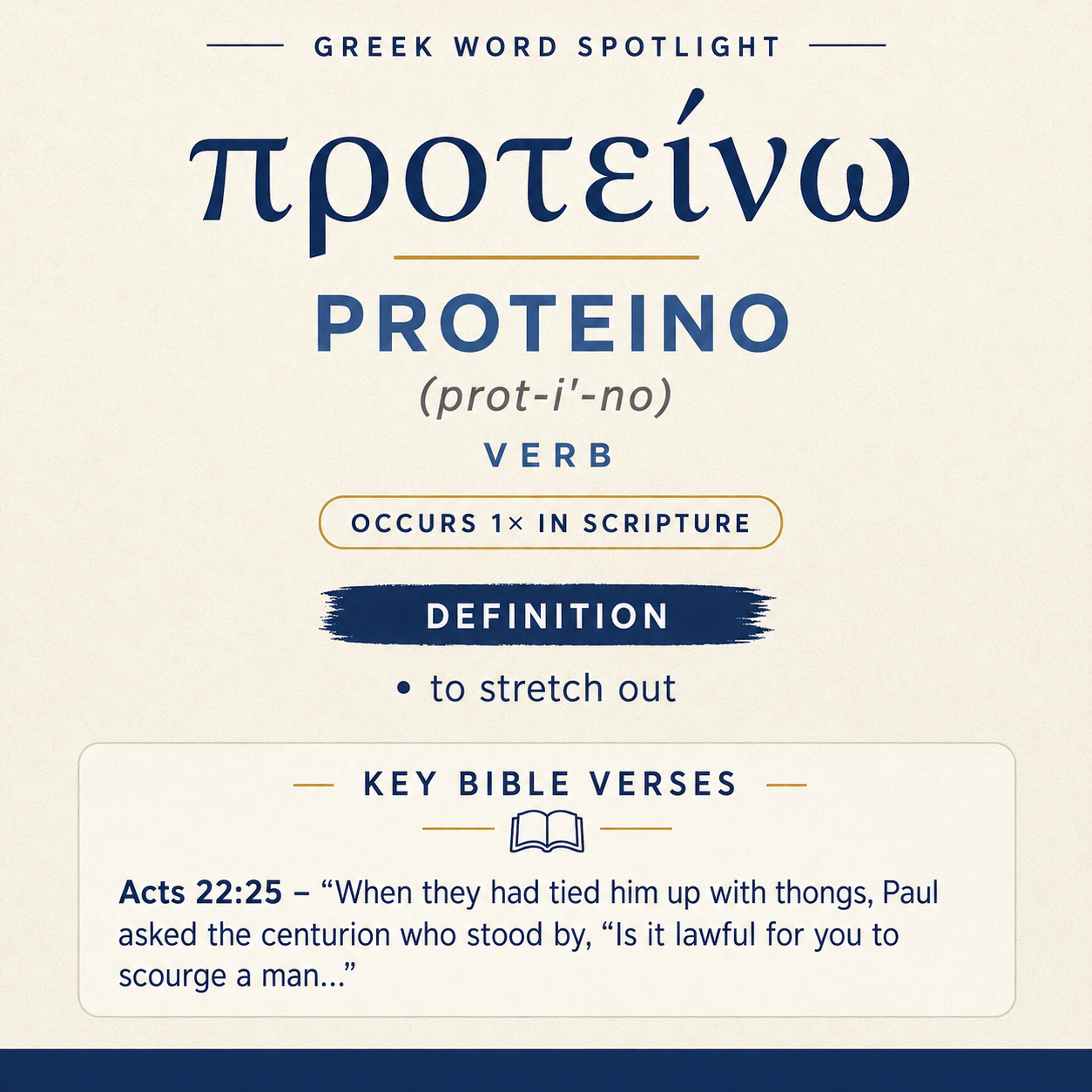
προτείνω means “to stretch out” and appears once in Scripture, in Acts 22:25.
Biblical Occurrence
This verb occurs 1 time in Scripture. The occurrence is in Acts 22:25.
Learn More →Context Note
In Acts 22:25, it appears in a scene where Paul has been tied up with thongs before scourging.
Learn More →προτείνω expresses the action “to stretch out,” and it appears in the account of Paul being prepared for a beating in Jerusalem. In that moment the word belongs to a scene of physical restraint and the imminent use of force.
Root and Related Words
προτείνω is related to pro (πρό), “before.” In this relationship, the prepositional element frames the verbal idea with a sense of forward orientation, fitting a motion that reaches outward from the actor toward something else.

Occurrences
“When they had tied him up with thongs, Paul asked the centurion who stood by, “Is it lawful for you to scourge a man who is a Roman, and not found guilty?”” (Acts 22:25)
In Acts 22:25 the setting is explicitly bodily and procedural: Paul has been “tied…up with thongs,” a centurion is present “who stood by,” and the stated intention is “to scourge.” In such a scene, “to stretch out” fits the mechanics of restraint immediately preceding a flogging. The movement is not casual extension but an imposed positioning of the prisoner’s body—an arranging of limbs or posture that makes the intended punishment possible. The surrounding details highlight control and readiness: the thongs indicate binding, the centurion’s proximity signals oversight, and Paul’s question challenges the legitimacy of what is about to be done.
The verb’s contribution is therefore concrete and physical. It evokes the action by which a bound person is positioned—pulled taut, extended, or placed in a stretched posture—in preparation for the scourging referenced in Paul’s question. The word sits between the restraint (“tied…up”) and the threatened violence (“scourge”), giving language to the preparatory handling that makes the next act feasible. It also sharpens the urgency of Paul’s appeal: his legal question is raised not in abstract discussion but at the point where the body is being put into the posture that anticipates pain.
The scene also brings out an institutional dimension without changing the verb’s basic sense. The “centurion who stood by” represents authority at the moment of execution of orders. “To stretch out” here is not self-directed; it is done to Paul as part of an official process. The verb thus belongs to coercion and procedure: bodily movement carried out under control, within a chain of command, at the threshold of punishment.
Sense and Usage
As used in Acts 22:25, “to stretch out” is a verb of outward extension applied to the human body in a constrained circumstance. The immediate co-text (“tied…up with thongs”) keeps the sense anchored in physical manipulation rather than voluntary reaching. The action implied by the verb suits a posture that exposes, tightens, or fixes the body’s position—an extension that functions as preparation. In other words, the stretching is not an end in itself; it is instrumental, serving the next action named in the verse (“to scourge”).
The occurrence also shows how the same basic action can carry different force depending on agency and setting. Here, the presence of restraints and the stated intention of scourging make the stretching out something imposed. The bodily extension is part of the escalating sequence: custody becomes binding, binding becomes positioning, positioning leads into the threatened act of punishment. The verb’s simplicity—mere extension—allows it to convey this step without needing to name the instrument or describe the technique; the verse supplies the context that fills in why the stretching happens and what it is for.
Within the rhetorical flow of the verse, the action “to stretch out” heightens the immediacy of Paul’s question. Paul does not ask about legality in a detached forum; he speaks while the preparatory action is underway. The verb therefore helps locate his appeal at a critical moment, when procedure has moved from decision to implementation. In narrative terms, that timing underscores the seriousness of the situation and frames Paul’s words as an interruption of an unfolding act.
Imagery
The single scene in Acts 22:25 attaches to προτείνω a stark image: a bound body being extended in readiness for violence. The thongs, the nearby officer, and the mention of scourging make “to stretch out” feel taut and immediate—an action that pulls a person into vulnerability at the very moment he speaks up to challenge the justice of what is being done.
Sources: Lexical data from Strong’s Exhaustive Concordance and the Translators Brief Lexicon of Extended Strongs for Greek (STEPBible, CC BY). Occurrence data from the Translators Amalgamated Greek New Testament (STEPBible, CC BY). Scripture quotations from the World English Bible (public domain).





