
Exploring the Meaning of Proteros in Greek
πρότερος means “before” and appears six times in Scripture: John 6:62; 7:50; 9:8; 2 Corinthians 1:15; Galatians 4:13; Ephesians 4:22.
Core Meaning
πρότερος is defined as “before.” In the listed verses it points to what is earlier or former.
Learn More →Scripture Occurrences
It occurs 6 times in Scripture. These are in John 6:62; 7:50; 9:8; 2 Corinthians 1:15; Galatians 4:13; and Ephesians 4:22.
Learn More →Context Examples
In John 6:62 and John 9:8, it describes a prior state (“where he was before,” “blind before”). In Ephesians 4:22 it is used with “former way of life.”
Learn More →πρότερος expresses the idea of something being “before,” placing a person, condition, or event earlier in relation to what is presently being discussed. In these passages it marks prior location, prior time, prior condition, and what is earlier in sequence.
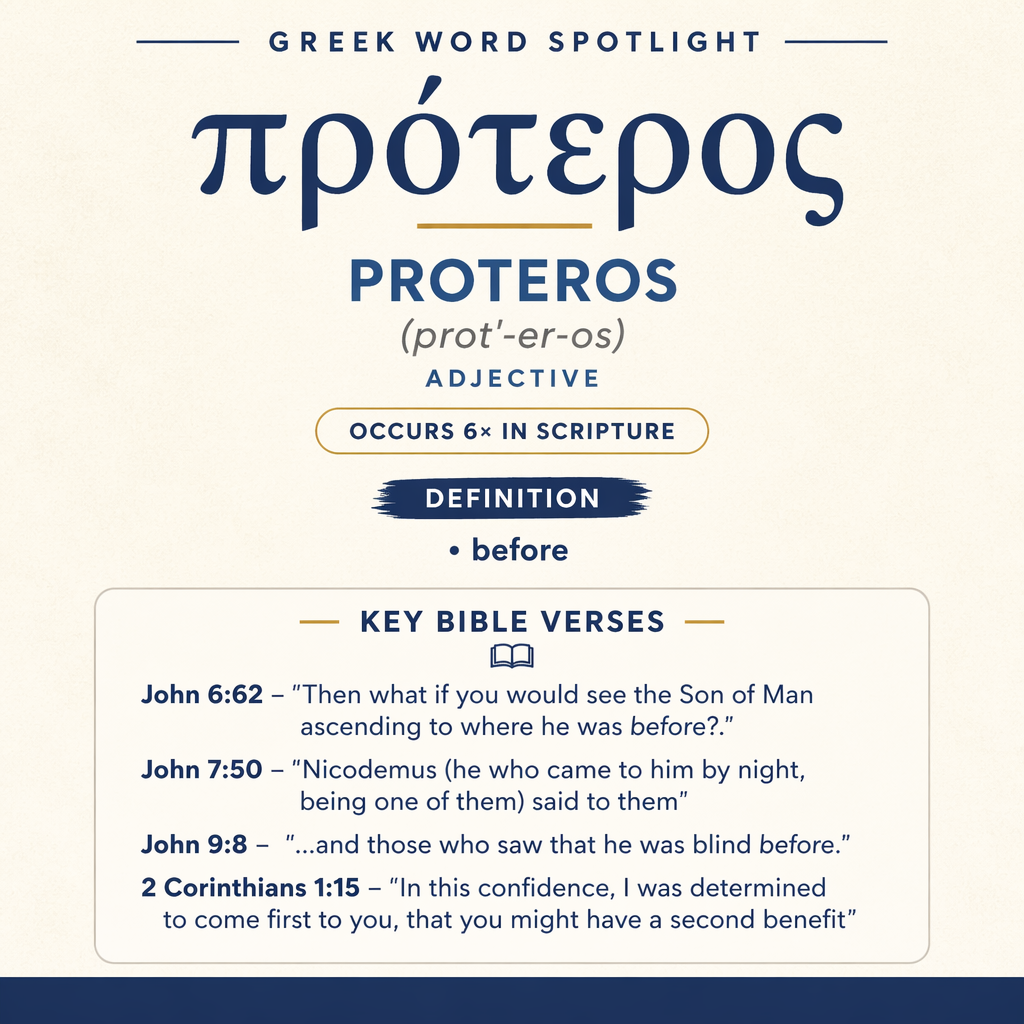
Occurrences
John 6:62: “Then what if you would see the Son of Man ascending to where he was before?”
Here πρότερος anchors the destination of the “ascending” in an earlier state: “where he was before.” The word does not merely indicate motion upward; it adds a point of reference behind the present moment, identifying the ascent as a return toward a prior location. In the flow of the sentence, “before” functions as the decisive locator: the speaker’s question draws attention to the contrast between what the hearers might witness (“ascending”) and what is presupposed about the Son of Man’s earlier status (“where he was before”).

John 7:50: “Nicodemus (he who came to him by night, being one of them) said to them,”
πρότερος supplies the backward-looking description embedded in the parenthesis: Nicodemus is identified as the one “who came to him by night.” The word’s contribution is to frame Nicodemus’ present speech as coming from someone already known through a prior approach. In this setting, “before” works as narrative orientation—linking his current words to an earlier movement and encounter, and thereby distinguishing him within the group addressed (“being one of them”).
John 9:8: “The neighbors therefore, and those who saw that he was blind before, said, “Isn’t this he who sat and begged?””
In this question of recognition, πρότερος points to the man’s earlier condition: he “was blind before.” The neighbors’ observation relies on a remembered prior reality as the basis for their doubt and inquiry. “Before” gives temporal depth to the identification process: the present sight of the man (implicit in their surprise) is measured against a prior state that was publicly known—so well known that it is tied to his habitual posture and activity, “he who sat and begged.”
2 Corinthians 1:15: “In this confidence, I was determined to come first to you, that you might have a second benefit,”
Here πρότερος belongs to travel intentions and sequence: “to come first to you.” It marks an earlier step within a planned set of benefits, since the goal is that they “might have a second benefit.” “Before” therefore defines order rather than simply time on a calendar. The sentence makes πρότερος serve a relational purpose: the addressees are designated as the initial recipients in the speaker’s itinerary, which sets up the contrast with what follows (“a second benefit”).
Galatians 4:13: “but you know that because of weakness in the flesh I preached the Good News to you the first time.”
In this recollection, πρότερος locates the preaching in an earlier visit or occasion: “the first time.” The word situates the message (“I preached the Good News to you”) within an initial episode that can be compared with later circumstances implied by the very idea of a “first time.” The clause also binds that earlier occasion to a concrete feature of the speaker’s situation—“because of weakness in the flesh”—so that “before” is not an abstract timestamp but a way of pointing to a remembered beginning marked by bodily frailty.
Ephesians 4:22: “that you put away, as concerning your former way of life, the old man that grows corrupt after the lusts of deceit,”
Here πρότερος characterizes a previous pattern of living: “your former way of life.” “Before” functions ethically and biographically, labeling a way of life as earlier and therefore to be set aside. The phrase ties the prior manner of life to what is to be removed—“the old man”—and then describes that old reality as one “that grows corrupt after the lusts of deceit.” πρότερος thus helps draw a line between what belonged to an earlier stage and what the audience is now called to reject.

Sense and Usage
Across these verses, πρότερος consistently supplies a backward reference point—an earlier “where,” “when,” “what,” or “which” against which the present statement gains its clarity. In John 6:62, “before” establishes a prior location as the goal of ascent, turning the verb “ascending” into movement with an earlier endpoint. In John 7:50 and John 9:8, the word supports identification by appeal to earlier knowledge: Nicodemus is marked out through a prior act (“came … by night”), and the man at the center of the neighbors’ question is assessed by reference to a prior condition (“blind before”). In both, πρότερος undergirds recognition and memory—who someone is now is argued from what was true earlier.
In 2 Corinthians 1:15 and Galatians 4:13, πρότερος organizes events into an ordered sequence. “First” in 2 Corinthians is not merely earlier in time; it creates an ordered relationship between two “benefits,” making the initial visit conceptually necessary for the second. Likewise, “the first time” in Galatians points to an initial preaching that can be recalled as the beginning of an ongoing relationship with the recipients. In Ephesians 4:22, the word’s backward orientation is applied to a life-pattern: “former way of life” designates what belongs to the earlier phase of existence and is therefore to be “put away.” Here “before” does not describe a single earlier moment but an earlier mode, contrasted with what the audience is now to pursue by rejecting “the old man.”
These uses show πρότερος functioning with different kinds of nouns and clauses: it can qualify a place (“where he was before”), an action used for identification (“he who came … by night”), a condition remembered by observers (“blind before”), an ordered step in plans (“come first”), an initial occurrence (“the first time”), and a lived pattern (“former way of life”). In each case, the word works relationally: it points away from the immediate scene to an earlier reference that shapes interpretation of the present statement—return, recognition, sequence, or renunciation.
Imagery
The imagery carried by πρότερος in these passages is often the imagery of looking back: an ascent described as a return to an earlier “where” (John 6:62), neighbors measuring present appearance against what they “saw … before” (John 9:8), and a community being asked to treat a “former way of life” as something to be set aside (Ephesians 4:22). Even when the word orders events (“first,” “first time”), it evokes the idea of beginnings that shape what follows—initial visits, first benefits, first preachings—so that the present moment is read in light of what came before.
Sources: Lexical data from Strong’s Exhaustive Concordance and the Translators Brief Lexicon of Extended Strongs for Greek (STEPBible, CC BY). Occurrence data from the Translators Amalgamated Greek New Testament (STEPBible, CC BY). Scripture quotations from the World English Bible (public domain).




