
Exploring the Meaning of Proskartereo in Greek
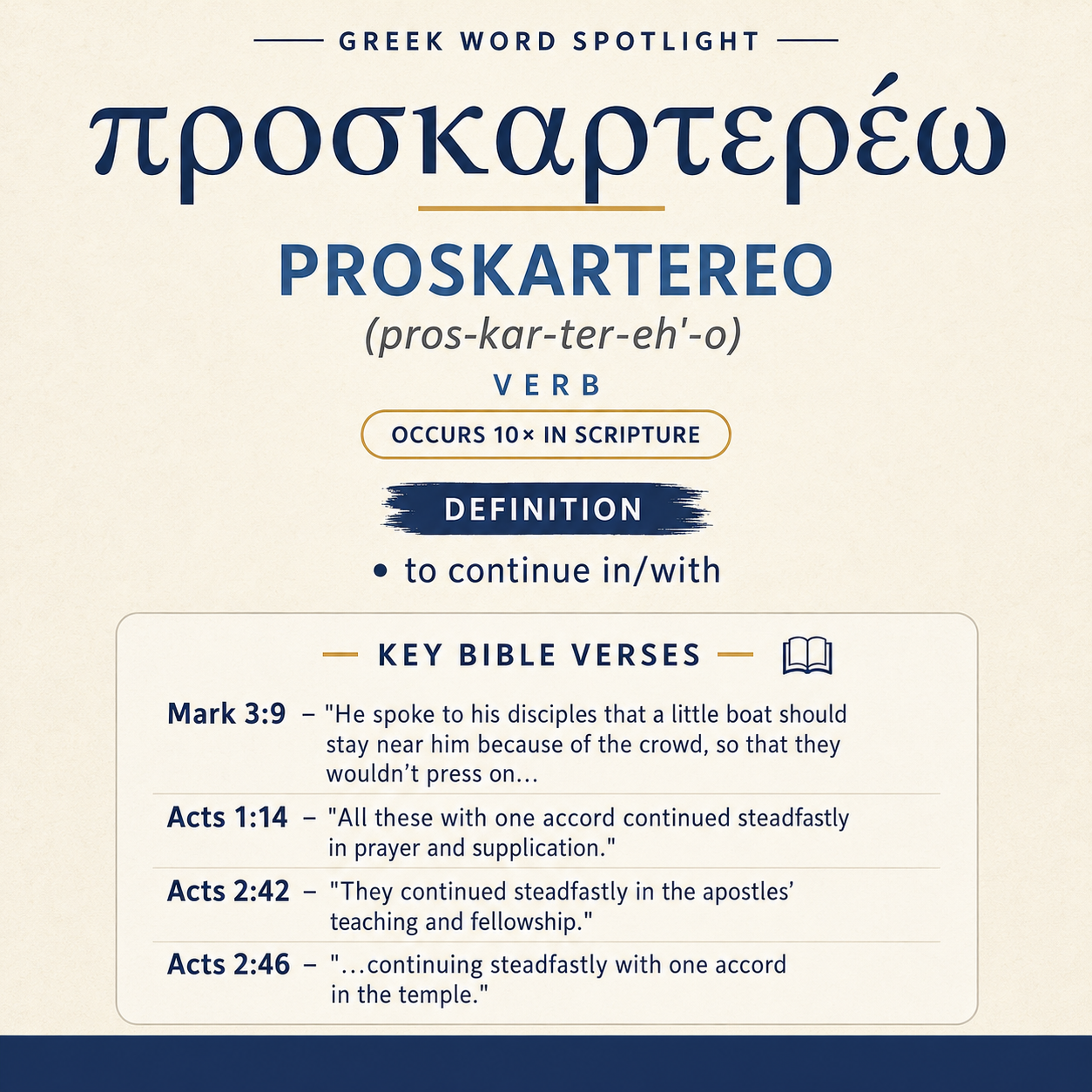
προσκαρτερέω means “to continue in/with” and occurs 10 times in Scripture, including Mark 3:9 and multiple passages in Acts and Romans.
Core Meaning
προσκαρτερέω is defined as “to continue in/with.” In the listed texts, it describes sustained attention or persistence.
Learn More →Acts Emphasis
Acts uses προσκαρτερέω for continuing steadfastly in prayer, the apostles’ teaching, fellowship, breaking of bread, and temple worship (Acts 1:14; 2:42; 2:46; 6:4). It also describes Simon continuing with Philip after believing and being baptized (Acts 8:13).
Learn More →Prayer Focus
Prayer is a repeated setting for προσκαρτερέω in Acts 1:14, Acts 6:4, and Romans 12:12. Mark 3:9 uses it for a boat staying near Jesus because of the crowd.
Learn More →προσκαρτερέω speaks of persisting—continuing in or with something—in a way that marks ongoing attachment rather than a single act. In the New Testament it is heard both in narrative settings (especially Acts) and in exhortation, describing steady engagement in prayer, teaching, fellowship, service, and even practical arrangements.
Occurrences
“He spoke to his disciples that a little boat should stay near him because of the crowd, so that they wouldn’t press on him.” (Mark 3:9)
Here the continuing is concrete: a “little boat” is to “stay near” Jesus. The word’s force is not a momentary positioning but a maintained readiness alongside him, motivated by the ongoing pressure of “the crowd.” Continuance serves protection and access; the boat’s nearness is meant to be kept in place as circumstances demand.

“All these with one accord continued steadfastly in prayer and supplication, along with the women, and Mary the mother of Jesus, and with his brothers.” (Acts 1:14)
The verb describes a shared pattern of life: “with one accord” they persist “in prayer and supplication.” Continuance here is communal (the group is named and inclusive) and focused (prayer and supplication), depicting a sustained practice that holds them together as they remain aligned in purpose.
“They continued steadfastly in the apostles’ teaching and fellowship, in the breaking of bread, and prayer.” (Acts 2:42)
In this summary of early community life, the word frames multiple ongoing commitments. Continuing is distributed across “the apostles’ teaching,” “fellowship,” “the breaking of bread,” and “prayer,” portraying stable participation rather than occasional interest. The verb binds these activities into a coherent rhythm of ongoing involvement.
“Day by day, continuing steadfastly with one accord in the temple, and breaking bread at home, they took their food with gladness and singleness of heart,” (Acts 2:46)
“Day by day” pushes the sense of continuance into regular repetition over time. The persistence is again “with one accord,” and it is located both publicly (“in the temple”) and privately (“at home”). The verb holds together a sustained unity expressed through repeated gathering and shared meals, joined to the atmosphere described as “gladness and singleness of heart.”
“But we will continue steadfastly in prayer and in the ministry of the word.” (Acts 6:4)
The verb marks chosen priorities: “we will continue steadfastly” in two spheres named side by side—“prayer” and “the ministry of the word.” The emphasis falls on perseverance as an ongoing responsibility. Continuance signals not merely that these activities matter, but that they are to remain the leaders’ steady, maintained practice.
“Simon himself also believed. Being baptized, he continued with Philip. Seeing signs and great miracles occurring, he was amazed.” (Acts 8:13)
Continuance is relational and physical: Simon “continued with Philip,” suggesting sustained proximity and association after belief and baptism. The verse also supplies an immediate narrative texture—he keeps with Philip while “seeing signs and great miracles occurring,” his amazement unfolding alongside his ongoing attachment.
“When the angel who spoke to him had departed, Cornelius called two of his household servants and a devout soldier of those who waited on him continually.” (Acts 10:7)
Here the word characterizes a group’s established role: certain people are “those who waited on him continually.” Continuance is not described as a burst of enthusiasm but as a settled pattern of attendance and readiness. The verb supports the portrayal of Cornelius’ household order: he has attendants whose service is marked by steady, ongoing presence.
“rejoicing in hope; enduring in troubles; continuing steadfastly in prayer;” (Romans 12:12)
In this compact exhortation, continuing steadfastly stands alongside “rejoicing” and “enduring,” showing persistence as a deliberate posture. Prayer is singled out as an arena where ongoing engagement is expected, not sporadic response. The verse places continuance within the ordinary pressures of “troubles,” presenting prayer as something maintained while life remains demanding.
“For this reason you also pay taxes, for they are servants of God’s service, continually doing this very thing.” (Romans 13:6)
Continuance is applied to public administration: servants are “continually doing this very thing.” The verb underscores regularity and sustained execution of a task. The point is not the initiation of service but its ongoing performance—work that continues as an established duty.
“Continue steadfastly in prayer, watching in it with thanksgiving,” (Colossians 4:2)
The command to continue steadfastly is sharpened by two accompanying features: “watching” and “thanksgiving.” Continuance here is active and alert, not passive persistence. The verse envisions prayer as a maintained practice characterized by attentiveness (“watching in it”) and a particular tone (“with thanksgiving”).

Sense and Usage
Across these passages, προσκαρτερέω consistently signals a sustained orientation toward an activity, a place, or a person. In Mark 3:9 the continuity is practical and spatial: the boat’s nearness must be maintained because the crowd remains a pressing reality. In Acts, the word becomes a signature of communal life and mission. The early believers persist together in practices that structure their days—prayer, teaching, fellowship, shared meals, and temple presence—so that continuing becomes a marker of stability and shared direction (“with one accord,” “day by day”).
Acts 6:4 shows that such persistence can also express deliberate focus: certain responsibilities are singled out as what will be maintained. Acts 8:13 broadens the picture by using the verb for staying with a person; continuance can be embodied in ongoing accompaniment, not only in repeated activities. Acts 10:7 extends the range into household service, where “continually” describes a dependable pattern of attendance. Romans 13:6 applies the same idea to civic labor, highlighting regular, repeated execution rather than intermittent involvement.
Prayer is the most prominent setting for this verb in the cited texts (Acts 1:14; Acts 2:42; Acts 6:4; Romans 12:12; Colossians 4:2). Yet even within that shared domain, the passages shade its practice differently: in Acts it is communal and coordinated (“with one accord”); in Romans it is held together with endurance under pressure (“enduring in troubles”); in Colossians it is vigilant and thankful (“watching in it with thanksgiving”). The word thus frames continuance as a recognizable pattern—something that can be observed in daily cadence, in steadfast prioritization, and in faithful attendance.
Imagery and Texture
The imagery attached to προσκαρτερέω is often ordinary and tangible: a boat kept close to shore near Jesus (Mark 3:9), people gathering “day by day” in the temple and then breaking bread “at home” (Acts 2:46), attendants who “waited on him continually” (Acts 10:7), and workers who are “continually doing this very thing” (Romans 13:6). Even where the object is prayer, the surrounding language keeps it grounded—unity, endurance, watching, thanksgiving—so that continuance is pictured as steady presence and sustained practice woven into daily life.
Sources: Lexical data from Strong’s Exhaustive Concordance and the Translators Brief Lexicon of Extended Strongs for Greek (STEPBible, CC BY). Occurrence data from the Translators Amalgamated Greek New Testament (STEPBible, CC BY). Scripture quotations from the World English Bible (public domain).





