Exploring the Meaning of Proskairos in Greek
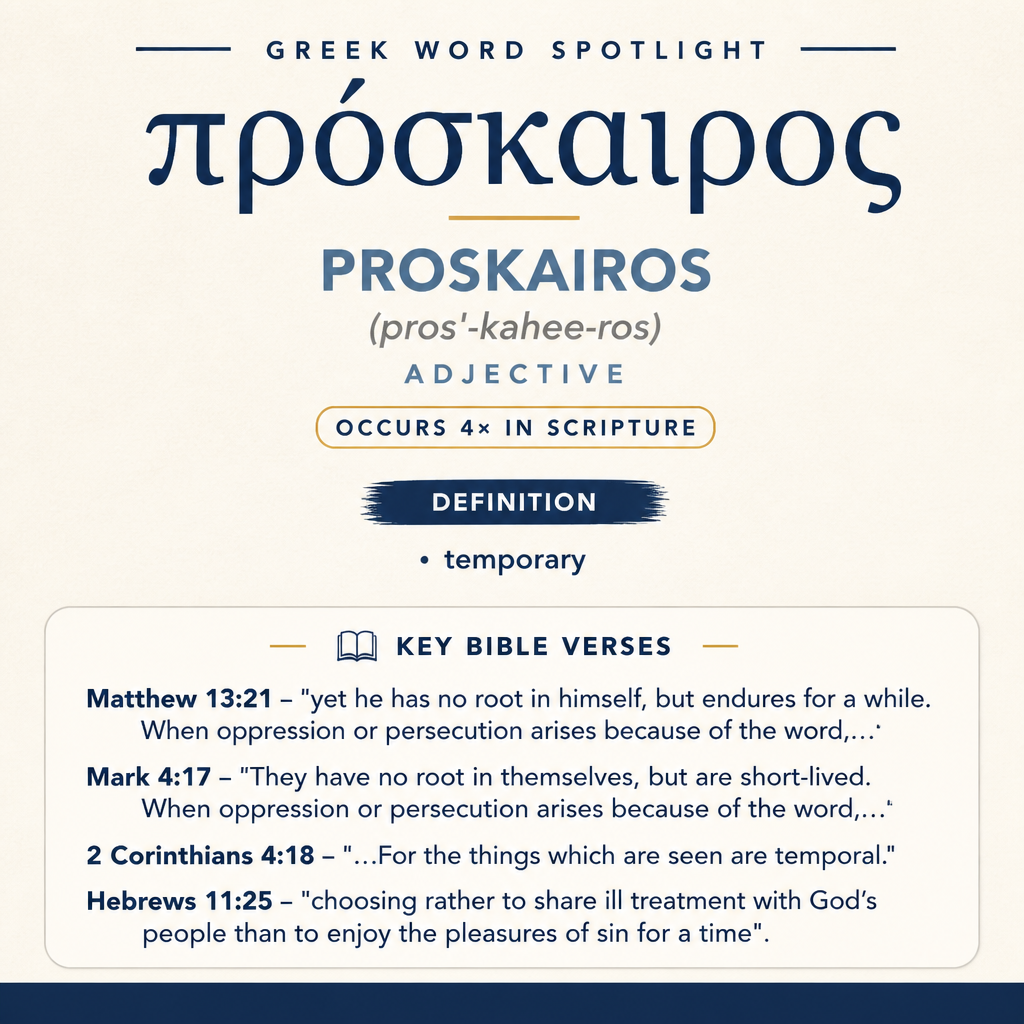
πρόσκαιρος means “temporary” and appears four times: Matthew 13:21, Mark 4:17, 2 Corinthians 4:18, and Hebrews 11:25.
Gospel Context
In Matthew 13:21 and Mark 4:17 it describes being short-lived, enduring only for a while. The texts connect this with oppression or persecution because of the word.
Learn More →Other Uses
In 2 Corinthians 4:18 it contrasts things seen with things not seen, calling what is seen temporary. In Hebrews 11:25 it describes enjoying the pleasures of sin “for a time.”
Learn More →πρόσκαιρος describes what is temporary—what lasts only for a limited span and does not endure. In the New Testament it appears in Jesus’ parable of the soils, in Paul’s contrast between what is seen and unseen, and in the description of sin’s pleasures “for a time.”
Root and Related Words
πρόσκαιρος is formed from πρός (pros), “to/with” (Strong’s G4314), and καιρός (kairos), “time/right time” (Strong’s G2540).

Occurrences
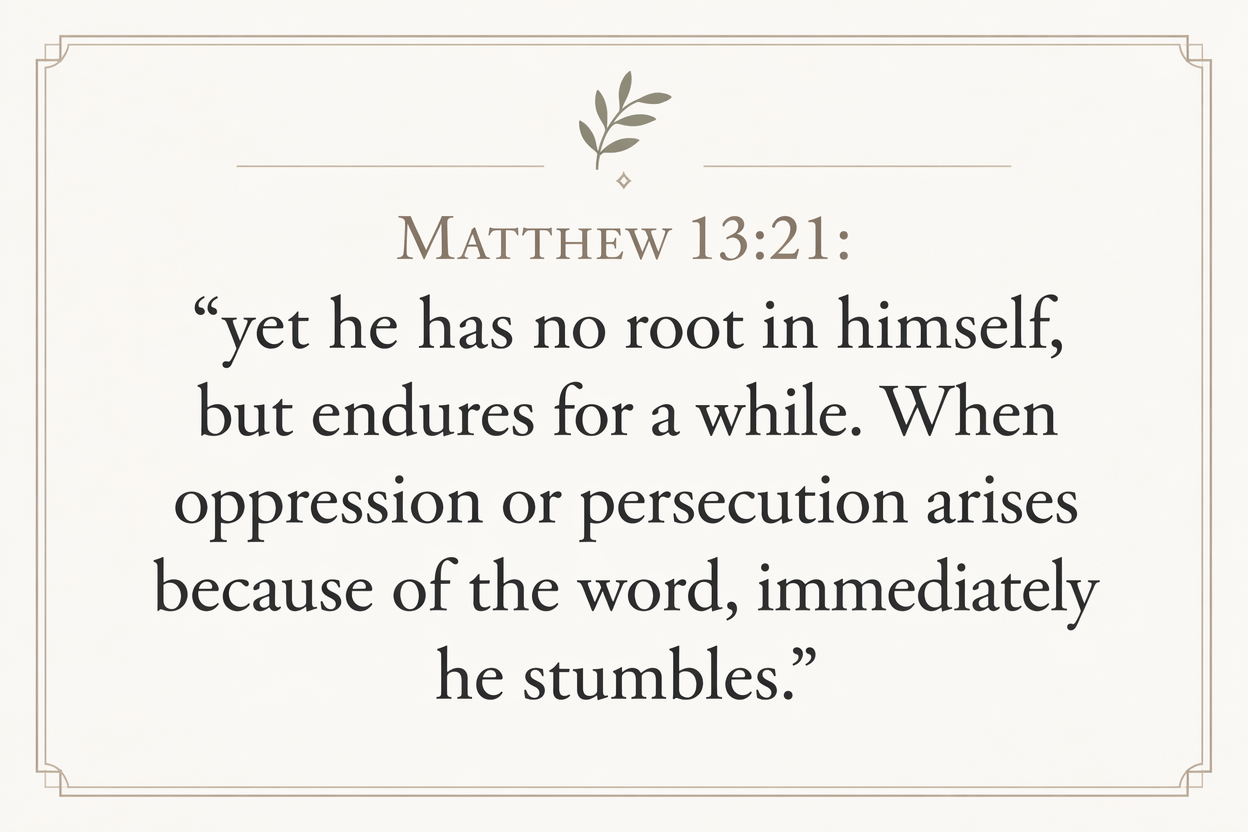
Matthew 13:21: “yet he has no root in himself, but endures for a while. When oppression or persecution arises because of the word, immediately he stumbles.”
In this parable scene, the stress falls on endurance that lasts only “for a while.” The person described receives the word in such a way that it initially holds, but the situation changes as soon as “oppression or persecution” arises “because of the word.” The temporary quality is exposed by pressure: what seemed stable proves unable to continue when circumstances turn hostile, and the response is immediate stumbling. The image of having “no root in himself” ties the brief endurance to a lack of inner depth; the temporary duration is not merely a short calendar span but a short-lived perseverance that fails at the first serious test.
Mark 4:17: “They have no root in themselves, but are short-lived. When oppression or persecution arises because of the word, immediately they stumble.”
Mark’s parallel repeats the same inner logic with a slightly different phrasing: instead of “endures for a while,” it says “are short-lived.” The temporary aspect is not presented as a neutral fact but as the defining limitation of this response to the word. Again, the sequence in the verse moves from an inward deficiency (“no root in themselves”) to the outward crisis (“oppression or persecution”), and then to the instant collapse (“immediately they stumble”). Here πρόσκαιρος marks a kind of durability that exists only until the moment the word brings trouble; the time of apparent steadiness is real but brief, and its brevity is revealed by how quickly the stumbling comes once adversity arrives.
2 Corinthians 4:18: “while we don’t look at the things which are seen, but at the things which are not seen. For the things which are seen are temporal, but the things which are not seen are eternal.”
Paul uses πρόσκαιρος to classify “the things which are seen” as temporal in contrast with “the things which are not seen” as “eternal.” The temporary quality here is not limited to a particular trial or pleasure; it is a broad evaluation of the visible realm as belonging to a time-bounded order. The word serves Paul’s argument about what shapes attention: the believer’s gaze is directed away from what can be seen precisely because what is seen is characterized by temporality. In this verse, “temporal” functions as a reason—“For…”—supporting the discipline of looking beyond the immediate and perceptible. πρόσκαιρος thus carries rhetorical force: it marks the seen world as passing and therefore inadequate as the main object of focus when set against what is “eternal.”
Hebrews 11:25: “choosing rather to share ill treatment with God’s people than to enjoy the pleasures of sin for a time,”
In Hebrews, πρόσκαιρος modifies the enjoyment of “the pleasures of sin,” describing them as experienced “for a time.” The verse frames this temporality within a deliberate choice: one option is “to share ill treatment with God’s people,” the other is to enjoy sin’s pleasures within a limited window. The temporary quality of those pleasures underscores their restricted duration: they are presented as enjoyable, but their enjoyment is bounded. Within the logic of the sentence, the fact that they last only “for a time” belongs to what makes the choice intelligible—temporary pleasure is set alongside the acceptance of suffering with God’s people. πρόσκαιρος thereby gives the pleasures a defined limit and places them in the category of what can be had briefly rather than what can be embraced as lasting.
Sense and Usage
Across these passages, πρόσκαιρος consistently marks a reality whose duration is limited and whose limitation matters for judgment, attention, and decision. In the parable texts (Matthew 13:21; Mark 4:17), the temporary quality is tested by “oppression or persecution,” and the result is immediate failure; what is temporary there is an endurance that cannot outlast conflict. The word therefore aligns with a pattern: initial receptivity and apparent stability are not proof of permanence, because the decisive moment comes when difficulty arises “because of the word.” Temporality is shown not as a harmless short season but as an exposed weakness—something that ends right when it is most needed.
In 2 Corinthians 4:18, the same notion of limited duration is used to guide perspective. Temporality becomes a category for evaluating what claims attention: what is “seen” is temporal, and that assessment supports the choice to look toward “the things which are not seen.” Here the term helps separate what is immediate from what is enduring, not by denying the reality of what is seen, but by assigning it a time-bound quality that makes it less ultimate. Temporality, in Paul’s contrast, is not merely about shortness but about belonging to a realm that does not last in the same way as what is “eternal.”
Hebrews 11:25 applies temporality to the “pleasures of sin,” placing them among experiences that can be enjoyed but only within a bounded time. The verse does not argue that the pleasures are imaginary; rather, it places a time-limit on them and uses that limitation within a moral choice. In this setting, πρόσκαιρος helps weigh options: temporary enjoyment versus sharing “ill treatment with God’s people.” The word’s contribution is to locate the pleasures within a brief horizon, making their allure explicitly time-restricted.
Taken together, these uses show πρόσκαιρος functioning in three overlapping ways: (1) to describe response that does not last under pressure (the stumbling that follows persecution), (2) to classify the visible order as belonging to what passes (the seen as temporal), and (3) to set a boundary around enjoyment that is real but limited (pleasures “for a time”). In each case, the temporary character is not a stray detail but an interpretive key: it explains why something fails, why attention should be directed elsewhere, or how a choice can be made clear-eyed about what can only be possessed briefly.
Imagery
The word’s imagery in these texts is shaped by contrast and exposure. In the parable, the temporary is like a plant with “no root,” holding briefly until heat comes in the form of “oppression or persecution,” and then collapsing “immediately.” In Paul, the temporary is the whole field of “things which are seen,” real enough to be noticed yet defined by passing time when set beside “eternal” realities. In Hebrews, the temporary is pleasure framed by a limit—enjoyment that can be tasted “for a time,” but that stands opposite a choice to endure suffering with God’s people. πρόσκαιρος, in these scenes, continually points to the brief span in which something can be held before it gives way, fades, or ends.
Sources: Lexical data from Strong’s Exhaustive Concordance and the Translators Brief Lexicon of Extended Strongs for Greek (STEPBible, CC BY). Occurrence data from the Translators Amalgamated Greek New Testament (STEPBible, CC BY). Scripture quotations from the World English Bible (public domain).