
Exploring the Meaning of Prosphero in Greek
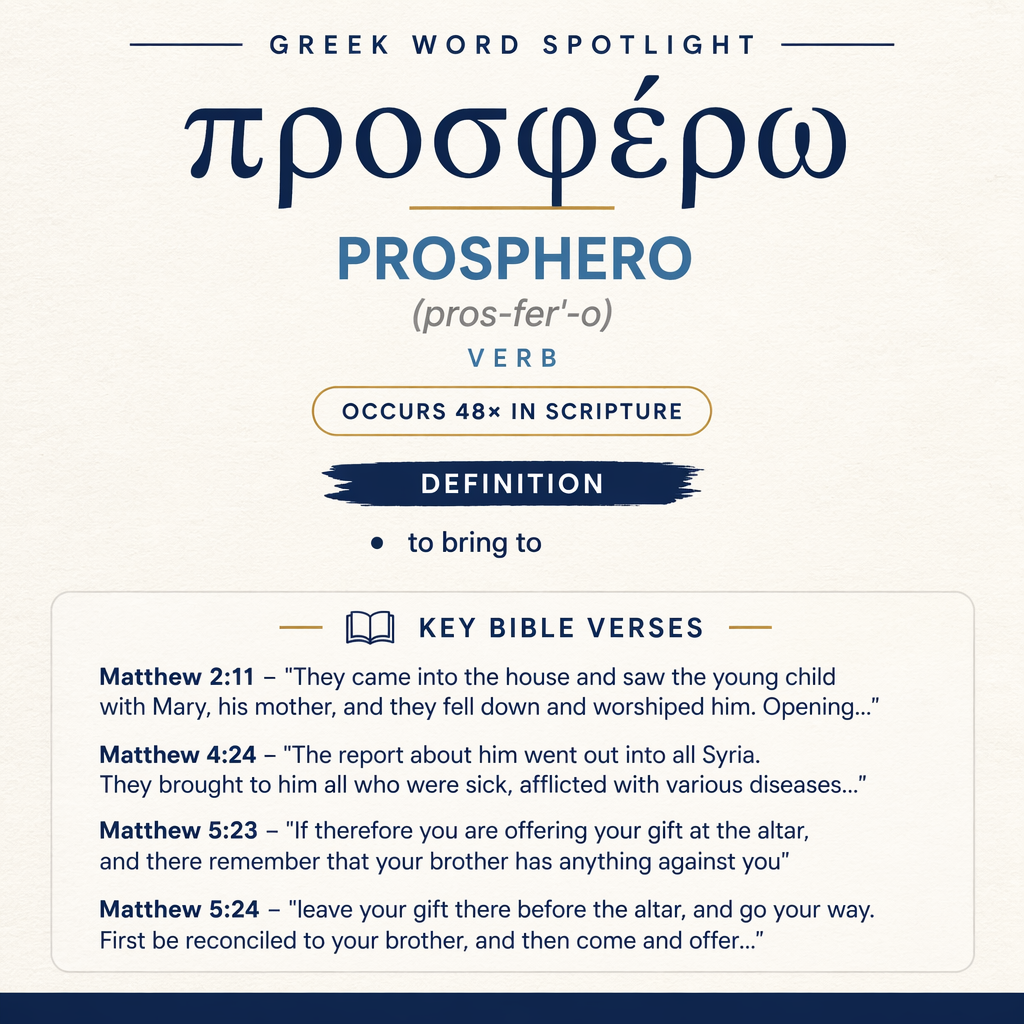
προσφέρω means “to bring to” and appears 48 times in Scripture, including Matthew 2:11; 4:24; 5:23–24; 8:4,16; 9:2,32.
Core Meaning
προσφέρω is defined as “to bring to.” In the listed passages, it describes bringing people or gifts to Jesus or to the altar.
Learn More →Matthew Examples
In Matthew 4:24; 8:16; 9:2,32, people brought the sick, demon-possessed, and a paralyzed man to Jesus. In Matthew 2:11, worshipers came and opened their treasures to him.
Learn More →Offering Context
In Matthew 5:23–24, it is used for offering a gift at the altar. In Matthew 8:4, Jesus commands presenting the gift Moses commanded.
Learn More →προσφέρω expresses the act of bringing something (or someone) to another. In the passages below it regularly frames movement toward Jesus or toward the altar, highlighting what is carried, why it is brought, and what results from the bringing.
Occurrences
They came into the house and saw the young child with Mary, his mother, and they fell down and worshiped him. Opening their treasures, they offered to him gifts: gold, frankincense, and myrrh. (Matthew 2:11)
Here the verb marks a deliberate approach to a specific recipient (“to him”) and a specific object (“gifts”). The narrative builds from arrival (“came into the house”) and reverence (“fell down and worshiped”) to the concrete action of bringing: treasures are opened and then brought as named items. The bringing is not generic generosity but a focused presentation directed to the child, carried out as part of the visitors’ response of honor.
The report about him went out into all Syria. They brought to him all who were sick, afflicted with various diseases and torments, possessed with demons, epileptics, and paralytics; and he healed them. (Matthew 4:24)
In this summary of Jesus’ widening fame, προσφέρω frames people as the ones being brought. The action draws a line from “the report about him” to the crowd’s response: sufferers of many kinds are carried or led to Jesus, and the bringing is followed immediately by the outcome (“and he healed them”). The verb thus functions as a hinge between need (named afflictions) and remedy (his healing), emphasizing the movement that places the sick in his presence.
“If therefore you are offering your gift at the altar, and there remember that your brother has anything against you, (Matthew 5:23)
This occurrence places the bringing within worship at “the altar.” The worshiper is pictured mid-action—already in the act of bringing a “gift”—when a relational memory interrupts. The verb highlights that the gift is not merely possessed but being actively brought to a sacred place; the moment of bringing becomes the moment when moral and relational obligations press upon worship.
leave your gift there before the altar, and go your way. First be reconciled to your brother, and then come and offer your gift. (Matthew 5:24)
The command continues the altar scene and turns προσφέρω into a postponed action: the gift is to remain “there before the altar” while the worshiper goes to seek reconciliation. Only after that return (“then come”) is the bringing resumed (“offer your gift”). The verb therefore stands at the intersection of ritual intention and relational repair, portraying the offering as something that can be suspended and then completed in proper order.
Jesus said to him, “See that you tell nobody, but go, show yourself to the priest, and offer the gift that Moses commanded, as a testimony to them.” (Matthew 8:4)
Here the bringing is directed not to Jesus but to the priest, and it is tied to a commanded “gift.” The verb carries an official tone: the healed man is instructed to go, present himself, and bring the required gift “as a testimony to them.” The action of bringing serves a public, confirmatory function within a recognized procedure, connecting healing with a formal presentation that bears witness.
When evening came, they brought to him many possessed with demons. He cast out the spirits with a word, and healed all who were sick; (Matthew 8:16)
The evening setting gathers a group (“many possessed with demons”) who are brought “to him.” The verb again foregrounds the approach to Jesus as the critical movement that precedes deliverance and healing. In the verse’s rhythm, the crowd’s bringing is met by Jesus’ decisive response (“cast out… and healed”), so the act of bringing becomes the practical means by which many are placed within reach of his word.
Behold, they brought to him a man who was paralyzed, lying on a bed. Jesus, seeing their faith, said to the paralytic, “Son, cheer up! Your sins are forgiven you.” (Matthew 9:2)
In this vignette, the object of bringing is described with vivid specificity: a paralyzed man “lying on a bed.” προσφέρω captures the friends’ (or companions’) action of carrying him into Jesus’ presence. The narrative then links that bringing to Jesus’ perception (“seeing their faith”) and to his pronouncement. The verb thus underlines the physical effort of bringing as the scene’s initiating human action, opening the way for Jesus’ spoken response.
As they went out, behold, a mute man who was demon possessed was brought to him. (Matthew 9:32)
The verb appears in a brief transition (“As they went out”) that introduces another case. The mute, demon-possessed man is brought “to him,” and the bringing functions as the narrative trigger that sets the encounter in motion. Even without describing the carriers, the passive sense (“was brought”) keeps attention on the man’s being conveyed into Jesus’ proximity, preparing for what will follow the introduction.
Then one possessed by a demon, blind and mute, was brought to him and he healed him, so that the blind and mute man both spoke and saw. (Matthew 12:22)
Here bringing and healing are placed side by side in a single sentence. The man’s condition is doubly stated (“blind and mute”), intensifying the need, and the verb again marks the decisive movement toward Jesus: he “was brought to him.” The result (“he healed him”) is spelled out in concrete reversal—speech and sight—so the bringing is the step that situates the man at the point where change occurs.
When the people of that place recognized him, they sent into all that surrounding region, and brought to him all who were sick; (Matthew 14:35)
Recognition leads to coordinated action: people “sent into all that surrounding region” and then brought “all who were sick.” προσφέρω here operates on a larger scale than a single case, depicting community mobilization. The verb gathers the sick into one movement toward Jesus, portraying him as the focal point to whom the region’s need is carried.
So I brought him to your disciples, and they could not cure him.” (Matthew 17:16)
In this report to Jesus, the speaker uses the verb to recount a prior attempt at help: the afflicted person was brought, not to Jesus directly, but “to your disciples.” The bringing still conveys the same directional act, yet the outcome differs: “they could not cure him.” The verb thus helps contrast where someone is brought and what results from that destination, setting up the need for a different responder.
When he had begun to reconcile, one was brought to him who owed him ten thousand talents. (Matthew 18:24)
Within a parable setting, προσφέρω is used in an administrative or judicial scene: as reconciliation begins, a debtor “was brought to him” with an enormous stated debt. The verb captures the formal presentation of a person before an authority in the process of settling accounts. In this context, bringing does not concern illness or worship but accountability—someone is brought forward so the matter can be addressed.

Sense and Usage
Across these passages προσφέρω consistently depicts directed movement: something or someone is carried, led, or presented to a recipient. The recipient may be Jesus (“to him”) in scenes of healing and deliverance (Matthew 4:24; 8:16; 9:2; 9:32; 12:22; 14:35), but the verb also fits other relational targets: the altar in worship (Matthew 5:23–24), the priest in a commanded testimony (Matthew 8:4), the disciples as attempted healers (Matthew 17:16), and a figure of authority in a reckoning (Matthew 18:24). In each setting the verb’s force lies in the transfer toward a person or place where response is expected—honor through gifts (Matthew 2:11), reconciliation shaping worship (Matthew 5:23–24), verification through an appointed gift (Matthew 8:4), relief sought for the afflicted (multiple healing summaries and vignettes), or adjudication of obligation (Matthew 18:24).
The objects brought vary—material gifts, the worshiper’s offering, and people in need or under obligation—but the narrative role is similar: bringing is the initiating act that places the object within the recipient’s sphere. Where Jesus is the recipient, the surrounding clauses frequently pair the bringing with an immediate consequence (“and he healed them,” “and he healed him”), so the verb subtly marks the threshold between human initiative (carrying someone to him) and divine action (his word and healing). Where the altar or priest is the destination, bringing is embedded in ordered practice: the action can be interrupted for reconciliation (Matthew 5:24) or prescribed as testimony (Matthew 8:4). In the parable of Matthew 18:24, the verb’s passive presentation (“was brought to him”) suits a controlled setting where individuals are summoned or produced for settlement.
Imagery
These texts repeatedly picture a movement inward toward a focal point: treasures opened and placed before a child (Matthew 2:11), worshipers standing at an altar with a gift in hand (Matthew 5:23–24), and sufferers being carried from a wider region into Jesus’ presence (Matthew 4:24; 14:35). προσφέρω supplies the practical image of approach—hands carrying, companions escorting, or officials presenting—by which need, honor, and obligation are brought into the moment where they are answered.
Sources: Lexical data from Strong’s Exhaustive Concordance and the Translators Brief Lexicon of Extended Strongs for Greek (STEPBible, CC BY). Occurrence data from the Translators Amalgamated Greek New Testament (STEPBible, CC BY). Scripture quotations from the World English Bible (public domain).





