
Exploring the Meaning of Proskaleomai in Greek
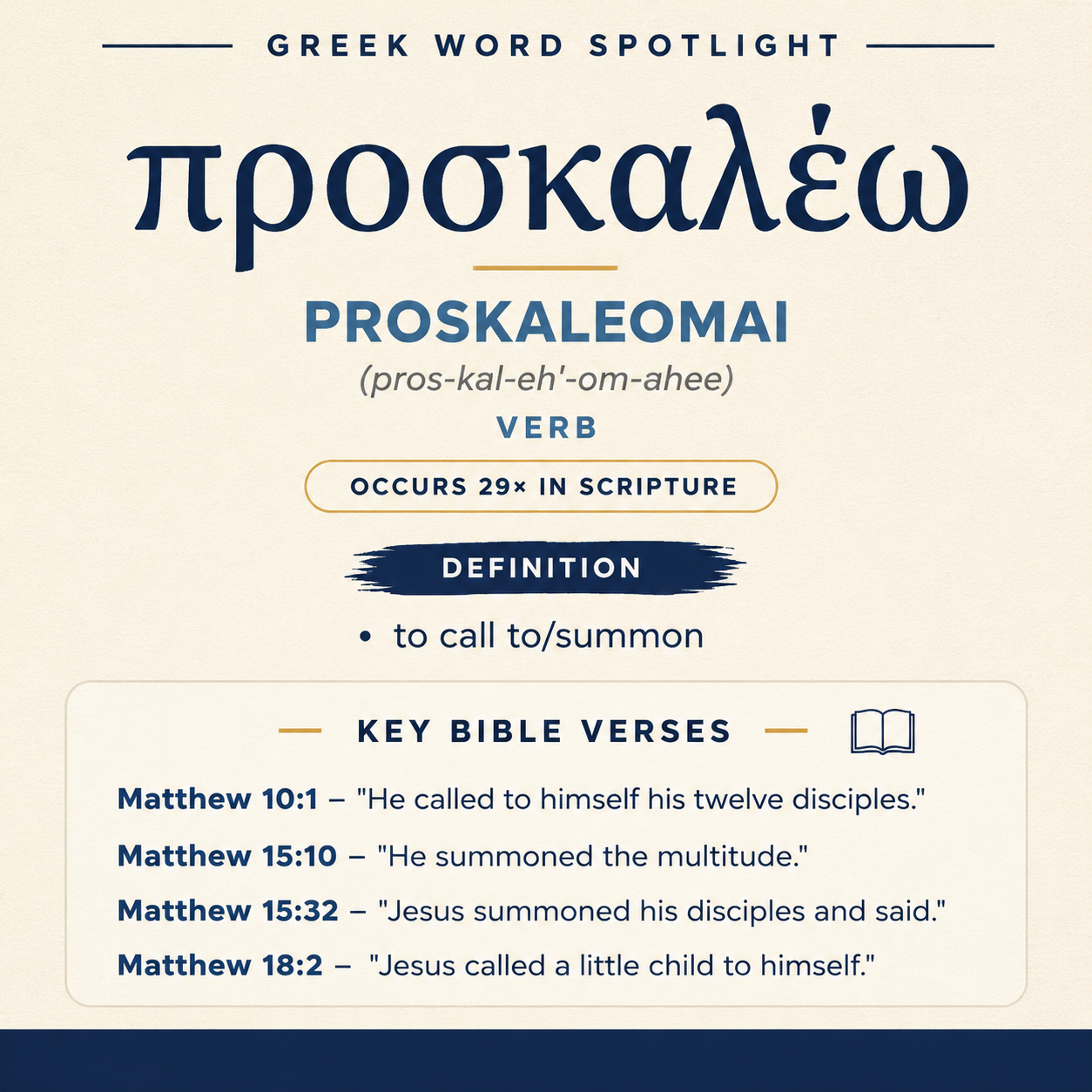
προσκαλέω means “to call to/summon” and appears 29 times in Scripture, including Matthew 10:1; 15:10,32; 18:2,32; 20:25; and Mark 3:13,23.
Core Meaning
προσκαλέω means “to call to/summon.” In several passages it is used for calling people to oneself.
Learn More →Matthew Uses
In Matthew, Jesus summons the multitude (15:10) and his disciples (15:32; 20:25). It also describes calling individuals, such as a little child (18:2).
Learn More →Mark Uses
In Mark 3:13 Jesus calls to himself those whom he wanted, and they went to him. In Mark 3:23 he summons them to speak in parables.
Learn More →προσκαλέω expresses the act of calling someone to oneself in order to summon them. In the Gospels it repeatedly marks Jesus (and in one parable, a master) drawing specific people close so that instruction, authority, or direct address can follow.
Occurrences
Matthew 10:1: “He called to himself his twelve disciples, and gave them authority over unclean spirits, to cast them out, and to heal every disease and every sickness.”
Here the summons creates a gathered circle—“his twelve disciples”—and the calling is immediately paired with commissioning. The movement implied by “called to himself” sets the stage for granting “authority,” so the summons functions as the opening act of delegation.

Matthew 15:10: “He summoned the multitude, and said to them, “Hear, and understand.”
The word introduces a public address. The multitude is not merely present; they are actively drawn in so that the imperative “Hear, and understand” lands on a group deliberately assembled for instruction.
Matthew 15:32: “Jesus summoned his disciples and said, “I have compassion on the multitude, because they continue with me now three days and have nothing to eat. I don’t want to send them away fasting, or they might faint on the way.””
The summons narrows from the crowd to “his disciples” for counsel or action in response to a need. The calling gathers the ones responsible to act, and the speech that follows explains the situation and its urgency (“might faint on the way”), showing the summons as the prelude to practical decision.
Matthew 18:2: “Jesus called a little child to himself, and set him in the middle of them,”
In this scene the summons is focused on one person—“a little child.” The calling brings the child near, and the subsequent placement “in the middle of them” indicates that the summons is used to arrange a living illustration by physically repositioning someone within the group.
Matthew 18:32: “Then his lord called him in, and said to him, ‘You wicked servant! I forgave you all that debt, because you begged me.”
Within the parable, the master’s summons initiates a confrontation and verdict. “Called him in” frames a formal reckoning: the servant is brought before his lord to hear an evaluative address grounded in a prior act of forgiveness (“I forgave you all that debt”).
Matthew 20:25: “But Jesus summoned them, and said, “You know that the rulers of the nations lord it over them, and their great ones exercise authority over them.”
The summons gathers “them” for corrective teaching about authority. The act of calling functions as an intentional regrouping so Jesus can reframe their assumptions, contrasting how power is exercised among “the rulers of the nations” and “their great ones.”
Mark 3:13: “He went up into the mountain, and called to himself those whom he wanted, and they went to him.”
The calling here highlights selection and response. The ones summoned are identified as “those whom he wanted,” and the narrative underlines the effectiveness of the summons: “they went to him,” presenting the call as the decisive moment that draws chosen individuals into proximity.
Mark 3:23: “He summoned them, and said to them in parables, “How can Satan cast out Satan?””
The summons precedes a measured reply “in parables” to a disputing context implied by the rhetorical question. Calling “them” to him sets up a controlled setting for argument and clarification, with the summoned group positioned as the direct recipients of the parabolic reasoning.
Mark 6:7: “He called to himself the twelve, and began to send them out two by two; and he gave them authority over the unclean spirits.”
As in Matthew 10:1, the summons gathers “the twelve” as the immediate preface to mission. The calling to himself transitions into sending (“began to send them out two by two”) and empowerment (“gave them authority”), so the verb marks the pivot from being with Jesus to being dispatched by him.
Mark 7:14: “He called all the multitude to himself, and said to them, “Hear me, all of you, and understand.”
The summons is expansive—“all the multitude”—and explicitly centers the crowd around Jesus (“to himself”). The command “Hear me, all of you” gains force because the verb has already depicted a deliberate gathering for attentive listening and comprehension.
Mark 8:1: “In those days, when there was a very great multitude, and they had nothing to eat, Jesus called his disciples to himself, and said to them,”
The setting emphasizes scale and need: “a very great multitude” and hunger. The summons again draws in “his disciples,” setting them apart from the crowd as the ones addressed first. The call functions as an internal conference in view of a public problem.
Mark 8:34: “He called the multitude to himself with his disciples, and said to them, “Whoever wants to come after me, let him deny himself, and take up his cross, and follow me.”
This occurrence combines groups: “the multitude” and “his disciples” are summoned together “to himself,” indicating a teaching meant for both committed followers and the broader audience. The summons establishes a single listening assembly for a demanding call to discipleship expressed in imperatives (“deny himself… take up his cross… follow me”).

Sense and Usage
Across these passages, προσκαλέω repeatedly functions as the narrative hinge between dispersed people and focused speech or action. The calling is not an abstract invitation; it produces a concrete gathering around the caller (“to himself”), whether the group is small (“his twelve disciples,” “the twelve”) or large (“the multitude,” “all the multitude”). The scenes show that the summons can be selective (those “whom he wanted,” a “little child”) or comprehensive (a whole crowd), but in either case it tightens attention and proximity so that what follows—teaching, commissioning, correction, or decision—can occur in an ordered way.
Several occurrences pair the summons with authority and mission. In Matthew 10:1 and Mark 6:7, the calling precedes the giving of “authority over unclean spirits” and the sending out of the twelve. The verb thus marks the moment of drawing near that logically precedes being sent out: those who are to act in Jesus’ name are first assembled to receive direction and empowerment. In Mark 3:13, the summons similarly defines the boundary of a chosen group: the ones called are “those whom he wanted,” and their response (“they went to him”) underscores the relational movement inherent in the word’s use.
In other contexts, the summons frames instruction aimed at understanding. Matthew 15:10 and Mark 7:14 are closely aligned in wording and function: the crowd is summoned and then commanded to listen and grasp meaning (“Hear, and understand”). The verb supports the pedagogical scene by making the audience an addressed unit rather than a passive background. Mark 3:23 similarly uses the summons to set up parabolic explanation, drawing opponents or questioners into a setting where Jesus’ reply is delivered as deliberate teaching.
The verb also serves to stage visible, social moments of correction and example. In Matthew 18:2, calling a child and placing the child “in the middle of them” shows how a summons can rearrange the group’s space to sharpen a lesson. In Matthew 20:25, Jesus summons “them” before speaking about the way rulers “lord it over” others, suggesting the need to gather the hearers close enough to reset their thinking. Matthew 18:32 applies the same dynamic within a parable: a master summons a servant for direct address that includes moral evaluation and reference to a previous plea (“because you begged me”). In each case the verb depicts the caller’s initiative in bringing someone under direct, personal speech.
Finally, Mark 8:34 expands the summons to include both the inner circle and the wider crowd: “He called the multitude to himself with his disciples.” The word there helps show that the subsequent demands are spoken within a deliberately convened assembly that spans levels of commitment. The summons gathers everyone into the same hearing range for a call that is framed as a path to be chosen (“Whoever wants to come after me…”).
Imagery
The recurring picture is of people moving toward a center—disciples, crowds, and individuals brought near to hear, to be commissioned, or to be confronted. Mountains, multitudes, a child set “in the middle,” and a servant called in before his lord all present summons as an act that shapes the moment: it gathers scattered listeners into an ordered scene where words carry immediate weight.
Sources: Lexical data from Strong’s Exhaustive Concordance and the Translators Brief Lexicon of Extended Strongs for Greek (STEPBible, CC BY). Occurrence data from the Translators Amalgamated Greek New Testament (STEPBible, CC BY). Scripture quotations from the World English Bible (public domain).





