
Exploring the Meaning of Potos in Greek
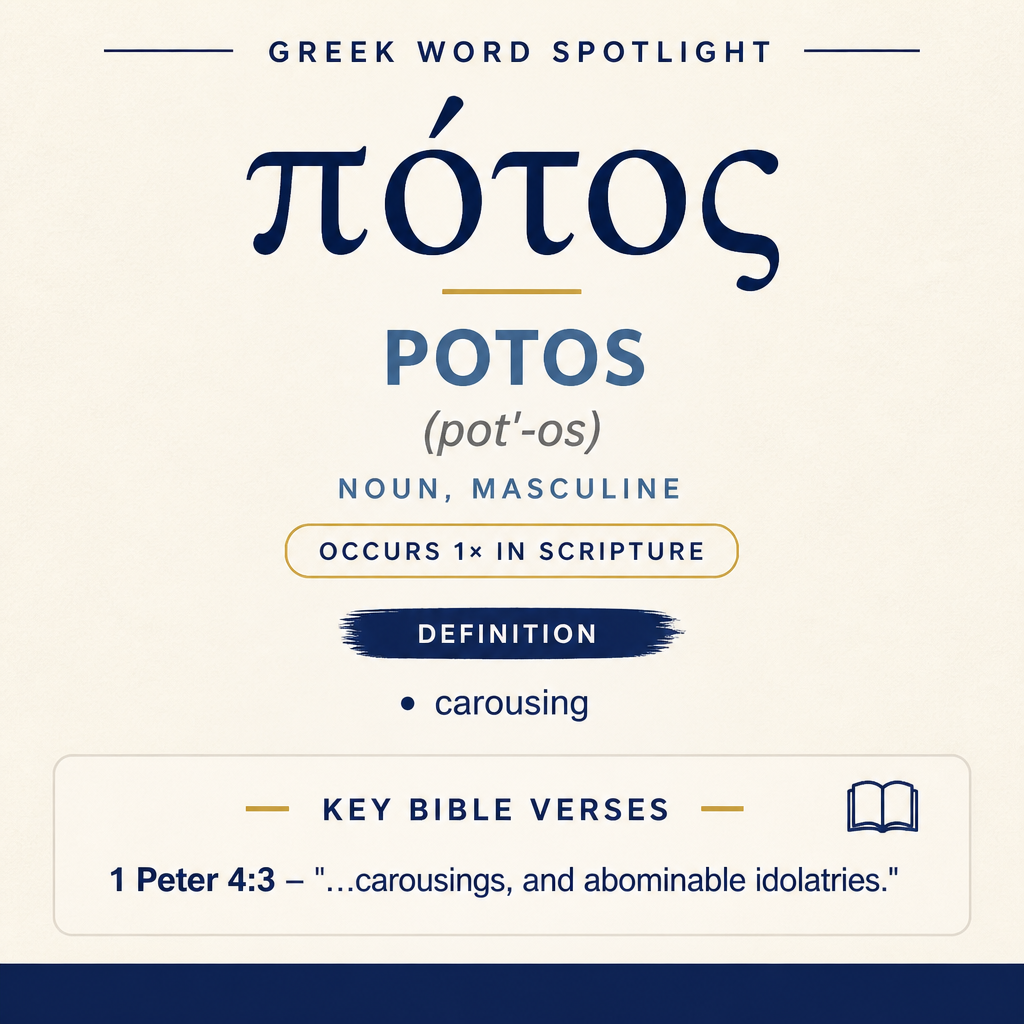
πότος (Potos) means “carousing” and appears once in Scripture, in 1 Peter 4:3.
Biblical Occurrence
It occurs 1 time in Scripture. Its attested reference is 1 Peter 4:3.
Learn More →Verse Context
In 1 Peter 4:3, πότος appears within a list of past behaviors connected with Gentile desires.
Learn More →πότος means “carousing” and appears in the vice list of 1 Peter 4:3, where it names a kind of social behavior bound up with other excesses. In that single context it functions as one item in a clustered description of a former way of life.
Root and Related Words
πότος is connected with the verb pino (πίνω), “to drink” (Strong’s G4095). The association places the noun in a sphere of conduct that naturally belongs with drinking activity, helping explain why it can sit alongside terms for intoxication and sexual excess in moral catalogues.

Occurrences
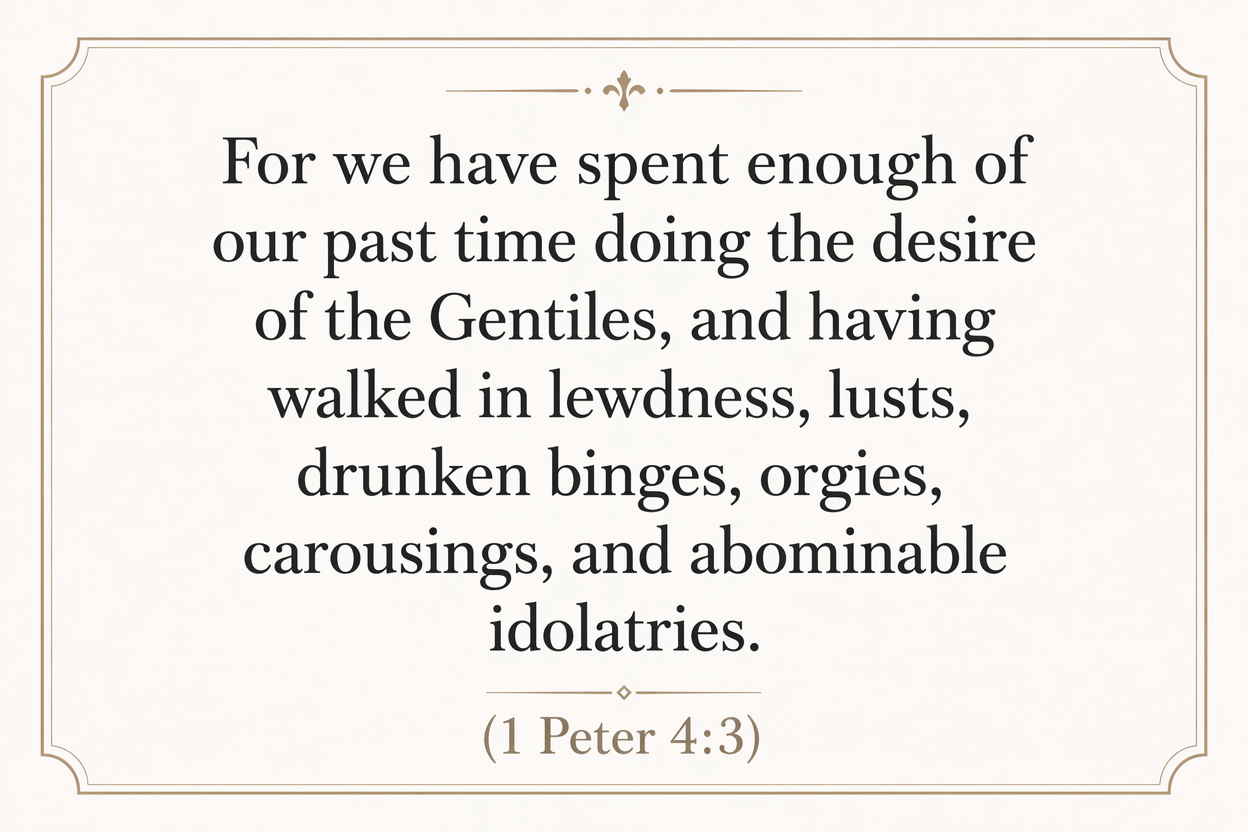
For we have spent enough of our past time doing the desire of the Gentiles, and having walked in lewdness, lusts, drunken binges, orgies, carousings, and abominable idolatries. (1 Peter 4:3)
In 1 Peter 4:3, πότος (“carousings”) is part of an extended accumulation of practices described as “the desire of the Gentiles,” framed as the readers’ “past time.” The verse presents these practices as a way of life—“having walked”—so πότος is not pictured as an isolated lapse but as a patterned social behavior. Its placement in the list is also significant: it stands after “drunken binges” and “orgies,” and before “abominable idolatries.” Within the flow of the sentence, “carousings” belongs to a chain of excesses that moves from internal desire (“lusts”) to outward acts (“drunken binges,” “orgies,” “carousings”), and then to explicitly religious wrongdoing (“idolatries”).
Because πότος is plural in this verse (“carousings”), it portrays repeated occasions or a recurring kind of activity rather than a one-time event. The term’s contribution is to name a recognizable expression of morally disordered celebration—public or group behavior that fits the “walked in” metaphor, where one’s “past time” is characterized by certain scenes and habits. In this setting, “carousings” is closely coordinated with other items by a simple additive structure (“and… and… and…”), emphasizing accumulation and breadth: the readers once had a whole repertoire of such pursuits, of which πότος is one component.
Sense and Usage
The gloss “carousing” is given its shape in 1 Peter 4:3 by the company it keeps. πότος appears among terms that describe overindulgent living: “lewdness” and “lusts” suggest a bent toward sensuality; “drunken binges” and “orgies” portray excess in drinking and sexual behavior; “abominable idolatries” names a further category of acts viewed as profoundly wrong. πότος participates in this portrayal of excess, marking a kind of behavior that fits naturally into a pattern of indulgence and social revelry.
Several features of the verse clarify how “carousing” functions as a moral descriptor here. First, it is embedded in a retrospective evaluation: “we have spent enough of our past time.” The force is not merely descriptive but interpretive—these behaviors constitute a period that the speaker and audience regard as completed and sufficient. πότος therefore belongs to the vocabulary of a renounced past, a label for conduct that once shaped communal identity and daily practice.
Second, πότος is presented not as an abstract concept but as part of an enacted “walk.” The metaphor of walking indicates continuity, direction, and habit. As one of the listed “paths,” πότος suggests the kind of occasions that fill time and direct relationships: it is the sort of behavior that can be “walked in,” repeated, and socially reinforced. In a vice list, each term helps to map an environment; “carousings” names one of the environments in which the “desire of the Gentiles” finds expression.
Third, the term’s plural form (“carousings”) intensifies the sense of repetitiveness. The plural does not merely multiply acts; it broadens the sense to a category of events—many instances of the same kind of conduct. Within the list, that plurality matches the sweep of the description: multiple kinds of wrong desire and practice characterized the “past time.”
Finally, the connection with pino (πίνω), “to drink,” aligns πότος with the drinking-related sphere already made explicit by “drunken binges.” This does not collapse πότος into that neighboring term, but it explains why the noun can stand where it does in the sequence: the verse groups certain behaviors that tend to cluster together in settings of excess. In 1 Peter 4:3, πότος is one of those clustered behaviors, functioning as a concise name for the kind of revel that belongs to such a setting.
Imagery and Associations
Even in a single occurrence, πότος carries vivid social imagery because 1 Peter 4:3 frames it as an aspect of a former “walk.” The verse evokes a life spent in repeated scenes of indulgence: a sequence of actions and gatherings marked by “drunken binges,” “orgies,” and “carousings.” In that portrait, πότος contributes the picture of communal revelry as a definable mode of life—something that can fill “past time” and be remembered as a distinct pattern alongside other excesses.
Sources: Lexical data from Strong’s Exhaustive Concordance and the Translators Brief Lexicon of Extended Strongs for Greek (STEPBible, CC BY). Occurrence data from the Translators Amalgamated Greek New Testament (STEPBible, CC BY). Scripture quotations from the World English Bible (public domain).




