
Exploring the Meaning of Neokoros in Greek
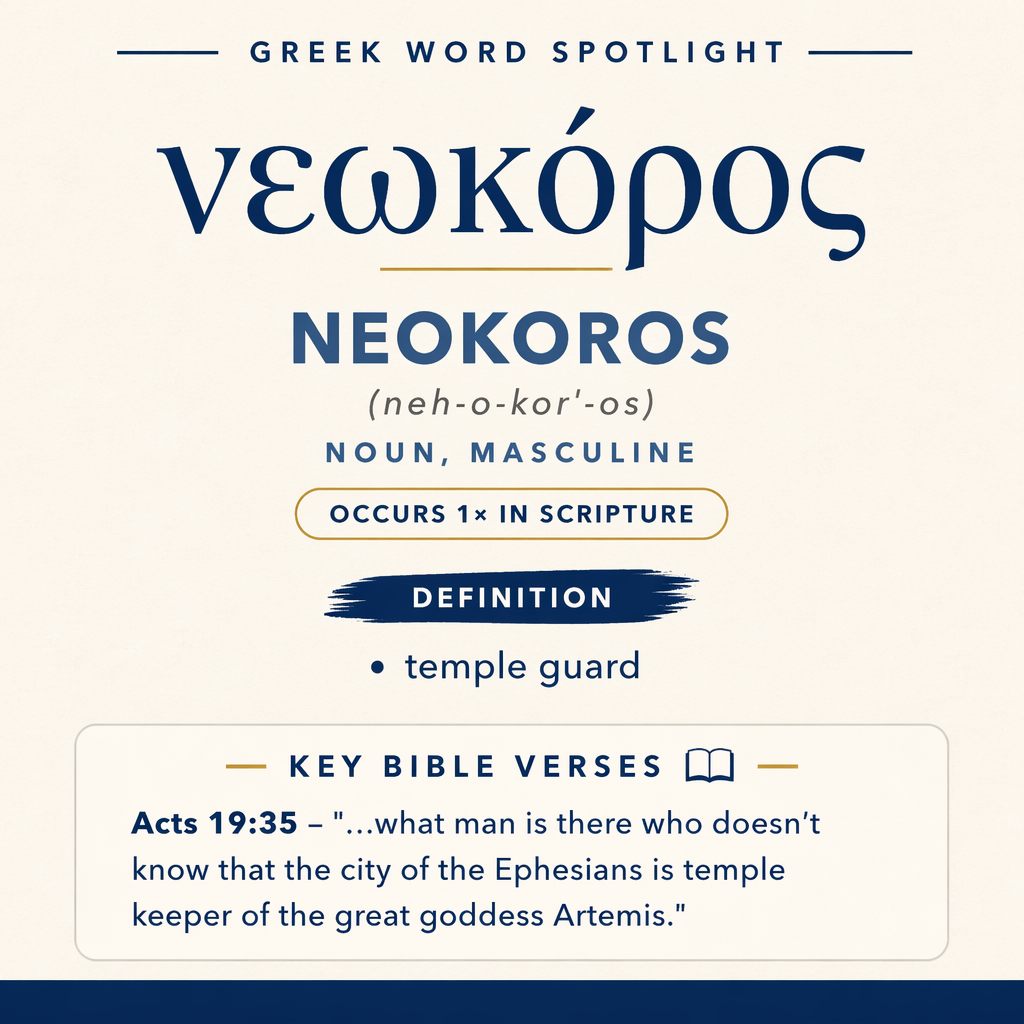
νεωκόρος means “temple guard” and appears once in Scripture in Acts 19:35.
Scripture Occurrence
This word occurs 1 time in Scripture. Its single occurrence is in Acts 19:35.
Learn More →Verse Context
In Acts 19:35, the town clerk addresses the men of Ephesus while quieting the multitude. The verse includes the statement, “You men of Ephesus, what man is there who doesn’t know that the …”.
Learn More →νεωκόρος describes a “temple guard.” It appears in the New Testament in Acts 19:35, where the term is used publicly to characterize the city of Ephesus in relation to Artemis.
Root and Related Words
νεωκόρος is related to naos (ναός), “temple” (Strong’s G3485). In Acts 19:35 the setting is explicitly cultic, with reference to “the great goddess Artemis” and a revered “image,” so the link to naos fits the speech’s focus on the city’s recognized standing in temple matters.

Occurrences
“When the town clerk had quieted the multitude, he said, “You men of Ephesus, what man is there who doesn’t know that the city of the Ephesians is temple keeper of the great goddess Artemis, and of the image which fell down from Zeus?” (Acts 19:35)
In this scene, the town clerk addresses a “multitude” and begins by establishing common knowledge: “what man is there who doesn’t know….” νεωκόρος is the key label in that appeal to public consensus. The clerk does not present it as a disputed claim but as something woven into the city’s well-known identity: “the city of the Ephesians is temple keeper.” The word therefore functions as an official-sounding descriptor that anchors his argument in what is assumed to be indisputable civic fact.
The immediate content tied to this designation is twofold: the city is temple keeper “of the great goddess Artemis,” and also “of the image which fell down from Zeus.” Within the clerk’s sentence, νεωκόρος helps bind the city’s role to both deity and image, treating them as objects of recognized guardianship. The effect is to frame the agitation of the crowd against a backdrop of established religious prestige; the clerk’s calming strategy begins by pointing to Ephesus’s publicly acknowledged responsibility toward the cult of Artemis and her image.
Because the term is applied to “the city of the Ephesians,” it moves beyond a merely personal job title and becomes a civic epithet. The city itself is presented as holding this role in a corporate sense, as though the community’s institutions, personnel, and public reputation together sustain the standing expressed by νεωκόρος. The word thus carries not only the idea of guarding but the idea of recognized custodianship as part of a city’s public profile—something that can be invoked to quiet a crowd and to establish a baseline of shared assumptions.
Sense and Usage
The definition “temple guard” plays out in Acts 19:35 not as a narrative detail about a single watchman but as a title attached to Ephesus as a whole. In the clerk’s speech, the term marks a relationship of responsibility: Ephesus stands in a guarding or keeping relation to “the great goddess Artemis” and her “image.” The verse’s wording keeps the focus on the status being widely known (“what man is there who doesn’t know”), so the sense is socially and publicly legible: the audience is expected to recognize and accept that this is what their city is.
Within the rhetoric of the address, this civic self-understanding is meant to have a stabilizing force. A crowd is easiest to inflame when identity feels threatened; conversely, it can be quieted when identity is presented as secure and unquestioned. By invoking νεωκόρος, the clerk points to a settled role that already belongs to Ephesus. The implication built into his sentence is that a city with such a widely acknowledged standing does not need disorderly agitation to defend it. In other words, “temple keeper” functions here as a badge of established religious custodianship rather than a call to immediate action.
The verse also places this guardianship alongside a particular object: “the image which fell down from Zeus.” Without adding details beyond the sentence, the wording shows that the city’s temple-keeping identity includes safeguarding what is regarded as a heaven-linked image. That connection intensifies the public weight of the title: Ephesus is not merely associated with a cult; it is presented as the keeper of a revered image with a storied origin. νεωκόρος, in this context, carries the sense of protecting and maintaining the integrity of what is held sacred in the city’s religious life.
Because νεωκόρος is embedded in a political moment—“the town clerk” addressing a crowd—it also shows how a term from temple life can be used in civic speech. The clerk’s role in quieting the multitude suggests an official attempt to restore order. He does so first by naming what “everyone knows” about Ephesus. The word therefore bridges temple and city: it is a religious descriptor used for a civic argument, aimed at shaping public behavior by appealing to collective reputation.
Imagery
Acts 19:35 attaches νεωκόρος to a city’s claim to be the keeper of a goddess’s cult and a revered image. The imagery is that of a prominent temple sphere—guarded, maintained, and publicly known—standing at the center of civic identity. In the clerk’s sentence, the city’s role as keeper is not hidden work done in the background; it is a widely recognized feature of Ephesus that can be spoken aloud in a moment of public unrest.
Sources: Lexical data from Strong’s Exhaustive Concordance and the Translators Brief Lexicon of Extended Strongs for Greek (STEPBible, CC BY). Occurrence data from the Translators Amalgamated Greek New Testament (STEPBible, CC BY). Scripture quotations from the World English Bible (public domain).




