
Exploring the Meaning of Potioloi in Greek
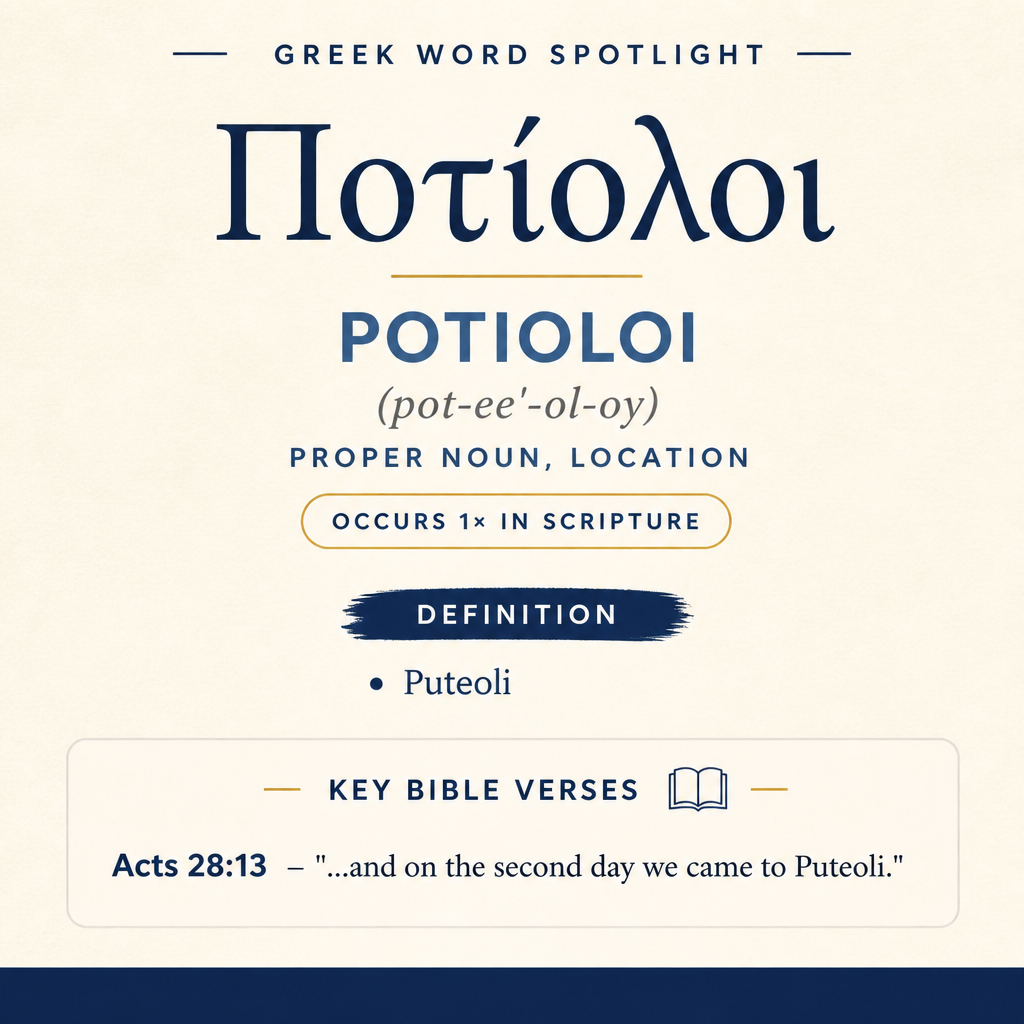
Ποτίολοι means Puteoli and appears once in Scripture, in Acts 28:13.
Acts Context
In Acts 28:13, the narrative includes travel details: circling around, arriving at Rhegium, then moving on with a south wind.
Learn More →Potioloi means Puteoli and appears once in Scripture, in the travel narrative of Acts 28. In that verse it marks the destination reached after a short sequence of coastal movements and favorable wind.
Occurrences
“From there we circled around and arrived at Rhegium. After one day, a south wind sprang up, and on the second day we came to Puteoli,” (Acts 28:13)
Here Potioloi identifies the place reached at the end of a tightly paced itinerary. The sentence moves by stages: “From there” signals departure from the prior point on the route, then the travelers “circled around” and “arrived at Rhegium.” The mention of time—“After one day… on the second day”—and the change in conditions—“a south wind sprang up”—frame Puteoli as a concrete waypoint made possible by ordinary seafaring realities. The word therefore functions as more than a label on a map: it anchors the narrative’s progress in a specific landing point, showing movement toward a goal by means of successive arrivals.
Because the place-name occurs at the close of the verse’s sequence, it also serves as a narrative hinge. The earlier clauses describe the route and the wind; the final clause (“we came to Puteoli”) delivers the outcome of those details. In this way, Potioloi gathers up what precedes it—distance covered, time elapsed, and the enabling wind—and presents a settled arrival, a moment of completion before the story proceeds to whatever follows the landing.

Sense and Usage
As a proper noun for a location, Potioloi contributes specificity: it does not describe a type of place but names the destination itself. In Acts 28:13, the narrative emphasis rests on travel accomplished step-by-step; the place-name supplies the fixed point that allows the reader to track the journey. The verse’s structure highlights this function. The sequence “arrived at Rhegium… a south wind sprang up… we came to Puteoli” places Puteoli in parallel with another named stop (Rhegium), so that each name marks a distinct stage along the coast. Potioloi thus participates in a chain of geographic references that conveys continuity of movement and orderly progress rather than sudden, unexplained relocation.
The verb paired with the name—“we came”—portrays Puteoli as the result of directed motion. The verse does not treat the destination as incidental; it is reached “on the second day” following the onset of the south wind. Potioloi therefore sits at the intersection of geography and timing: it is a place reached within a measured span, and its mention allows the narrative to assign the journey a rhythm (one day, then the second day) with a clear endpoint. Even without additional descriptive clauses about the city itself, the name functions as a concrete coordinate in the story’s unfolding travel log.
Within this single attestation, the use of a distinct Greek form of the place-name reinforces that the narrative is comfortable naming foreign or non-local destinations directly. Potioloi stands as a transliterated geographic designation inside a sentence otherwise composed of common travel vocabulary (arrived, sprang up, came). That contrast—ordinary verbs with a specific proper noun—keeps the prose readable while still supplying precise location data. The effect is that the reader senses real movement across real places, conveyed by familiar action words punctuated by named ports.
Imagery
The verse attaches Puteoli to maritime motion and weather: a route traced by “circl[ing] around,” a pause marked by “one day,” and a change signaled when “a south wind sprang up.” Against that backdrop, Potioloi evokes the visual of a ship finally making harbor after days measured and wind awaited. The name is the line’s point of rest—the destination that turns wind and time into arrival.
Sources: Lexical data from Strong’s Exhaustive Concordance and the Translators Brief Lexicon of Extended Strongs for Greek (STEPBible, CC BY). Occurrence data from the Translators Amalgamated Greek New Testament (STEPBible, CC BY). Scripture quotations from the World English Bible (public domain).




