
Exploring the Meaning of Potamos in Greek
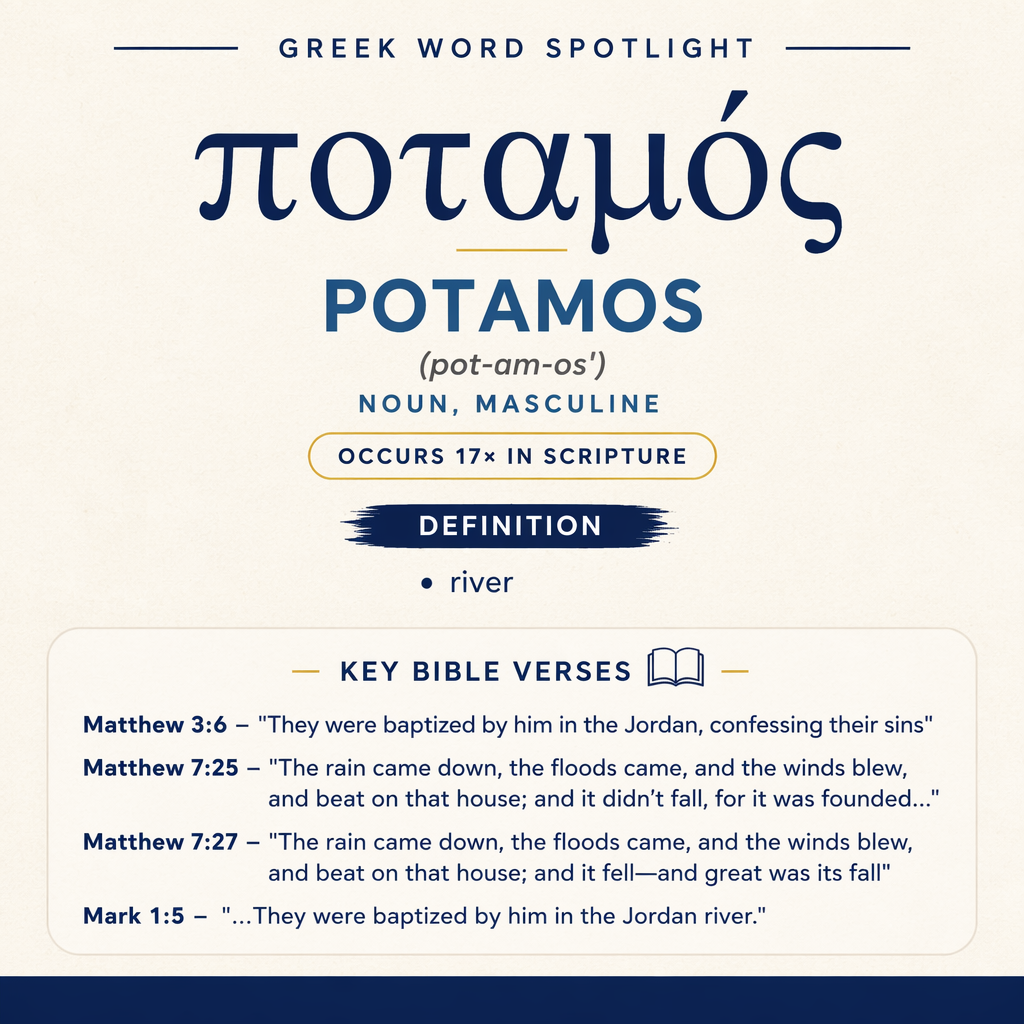
ποταμός means “river” in Greek and occurs 17 times in Scripture, including in Matthew, Mark, Luke, John, and Acts.
Gospel Usage
It appears in baptism scenes at the Jordan (Matthew 3:6; Mark 1:5) and in flood imagery in Jesus’ teaching (Matthew 7:25, 7:27; Luke 6:48–49).
Learn More →Acts and John
John 7:38 uses it in the phrase “rivers of living water.” Acts 16:13 mentions a riverside location where people gathered for prayer.
Learn More →ποταμός denotes a river, appearing in Gospel narratives, apostolic travel, and Revelation’s judgment and conflict imagery. In these passages it can be a named geographical feature, a threatening force in a storm or flood, a setting for prayer, a symbol of inward abundance, and a target or vehicle in apocalyptic scenes.
Occurrences
Matthew 3:6 — “They were baptized by him in the Jordan, confessing their sins.”
Here the river is the physical location of baptism. The Jordan provides a concrete, public setting in which confession and baptism occur together, making the act something done “in” a real body of water rather than in a private or merely verbal way.
Matthew 7:25 — “The rain came down, the floods came, and the winds blew, and beat on that house; and it didn’t fall, for it was founded on the rock.”
In this storm scene the river is present through “the floods,” the surge of water that tests the house. The river is not described as calm or scenic; it is a force that rises and strikes, contributing to the picture of external pressures that reveal whether a foundation holds.
Matthew 7:27 — “The rain came down, the floods came, and the winds blew, and beat on that house; and it fell—and great was its fall.”
The same water pressure appears again, now paired with collapse. The floods that beat on the house are part of the chain of events leading to ruin, so the river functions as a destructive stressor when there is no adequate foundation.
Mark 1:5 — “All the country of Judea and all those of Jerusalem went out to him. They were baptized by him in the Jordan river, confessing their sins.”
As in Matthew, the river is the site of baptism; Mark explicitly names it “the Jordan river.” The river also serves as a gathering point: people “went out,” implying movement toward this place where baptism and confession were taking place.
Luke 6:48 — “He is like a man building a house, who dug and went deep, and laid a foundation on the rock. When a flood arose, the stream broke against that house, and could not shake it, because it was founded on the rock.”
Luke describes the river’s impact in terms of a “flood” and “the stream” that “broke against” the house. The river is the agent of battering pressure; yet here it highlights stability, because even an active current cannot move what is well-founded.
Luke 6:49 — “But he who hears, and doesn’t do, is like a man who built a house on the earth without a foundation, against which the stream broke, and immediately it fell, and the ruin of that house was great.”
The river appears as “the stream” again, now revealing structural weakness. The immediate fall shows the river’s force as decisive and relentless when there is nothing underneath the structure to resist the current’s repeated blows.
John 7:38 — “He who believes in me, as the Scripture has said, from within him will flow rivers of living water.”
Rivers here are not a location outside a person but something that “will flow” from within. The plural “rivers” intensifies the image of abundance and movement: the river is a channel of continual outflow, and its vitality is emphasized by the phrase “living water.”
Acts 16:13 — “On the Sabbath day we went outside of the city by a riverside, where we supposed there was a place of prayer, and we sat down and spoke to the women who had come together.”
The river functions as a landmark: a “riverside” is where the group expects to find “a place of prayer.” It shapes the geography of meeting and worship, providing a recognizable edge-of-city setting where conversation and communal gathering occur.
2 Corinthians 11:26 — “I have been in travels often, perils of rivers, perils of robbers, perils from my countrymen, perils from the Gentiles, perils in the city, perils in the wilderness, perils in the sea, perils among false brothers;”
Rivers are named among the dangers of travel. The river is not presented as a destination but as an obstacle and hazard—one item in a catalog of threats that can confront a traveler in varied environments.
Revelation 8:10 — “The third angel sounded, and a great star fell from the sky, burning like a torch, and it fell on one third of the rivers, and on the springs of the waters.”
Rivers here are part of the created order affected by a dramatic heavenly event. They are counted (“one third”) and paired with “the springs of the waters,” portraying rivers as major water sources subject to measurable, wide-reaching impact.
Revelation 9:14 — “saying to the sixth angel who had the trumpet, “Free the four angels who are bound at the great river Euphrates!””
The river is a specific, named boundary: “the great river Euphrates.” It marks the location where the angels are “bound,” so the river serves as a concrete geographical reference point within the vision’s unfolding commands.
Revelation 12:15 — “The serpent spewed water out of his mouth after the woman like a river, that he might cause her to be carried away by the stream.”
The river becomes a comparison for a sudden, forceful outpouring: water is spewed “like a river” with the intent to sweep someone away. The river’s defining contribution is its capacity to carry and overwhelm, matching the phrase “carried away by the stream.”
Sense and Usage
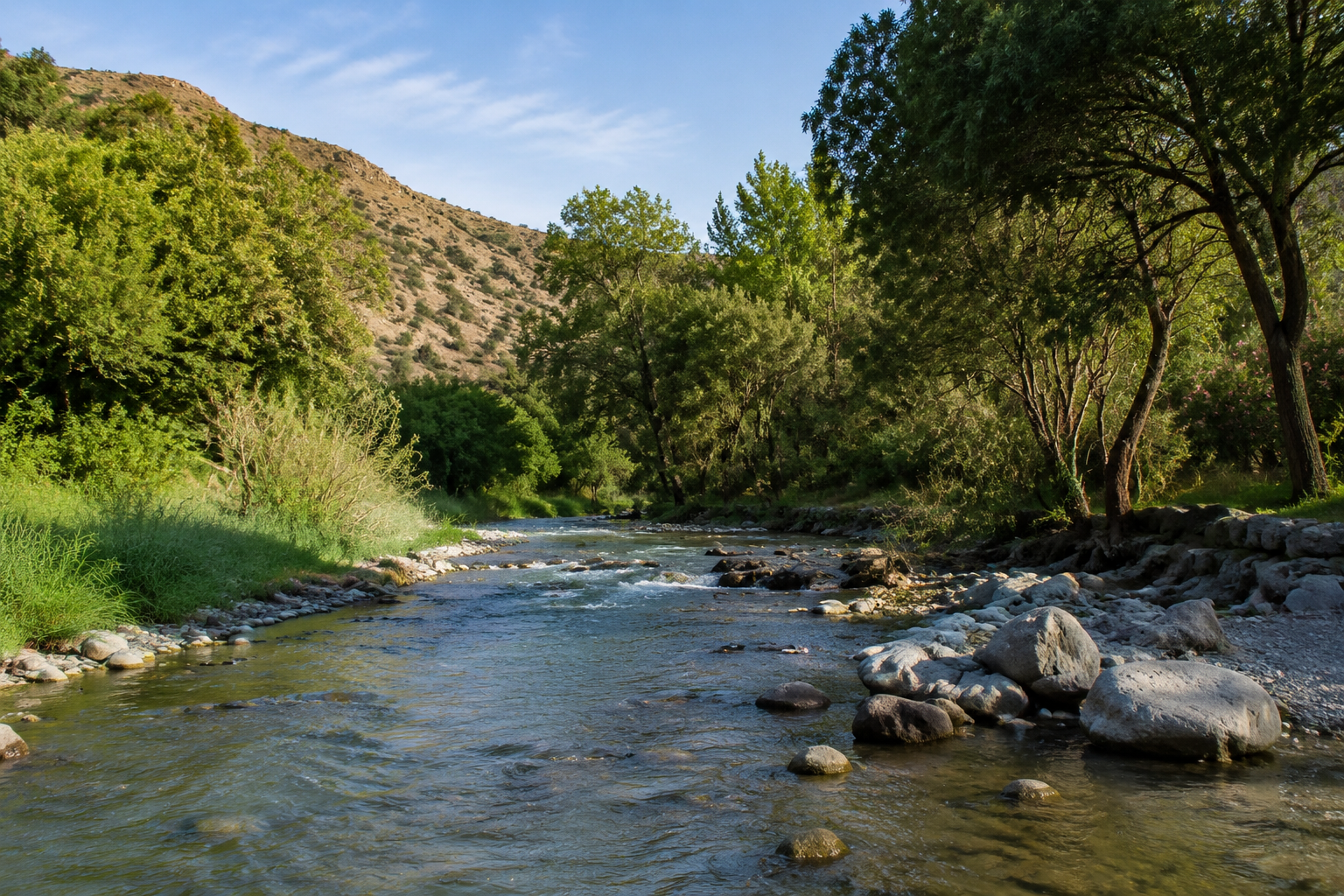
Across these passages, ποταμός functions first as a literal river within familiar landscapes. The Jordan appears as the setting for baptism (Matthew 3:6; Mark 1:5), anchoring repentance and confession in an embodied action performed in water. Acts 16:13 uses the river more quietly as a place-marker: a riverside is where people expect to find others gathered for prayer, and it becomes a setting for speaking and listening.
A second cluster of uses emphasizes the river’s power when it rises or surges. In Matthew 7:25 and 7:27, and in Luke 6:48–49, the river is present as floodwater or a stream that pounds against a house. These scenes rely on the river’s ability to test what humans build: the current “beat on” the house and “broke against” it. The difference between standing and falling is not the river’s intensity but the condition of the foundation, so the river supplies the consistent external pressure that reveals what is secure.
John 7:38 shifts the river from an external feature to an image of internal, flowing abundance: “from within him will flow rivers of living water.” Here “rivers” convey not threat or boundary but continual movement and supply. The imagery depends on what rivers do—flow outward in persistent streams—so the river becomes a metaphor of outward-going life and refreshment.
Another use is practical and experiential: “perils of rivers” (2 Corinthians 11:26). Rivers here are not described in detail; they are encountered as dangers along the way, like other travel hazards listed in rapid succession. The river is thus a real-world factor that can threaten progress and safety.
In Revelation, rivers are treated at a larger scale. Revelation 8:10 presents them as part of a network of waters subject to sweeping judgment, counted in fractions and paired with “springs.” Revelation 9:14 names “the great river Euphrates,” giving a precise location within the vision and using the river as a marker for where something is restrained. Revelation 12:15 uses the river’s sweeping force as a simile for a hostile attempt to overwhelm and remove the woman by a current strong enough to carry her away. In these scenes, the river can be struck, can bound, or can become a weapon-like flow—each use depending on the river’s scale, movement, and capacity to affect what lies in its path.
Imagery
Within these passages, ποταμός carries a flexible but consistent picture: a large moving body of water that can gather people (Jordan baptism; riverside prayer), test stability (flood and stream against a house), supply life in overflowing measure (“rivers of living water”), endanger travelers (“perils of rivers”), and in apocalyptic visions become a counted target, a named boundary, or a sweeping current meant to carry away. Whether calm or violent, the river remains something with direction and force—water that goes somewhere and, in going, affects everything near it.
Sources: Lexical data from Strong’s Exhaustive Concordance and the Translators Brief Lexicon of Extended Strongs for Greek (STEPBible, CC BY). Occurrence data from the Translators Amalgamated Greek New Testament (STEPBible, CC BY). Scripture quotations from the World English Bible (public domain).




