
Exploring the Meaning of Poterion in Greek
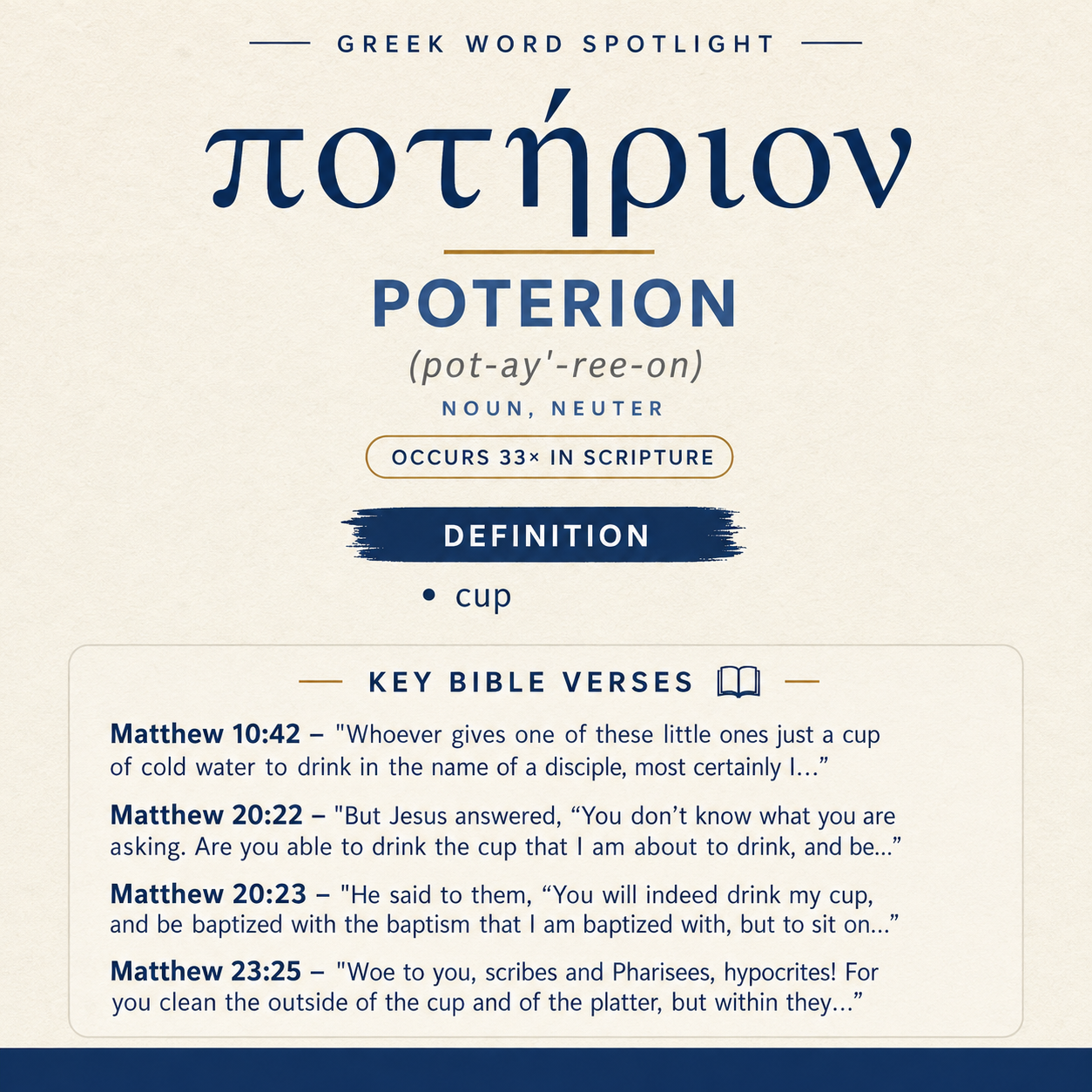
ποτήριον means “cup” in Greek and occurs 33 times in Scripture, including in Matthew 10, 20, 23, and 26.
Core Meaning
ποτήριον is defined as “cup.” In Matthew it appears in both everyday and figurative contexts.
Learn More →Matthew Examples
Matthew 10:42 mentions “a cup of cold water.” Matthew 26:27 records Jesus taking “the cup” and telling his disciples to drink it.
Learn More →Prayer and Cup
In Matthew 26:39 and 26:42 Jesus prays about “this cup” passing away, or being drunk if it cannot pass.
Learn More →The noun ποτήριον refers to a “cup,” appearing in sayings of Jesus about ordinary acts of giving, debates about ritual purity, and crucial moments where Jesus speaks of what he must “drink.” Across these passages the word can point to a literal drinking vessel, or it can be used in speech to concentrate attention on what is received or undergone.
Occurrences
Matthew 10:42 — “Whoever gives one of these little ones just a cup of cold water to drink in the name of a disciple, most certainly I tell you he will in no way lose his reward.”
Here ποτήριον anchors a small, concrete act: giving “a cup of cold water to drink.” The cup is the measured, personal form that the gift takes—something simple enough to be within reach of “whoever,” yet still meaningful when done “in the name of a disciple.” The scene depends on the cup as an everyday object that carries the water to the thirsty person, making the kindness tangible and specific.
Matthew 20:22 — “But Jesus answered, “You don’t know what you are asking. Are you able to drink the cup that I am about to drink, and be baptized with the baptism that I am baptized with?” They said to him, “We are able.”
In this exchange the cup is not placed in anyone’s hand; it is something to be “drunk,” and Jesus speaks of “the cup that I am about to drink.” The question uses the cup as a focused image for what lies ahead for Jesus—something he will undergo—and it functions as a test of understanding: the hearers say “We are able,” but Jesus frames their request as ignorance of what that “cup” entails.
Matthew 20:23 — “He said to them, “You will indeed drink my cup, and be baptized with the baptism that I am baptized with, but to sit on my right hand and on my left hand is not mine to give; but it is for whom it has been prepared by my Father.”
Now ποτήριον becomes possessive and shared: “my cup” is something others “will indeed drink.” The cup marks participation—an entered experience aligned with Jesus’ own—while the verse separates that participation from the granting of status (“to sit on my right hand and on my left hand”). The cup imagery keeps the focus on undergoing what Jesus undergoes rather than grasping for position.
Matthew 23:25 — ““Woe to you, scribes and Pharisees, hypocrites! For you clean the outside of the cup and of the platter, but within they are full of extortion and unrighteousness.”
Here the cup is firmly literal—an item that can be cleaned—yet it becomes the hinge of moral critique. The contrast between “outside” and “within” depends on the cup’s ordinary structure: a vessel with an exterior surface and an interior space. The cup enables the point that attention to visible cleanliness can coexist with an interior that is “full of extortion and unrighteousness.”
Matthew 23:26 — “You blind Pharisee, first clean the inside of the cup and of the platter, that its outside may become clean also.”
This continuation intensifies the same vessel imagery. The instruction “first clean the inside of the cup” uses the cup as a concrete model for order and priority: begin with what is inside, and the outside follows. The cup remains an everyday object, but it carries the logic of inward-to-outward integrity embedded in the command.
Matthew 26:27 — “He took the cup, gave thanks, and gave to them, saying, “All of you drink it,”
In this moment ποτήριον is a handled object within a shared meal: Jesus “took the cup,” “gave thanks,” and “gave to them.” The word stands at the center of a sequence of actions—taking, thanking, giving, drinking—so the cup is the visible, passable vessel that unites the participants in a common act (“All of you drink it”). The cup here is not merely present; it structures the communal movement of giving and receiving.
Matthew 26:39 — “He went forward a little, fell on his face, and prayed, saying, “My Father, if it is possible, let this cup pass away from me; nevertheless, not what I desire, but what you desire.”
Here the cup is spoken of as something that might “pass away” from Jesus, and the language places it within prayer and submission. The cup is no longer a vessel on a table but a looming reality that can be approached or removed. The verse pairs “this cup” with the surrender of will—“not what I desire, but what you desire”—so the cup concentrates the weight of what Jesus faces into a single, speakable object.
Matthew 26:42 — “Again, a second time he went away, and prayed, saying, “My Father, if this cup can’t pass away from me unless I drink it, your desire be done.”
The cup is now explicitly linked with drinking as the necessary path: it cannot “pass away” unless Jesus “drink it.” The repetition of prayer (“a second time”) and the conditional statement keep the cup imagery tight: the cup is what must be received, and drinking is the act of acceptance. The closing line, “your desire be done,” keeps the cup from becoming mere metaphorical drama; it remains an element within the lived obedience expressed in prayer.
Mark 7:4 — “They don’t eat when they come from the marketplace unless they bathe themselves, and there are many other things, which they have received to hold to: washings of cups, pitchers, bronze vessels, and couches.)”
In Mark 7 the cup appears among items subject to “washings.” The plural “cups” places ποτήριον in the world of household and dining practice, where vessels are cleaned as part of a broader pattern of ritualized behavior. The cup is one example in a list that moves from smaller containers (“cups, pitchers”) to larger and heavier items (“bronze vessels, and couches”), emphasizing how extensive the washings are.
Mark 7:8 — ““For you set aside the commandment of God, and hold tightly to the tradition of men—the washing of pitchers and cups, and you do many other such things.”
This verse uses “cups” again as a representative object within a disputed set of practices. The cup stands for what is meticulously handled—washed—as a “tradition of men,” and it becomes part of the contrast between what is “held tightly” and what is “set aside.” The point does not depend on the cup’s contents; it depends on the cup’s role as a familiar, repeatable object of attention that can become a marker of tradition.
Mark 9:41 — “For whoever will give you a cup of water to drink in my name, because you are Christ’s, most certainly I tell you, he will in no way lose his reward.”
This is the same concrete kindness as in Matthew 10:42, now directed to “you” and grounded in identity: “because you are Christ’s.” The cup is again a small unit of refreshment—“a cup of water to drink”—and its significance comes from the relational and confessional setting (“in my name”). The cup makes generosity measurable and ordinary, yet still weighty enough to be linked to a promised “reward.”
Mark 10:38 — “But Jesus said to them, “You don’t know what you are asking. Are you able to drink the cup that I drink, and to be baptized with the baptism that I am baptized with?””
As in Matthew 20:22, the cup is something Jesus drinks, and the question probes whether others can share it. Mark’s phrasing, “the cup that I drink,” keeps the imagery immediate and personal: the cup is tied directly to Jesus’ own act. The cup’s force lies in the challenge—whether the hearers’ ambition corresponds to their readiness to drink what Jesus drinks.

Sense and Usage
Across these occurrences ποτήριον consistently denotes a cup as the definable object in view, but its narrative and rhetorical functions vary. In the sayings about hospitality (Matthew 10:42; Mark 9:41), the cup is a modest vessel for water, turning kindness into a concrete, deliverable gift; its smallness helps highlight that the act is accessible, while still personally directed (“to drink,” “in my name”). In discussions of washing and purity customs (Mark 7:4, 7:8) and in Jesus’ critique of hypocrisy (Matthew 23:25–26), the cup belongs to the world of eating and cleaning; it is the kind of object people repeatedly handle, wash, and inspect. Because a cup has an inside and an outside, it naturally supports the contrast between external appearance and internal reality in Matthew 23.
In the passages where Jesus speaks of “drinking the cup” (Matthew 20:22–23; Mark 10:38; Matthew 26:39, 26:42), the cup remains a “cup” in the wording, but it functions as a concentrated image for what must be received. The repeated collocation with “drink” keeps the image anchored in the bodily act associated with a cup: taking in what is given. Possessive language (“my cup”) and demonstrative language (“this cup”) make the cup specific and particular, not generic. Within prayer (Matthew 26:39, 26:42), the cup is treated as something that can be approached in submission—spoken of in relation to desire and to the Father’s desire—so the cup imagery carries the weight of decision and obedience without ceasing to be framed as a cup to be drunk.
Imagery
These passages together show ποτήριον moving between the table and the heart. A cup can be handed to another person as cold water; it can be scrubbed and displayed as clean; it can be passed among disciples with a command to drink; and it can be named in solitary prayer as something that must be accepted. Because it is a vessel meant for drinking, the cup readily gathers themes of giving, receiving, and undergoing into one simple, concrete object.
Sources: Lexical data from Strong’s Exhaustive Concordance and the Translators Brief Lexicon of Extended Strongs for Greek (STEPBible, CC BY). Occurrence data from the Translators Amalgamated Greek New Testament (STEPBible, CC BY). Scripture quotations from the World English Bible (public domain).




