Exploring the Meaning of Plethuno in Greek
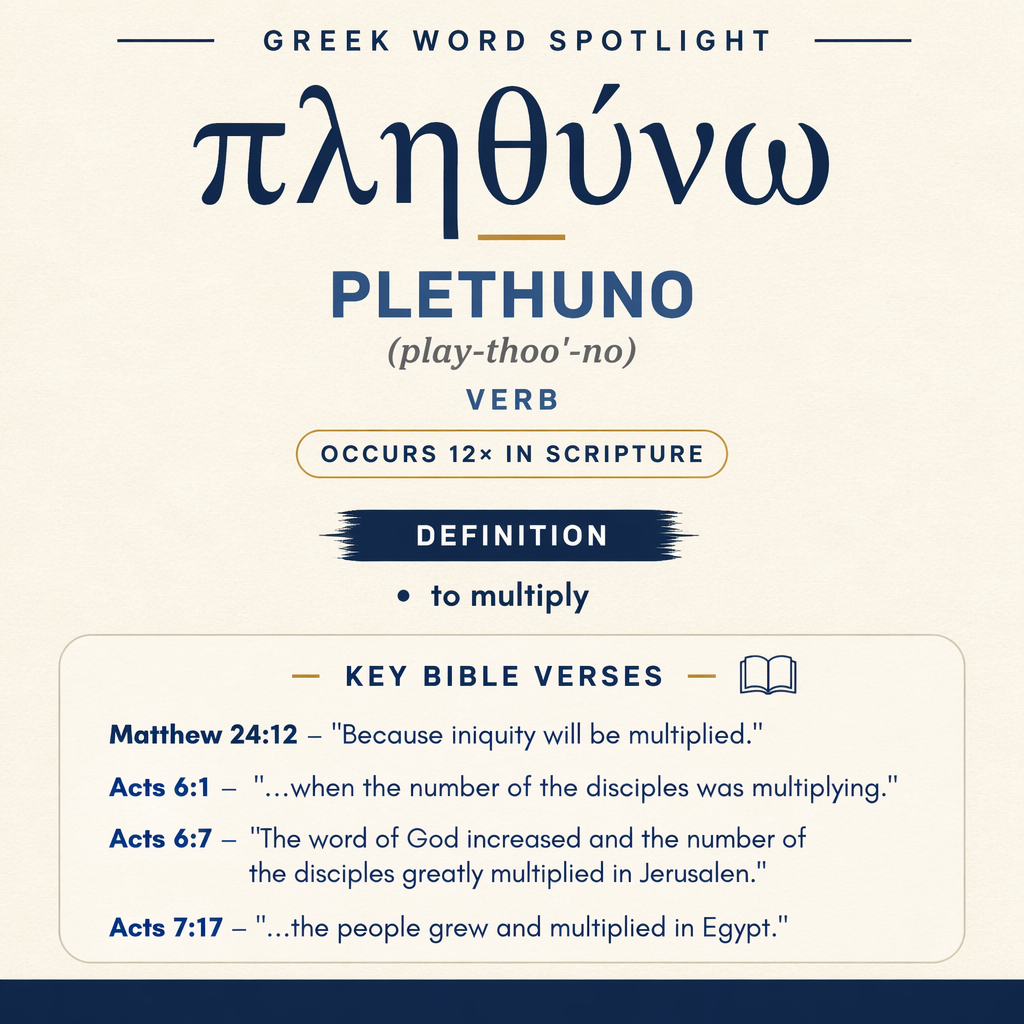
πληθύνω means “to multiply” and occurs 12 times in Scripture, including Matthew 24:12 and multiple passages in Acts, 2 Corinthians, and Hebrews.
Core Meaning
πληθύνω means “to multiply.” It describes increase in number or extent in the cited passages.
Learn More →Acts Emphasis
Acts uses πληθύνω for the multiplying of disciples (Acts 6:1; 6:7) and for God’s word growing and multiplying (Acts 12:24). It also describes people multiplying in Egypt (Acts 7:17).
Learn More →Other Occurrences
Matthew 24:12 uses it for iniquity being multiplied. It appears in 2 Corinthians 9:10 for multiplying seed and in Hebrews 6:14 in the promise, “multiplying I will multiply you.”
Learn More →πληθύνω expresses increase by multiplication. In the passages where it appears, it can describe the spread of wrongdoing, the growth of people and disciples, the advance of “the word of God,” and the enlarging of spiritual gifts and blessings addressed to believers.
Occurrences
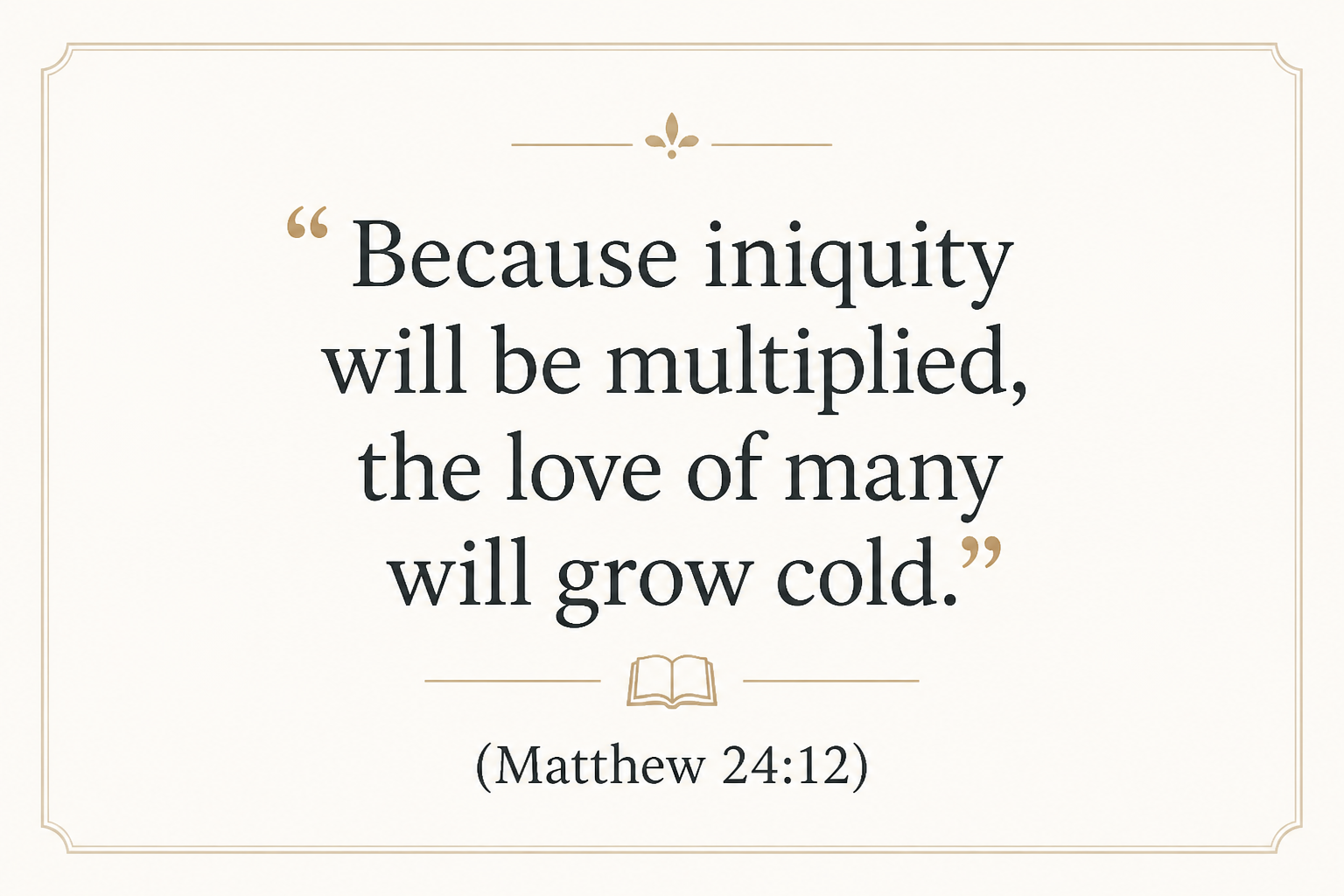
“Because iniquity will be multiplied, the love of many will grow cold.” (Matthew 24:12)
Here multiplication is attached to “iniquity.” The term frames lawlessness as something that does not merely persist but expands in scope, and the sentence links that expansion to a social and spiritual effect: “the love of many will grow cold.” Multiplication functions as the engine of the decline described; as iniquity increases, the relational climate deteriorates.
“Now in those days, when the number of the disciples was multiplying, a complaint arose from the Hellenists against the Hebrews, because their widows were neglected in the daily service.” (Acts 6:1)
Multiplication describes the rising “number of the disciples.” The growth is not presented as abstract success alone; it creates pressures within communal care—specifically, a perceived neglect “in the daily service.” The verb therefore marks a transition point where increase brings new administrative and pastoral challenges that must be addressed inside the community.
“The word of God increased and the number of the disciples greatly multiplied in Jerusalem. A great company of the priests were obedient to the faith.” (Acts 6:7)
This verse places multiplication alongside another growth statement: “The word of God increased.” The multiplication is “greatly” and is localized “in Jerusalem,” emphasizing notable expansion in a specific setting. The further note that “a great company of the priests were obedient to the faith” illustrates the kind of increase being described: multiplication is visible in the swelling ranks of adherents, including a surprising segment of society.
““But as the time of the promise came close which God had sworn to Abraham, the people grew and multiplied in Egypt,” (Acts 7:17)
Multiplication is applied to “the people” and coordinated with “grew,” portraying an enlarging population in Egypt. The setting is explicitly tied to a timeline—“as the time of the promise came close”—and to an oath “God had sworn to Abraham.” In this scene, multiplication signals a historical development: the people expand as events move toward a promised turning point.
“So the assemblies throughout all Judea, Galilee, and Samaria had peace, and were built up. They were multiplied, walking in the fear of the Lord and in the comfort of the Holy Spirit.” (Acts 9:31)
The subject is “the assemblies” spread across a wide geography. Multiplication is set within a cluster of community descriptors: “had peace,” “were built up,” and then “were multiplied.” The concluding phrases—“walking in the fear of the Lord and in the comfort of the Holy Spirit”—portray the manner in which this multiplication occurs, linking numerical or communal expansion with a lived posture of reverence and Spirit-given encouragement.
“But the word of God grew and multiplied.” (Acts 12:24)
Multiplication is attributed to “the word of God” itself. The brevity heightens the contrast between obstacles implied by the narrative flow in Acts and the unstoppable advance summarized here. “Grew and multiplied” depicts expansion both in strength and in reach; multiplication contributes the idea of widening effect, as the word’s influence extends beyond prior limits.
“Now may he who supplies seed to the sower and bread for food, supply and multiply your seed for sowing, and increase the fruits of your righteousness,” (2 Corinthians 9:10)
Multiplication occurs within agricultural and provision imagery. God “supplies seed” and “bread,” and Paul petitions that God would “multiply your seed for sowing.” The multiplication is not an endpoint; it serves further “sowing,” and it is paired with “increase the fruits of your righteousness.” The term thus supports a cycle: provision leads to multiplied capacity for generosity and results in growing outcomes characterized as “fruits.”
“saying, “Surely blessing I will bless you, and multiplying I will multiply you.”” (Hebrews 6:14)
The expression is formulated as a solemn assurance with emphatic repetition: “multiplying I will multiply you.” The parallelism with “blessing I will bless you” places multiplication within a promissory declaration. The doubled form underscores certainty and intensity; multiplication here is a pledged act, grounded in the speaker’s commitment.
“according to the foreknowledge of God the Father, in sanctification of the Spirit, that you may obey Jesus Christ and be sprinkled with his blood: Grace to you and peace be multiplied.” (1 Peter 1:2)
The closing wish, “Grace to you and peace be multiplied,” comes after a densely theological framing involving the Father’s foreknowledge, the Spirit’s sanctification, obedience to Jesus Christ, and being “sprinkled with his blood.” Within that setting, multiplication is not about headcount or material stock; it expresses an enlarging measure of “Grace” and “peace” for those addressed, matching the letter’s covenantal and communal tone.
“Grace to you and peace be multiplied in the knowledge of God and of Jesus our Lord,” (2 Peter 1:2)
As in 1 Peter, multiplication modifies “Grace” and “peace,” but here it is explicitly located: “in the knowledge of God and of Jesus our Lord.” Multiplication is connected to a relational-cognitive sphere—knowledge—so that increase is portrayed as accompanying (and, in the wording, occurring within) deepened understanding of God and of Jesus.
“Mercy to you and peace and love be multiplied.” (Jude 1:2)
Jude’s greeting expands the list: “Mercy… and peace and love.” Multiplication gathers these three together as blessings that can grow in the community addressed. The compact form presents multiplication as a comprehensive increase of communal well-being—compassion (“Mercy”), wholeness (“peace”), and relational commitment (“love”).

Sense and Usage
Across these passages, πληθύνω regularly marks an increase that is measurable in outcomes: the spread of “iniquity” (Matthew 24:12), the rising “number of the disciples” (Acts 6:1; Acts 6:7), the growth of “the people” in a defined location (Acts 7:17), and the expansion of “the assemblies” across multiple regions (Acts 9:31). The verb’s effect is to depict increase as dynamic and consequential—something that changes the conditions on the ground. In Acts 6:1, multiplication is the backdrop against which a complaint surfaces, showing that increase can expose weaknesses in practice; in Acts 9:31, multiplication belongs with “peace” and being “built up,” describing growth that accompanies stability and spiritual formation.
The verb is also applied to realities that are not persons or groups. In Acts 6:7 and Acts 12:24, the “word of God” is said to grow and multiply, language that treats proclamation and its impact as capable of widening reach. In the epistolary blessings (1 Peter 1:2; 2 Peter 1:2; Jude 1:2), multiplication is invoked for virtues and benefits—“Grace,” “peace,” “Mercy,” and “love”—so the same idea of increase is carried into the moral and pastoral sphere. These greetings do not picture a one-time grant but an ongoing enlargement of what the communities live within.
2 Corinthians 9:10 supplies a concrete mechanism for multiplication: seed becomes more seed “for sowing,” and the multiplication is paired with an “increase” of “fruits.” The imagery places multiplication within a cycle of giving and resulting righteousness, aligning the act of increase with purposeful output rather than accumulation. Hebrews 6:14, by its doubled wording, highlights multiplication as a strong, promissory action, presented alongside an equally emphatic blessing. Taken together, the occurrences show πληθύνω used for both positive and negative expansion—iniquity can multiply, but so can disciples, assemblies, the word’s influence, and covenantal gifts—each time emphasizing an intensifying, widening effect in the sphere named by the context.
Imagery
The passages give multiplication a range of images: a chilling social climate as “iniquity” spreads (Matthew 24:12), crowded growth that requires fair “daily service” (Acts 6:1), geographic widening across “Judea, Galilee, and Samaria” (Acts 9:31), and an agricultural cycle of “seed” and “fruits” (2 Corinthians 9:10). In greetings and promises, the same verb lends the language of increase to blessings—grace, peace, mercy, love—portraying them not as static possessions but as realities that can expand within a community’s life (1 Peter 1:2; 2 Peter 1:2; Jude 1:2; Hebrews 6:14).
Sources: Lexical data from Strong’s Exhaustive Concordance and the Translators Brief Lexicon of Extended Strongs for Greek (STEPBible, CC BY). Occurrence data from the Translators Amalgamated Greek New Testament (STEPBible, CC BY). Scripture quotations from the World English Bible (public domain).