
Exploring the Meaning of Plethos in Greek
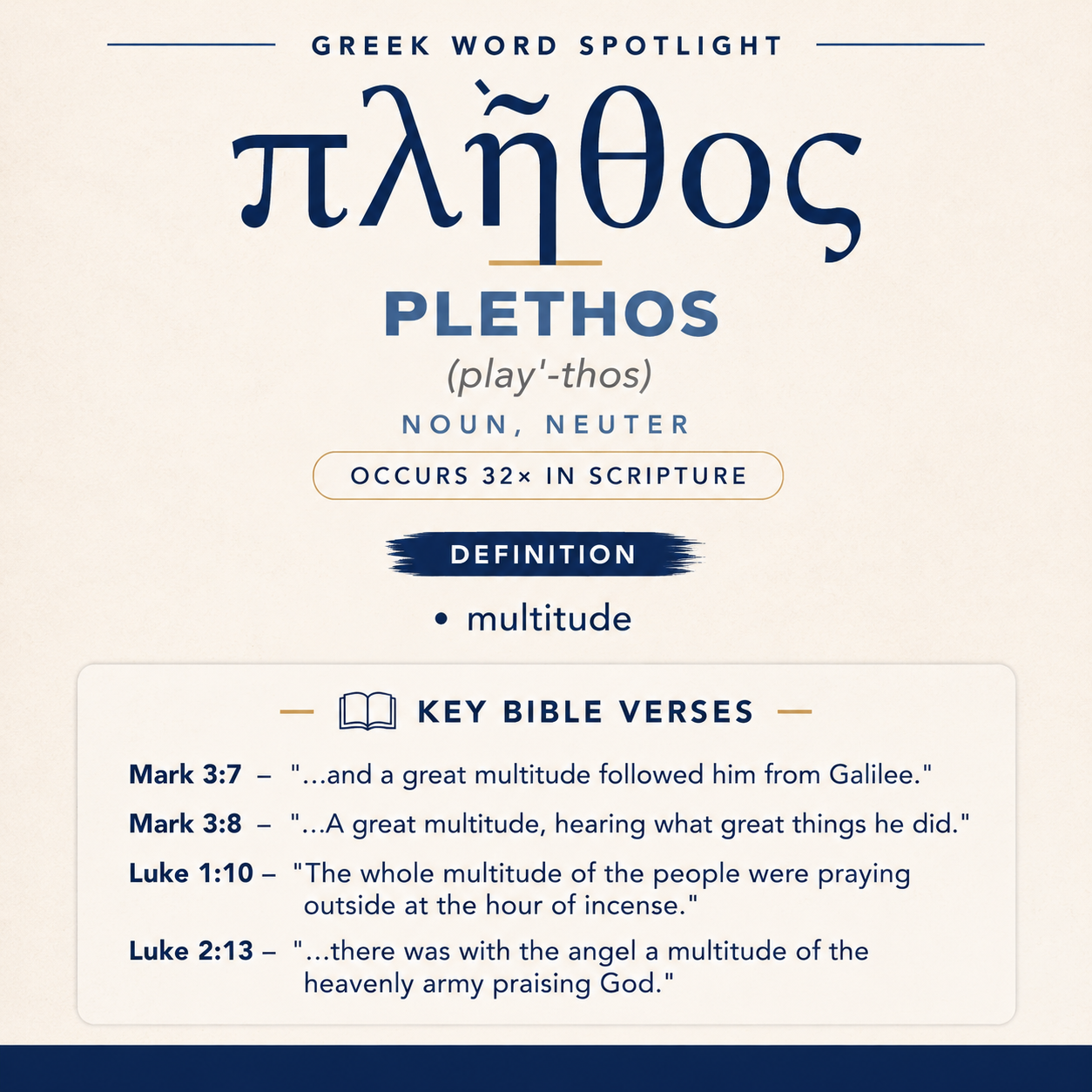
πλῆθος means “multitude” and appears 32 times in Scripture, including Mark 3:7–8 and Luke 1:10; 2:13; 5:6; 6:17; 8:37; 19:37.
Core Meaning
πλῆθος is defined as “multitude.” It refers to a large number or crowd in the listed passages.
Learn More →Gospel Crowds
In Mark 3:7–8, a great multitude follows Jesus from multiple regions. In Luke 6:17 and 19:37, it describes a large group of disciples and people.
Learn More →Notable Scenes
Luke 1:10 speaks of the whole multitude praying outside at the hour of incense. Luke 2:13 uses it for a multitude of the heavenly army praising God.
Learn More →πλῆθος names a “multitude,” highlighting sheer number as a defining feature of whatever group is in view. In the passages where it appears, it can gather crowds of people, an assembly in worship, an army of heaven, and even an overwhelming catch of fish.
Occurrences
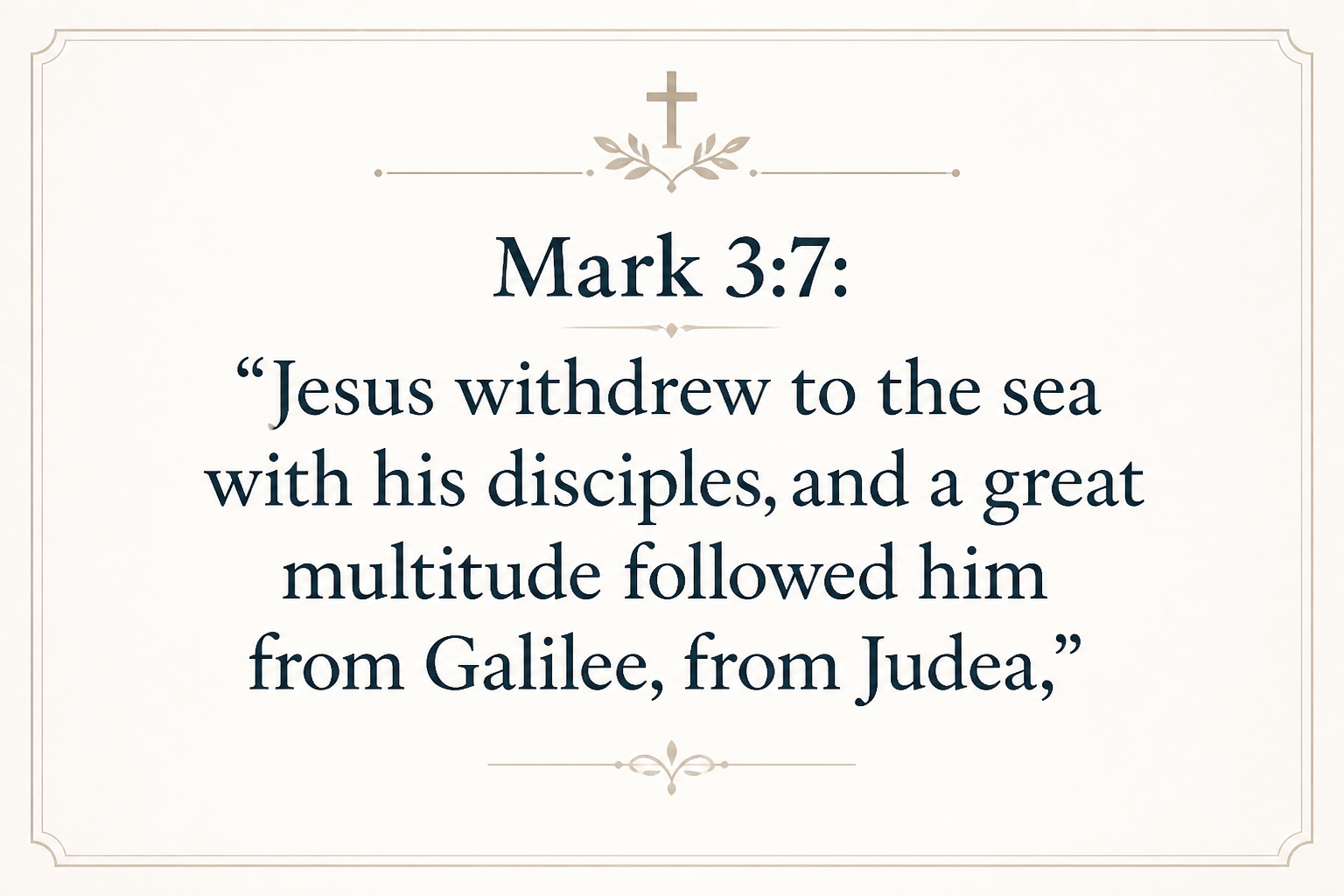
Mark 3:7: “Jesus withdrew to the sea with his disciples, and a great multitude followed him from Galilee, from Judea,”
Here πλῆθος frames Jesus’ movement toward the sea as prompting a large-scale response: people “followed him.” The phrase “a great multitude” does more than say that some came; it sets the scene as one where Jesus and his disciples are accompanied by numbers big enough to define the moment and the location.
Mark 3:8: “from Jerusalem, from Idumaea, beyond the Jordan, and those from around Tyre and Sidon. A great multitude, hearing what great things he did, came to him.”
πλῆθος is tied to a broad geographic spread—multiple regions are named, then the “great multitude” is described as responding to what they had “hearing what great things he did.” In this scene, the multitude is not random foot traffic; it is a mass drawn by report and expectation, converging upon Jesus (“came to him”).
Luke 1:10: “The whole multitude of the people were praying outside at the hour of incense.”
πλῆθος gathers worshipers into a single, unified group: “the whole multitude of the people.” The multitude is characterized by a shared action (“were praying”) and a shared setting (“outside”), coordinated with a specific time (“the hour of incense”), so that the word underscores the corporate scale of the prayer.
Luke 2:13: “Suddenly, there was with the angel a multitude of the heavenly army praising God, and saying,”
In this sudden appearance, πλῆθος marks the angel’s accompaniment as numerous—an entire “multitude of the heavenly army.” The multitude is defined by its function: it is “praising God,” and it is ready to speak (“and saying”), so the word heightens the sense of an expansive, organized chorus.
Luke 5:6: “When they had done this, they caught a great multitude of fish, and their net was breaking.”
πλῆθος shifts from people to fish, applying “multitude” to a catch so large it creates physical strain: “their net was breaking.” The word draws attention to quantity as the direct cause of the net’s failure, making the scene vivid by linking number with tangible consequence.
Luke 6:17: “He came down with them, and stood on a level place, with a crowd of his disciples, and a great number of the people from all Judea and Jerusalem, and the sea coast of Tyre and Sidon, who came to hear him and to be healed of their diseases;”
πλῆθος helps stack the scene with layers of people: disciples are present, and alongside them is “a great number of the people” from multiple areas. The multitude is identified by purpose—“who came to hear him and to be healed”—so the word supports a picture of widespread need and widespread attention focused on Jesus’ teaching and healing.
Luke 8:37: “All the people of the surrounding country of the Gadarenes asked him to depart from them, for they were very much afraid. Then he entered into the boat and returned.”
πλῆθος is expressed here as “All the people,” portraying a collective response rather than scattered reactions. The multitude is unified in its request (“asked him to depart from them”) and in its motive (“for they were very much afraid”), and that mass fear becomes the narrative pressure leading to Jesus’ departure by boat.
Luke 19:37: “As he was now getting near, at the descent of the Mount of Olives, the whole multitude of the disciples began to rejoice and praise God with a loud voice for all the mighty works which they had seen,”
Here πλῆθος narrows from “people” generally to “the disciples,” but still emphasizes the scale: “the whole multitude of the disciples.” Their united, audible response—“rejoice and praise God with a loud voice”—shows πλῆθος functioning to depict a large body acting as one, driven by shared memory (“for all the mighty works which they had seen”).
Luke 23:1: “The whole company of them rose up and brought him before Pilate.”
πλῆθος appears as “The whole company,” stressing that the action against Jesus is not the work of a few individuals acting quietly. The multitude rises together and acts together (“rose up and brought him”), so the word lends weight to the procedural momentum of the group’s unified movement toward Pilate.
Luke 23:27: “A great multitude of the people followed him, including women who also mourned and lamented him.”
πλῆθος again characterizes the scene along the way to the crucifixion as one dominated by numbers: “A great multitude of the people followed him.” Within that large crowd, Luke highlights a subset (“including women”) whose response is grief expressed in public sound and gesture (“mourned and lamented him”), so the multitude becomes the backdrop for visible, collective lament.
John 5:3: “In these lay a great multitude of those who were sick, blind, lame, or paralyzed, waiting for the moving of the water;”
Here πλῆθος frames the poolside setting as crowded with suffering: “a great multitude of those who were sick, blind, lame, or paralyzed.” The multitude is described not merely by number but by condition, and their shared posture and expectation (“lay… waiting”) create an image of concentrated need gathered into one place.
John 21:6: “He said to them, “Cast the net on the right side of the boat, and you will find some.” They cast it therefore, and now they weren’t able to draw it in for the multitude of fish.”
πλῆθος again modifies “fish,” focusing on the overwhelming quantity as the reason for the fishermen’s inability: “they weren’t able to draw it in.” The word functions as an explanation within the narrative—what prevents them is not weather or distance but the sheer multitude in the net.

Sense and Usage
Across these passages, πλῆθος consistently spotlights number as the main descriptive feature. It can describe moving crowds that “followed” or “came” (Mark 3:7–8; Luke 23:27), gathered worshipers praying at a set hour (Luke 1:10), disciples erupting into loud praise (Luke 19:37), and a collective body acting in a decisive, coordinated way (“rose up and brought him before Pilate,” Luke 23:1). In each of these, the word does not simply add color; it interprets the situation by making quantity narratively significant—large enough to intensify attention, amplify sound, and turn private sentiment into public event.
πλῆθος also extends naturally beyond human crowds to other domains where “multitude” is experienced as abundance. In Luke 5:6 and John 21:6 the multitude of fish becomes measurable by its effect: nets strain, and people cannot haul the catch. In Luke 2:13, the multitude belongs to “the heavenly army,” making the scale of praise itself part of the revelation: the suddenness is matched by the size of the company that appears and speaks. Even when the scene is dominated by fear (Luke 8:37), πλῆθος gathers the reaction into a communal force; fear is not isolated but shared, and the request that Jesus depart has the weight of a whole region’s people.
These uses show πλῆθος operating in several recurring patterns. It can be paired with language of totality (“whole multitude,” “whole company,” “all the people”), presenting a group as comprehensive and unanimous in visible action (Luke 1:10; Luke 8:37; Luke 19:37; Luke 23:1). It can also be intensified by modifiers such as “great,” where magnitude is the point (Mark 3:7–8; Luke 5:6; Luke 23:27; John 5:3). And it regularly appears in settings where the multitude is oriented toward a single center: Jesus as the one followed, heard, or brought to authorities; God as the one praised; the water as the object of waiting; the fish as the object filling nets. In this way, the word often helps the reader feel the press of numbers around a focal action or focal person.
Imagery
πλῆθος carries a strong visual and auditory presence in these texts: crowds forming by the sea from many regions (Mark 3:7–8), a praying assembly outside during incense (Luke 1:10), disciples praising “with a loud voice” on a descent from the Mount of Olives (Luke 19:37), and a large poolside gathering lying and waiting (John 5:3). When applied to fish (Luke 5:6; John 21:6), the imagery becomes tactile—weight, strain, and difficulty hauling a net—so that “multitude” is felt in the body as well as seen in the scene.
Sources: Lexical data from Strong’s Exhaustive Concordance and the Translators Brief Lexicon of Extended Strongs for Greek (STEPBible, CC BY). Occurrence data from the Translators Amalgamated Greek New Testament (STEPBible, CC BY). Scripture quotations from the World English Bible (public domain).




