
Exploring the Meaning of Pletho in Greek
πλήθω, πίμπλημι (Pletho) means “to fill” and occurs 24 times in Scripture, including Matthew 22:10, Matthew 27:48, and Luke 1–2.
Gospel Occurrences
It appears in Matthew 22:10 and Matthew 27:48, and repeatedly in Luke 1–2 (e.g., Luke 1:15, 1:41, 1:67).
Learn More →Filled or Fulfilled
In Luke 1 it is used for being “filled with the Holy Spirit” (Luke 1:41; 1:67). It is also used of something being “fulfilled” (Luke 1:23; 1:57).
Learn More →πλήθω / πίμπλημι expresses the act of filling, whether a space is crowded with people, a vessel is packed with liquid, or a person is filled with a powerful inner condition. In the cited passages it appears in scenes that range from a wedding hall to a synagogue, and from boats on the water to prophetic speech shaped by the Holy Spirit.

Occurrences
“Those servants went out into the highways, and gathered together as many as they found, both bad and good. The wedding was filled with guests.” (Matthew 22:10)
Here the verb marks the visible result of the servants’ gathering: the wedding setting becomes fully occupied. The story moves from invitation to completion—what was prepared for a wedding is no longer waiting; it has been filled with the guests brought in from the highways. The filling is social and spatial: a place intended for a celebration is made complete by the presence of “as many as they found.”

“Immediately one of them ran, and took a sponge, and filled it with vinegar, and put it on a reed, and gave him a drink.” (Matthew 27:48)
In this action sequence, filling is a deliberate step between taking the sponge and offering it. The sponge is made ready for use by being filled with vinegar; the verb highlights preparation by saturation so the sponge can serve as a means of giving a drink. The filling is concrete and tactile: an absorbent object is packed with liquid to carry it to someone else.
“For he will be great in the sight of the Lord, and he will drink no wine nor strong drink. He will be filled with the Holy Spirit, even from his mother’s womb.” (Luke 1:15)
The filling here is personal and inward, tied to vocation and identity. The statement links a life set apart (“he will drink no wine nor strong drink”) with being filled with the Holy Spirit, and it pushes the beginning of that filling back to the earliest possible point named in the verse (“from his mother’s womb”). The verb frames the Holy Spirit’s presence not as a brief touch but as an interior fullness associated with the whole course of his life.
“When the days of his service were fulfilled, he departed to his house.” (Luke 1:23)
In this sentence the verb describes time reaching its full measure. The days of service come to completion—filled out to their intended extent—and the completion triggers the next action: departure to his house. Filling is thus used for an allotted period being brought to its full end rather than for material content.
“When Elizabeth heard Mary’s greeting, the baby leaped in her womb; and Elizabeth was filled with the Holy Spirit.” (Luke 1:41)
The verse joins an external stimulus (hearing Mary’s greeting) with two immediate responses: the baby’s movement and Elizabeth’s being filled. The verb presents the Holy Spirit as an inward fullness that accompanies and explains her responsive moment. It also prepares for speech and recognition in the broader scene by depicting her inner state as abundantly occupied by the Spirit at the very moment of encounter.
“Now the time that Elizabeth should give birth was fulfilled, and she gave birth to a son.” (Luke 1:57)
Again the verb is applied to time, not a container. The “time” reaches its completion, and the narrative consequence follows right away: birth. The filling here is the finishing of a set period, emphasizing that the event occurs not randomly but at the moment when the expected span has been brought fully to term.
“His father Zacharias was filled with the Holy Spirit, and prophesied, saying,” (Luke 1:67)
Filling is directly linked to prophetic speech. The verse presents a sequence: Zacharias is filled with the Holy Spirit, and as a result he speaks in prophecy. The verb supplies the interior condition that stands behind the audible outcome; prophecy is portrayed as emerging from a person who has been filled, not merely inspired at the surface.
“While they were there, the day had come for her to give birth.” (Luke 2:6)
This clause uses the verb to state that the decisive day arrived in full. The sense is not simply that a date appeared on a calendar, but that the time reached its completed point—the day came to its intended arrival, and the birth is the contextual implication. Filling functions as the completion of a timeline.
“When eight days were fulfilled for the circumcision of the child, his name was called Jesus, which was given by the angel before he was conceived in the womb.” (Luke 2:21)
The verb again frames a period as fully completed: “eight days” reach their full count, and then the covenantal and communal act takes place—circumcision and naming. Filling emphasizes orderly fulfillment of an established period before the next step occurs. It gives the scene a measured rhythm: time is filled out, then action proceeds.
“When the days of their purification according to the law of Moses were fulfilled, they brought him up to Jerusalem, to present him to the Lord” (Luke 2:22)
Here the days associated with purification are treated as a span that must be completed. Once those days are fulfilled—filled to their full extent—the family undertakes travel and presentation in Jerusalem. The verb serves to connect observance (“according to the law of Moses”) with a completed timeframe that authorizes and prompts the next narrated movement.
“They were all filled with wrath in the synagogue, as they heard these things.” (Luke 4:28)
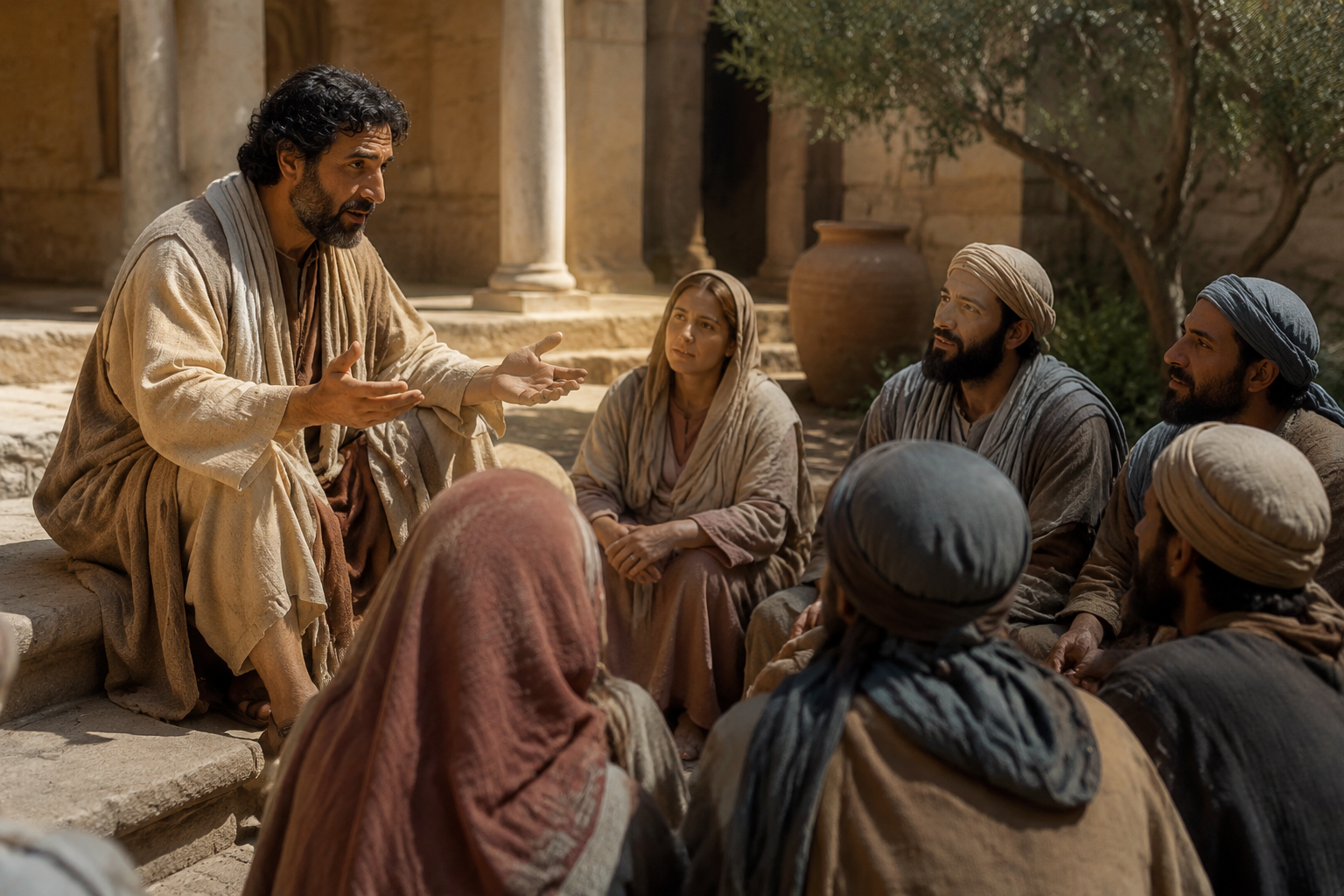
The filling is emotional and communal: “they were all filled with wrath.” The verb depicts wrath not as a mild irritation but as something that occupies them thoroughly, and it is triggered by hearing (“as they heard these things”). The synagogue setting underscores that this is a collective response in a public space; the verb captures the intensity and pervasiveness of the reaction across the group.
“They beckoned to their partners in the other boat, that they should come and help them. They came, and filled both boats, so that they began to sink.” (Luke 5:7)
Filling here is physical, measurable, and consequential. The catch is so abundant that it fills not one but “both boats,” and the result is immediate danger: “they began to sink.” The verb highlights the transition from success to overload; the boats’ capacity is surpassed because they are filled to a point that threatens their buoyancy.
Sense and Usage
Across these passages, “to fill” operates along three main lines of usage: filling a place, filling an object, and filling a person or a period. Matthew 22:10 presents filling as occupancy: the wedding setting becomes filled with guests, turning an invitation into a realized gathering. Matthew 27:48 uses filling for a practical act of making an object serve its purpose; the sponge must be filled in order to carry vinegar to someone else. Luke 5:7 again keeps the sense concrete and spatial—boats are filled with what they have taken in—yet the narrative stresses that filling can reach a threshold where fullness becomes peril.
Luke’s infancy narratives repeatedly apply the verb to time. In Luke 1:23, 1:57, 2:6, 2:21, and 2:22, “days” or “time” are fulfilled: the span is filled up to its completion, and the storyline advances because the period has reached its full measure. This usage lends a sense of ordered progression: service has its completed term, pregnancy comes to its completion, and prescribed days connected with rites reach their end before the family’s next act.
Luke also uses “to fill” for an inner state that occupies a person powerfully. In Luke 1:15, 1:41, and 1:67 the Holy Spirit is the content with which a person is filled; the verb portrays an interior fullness closely tied to speech and recognition—Elizabeth’s response to Mary’s greeting and Zacharias’s prophecy. Luke 4:28 provides a sharp contrast in content while keeping the same core notion of filling: a crowd is filled with wrath. In both kinds of scenes, the verb depicts what dominates the inner life and, by extension, shapes outward action—whether prophetic words or hostile reaction.
Imagery
The passages portray filling as completion, saturation, and overload. A hall is filled with guests until it is ready for celebration (Matthew 22:10), a sponge is filled so it can convey liquid (Matthew 27:48), and boats are filled until they verge on sinking (Luke 5:7). In the more inward scenes, filling is the language for what comes to dominate people from within: the Holy Spirit filling individuals in moments that lead into speech (Luke 1:41; Luke 1:67), and wrath filling a whole synagogue as they hear a provocative message (Luke 4:28). Even when the object is time, the picture is consistent: a span is filled out to its full end, and the next act follows when that fullness has been reached (Luke 2:21–22).
Sources: Lexical data from Strong’s Exhaustive Concordance and the Translators Brief Lexicon of Extended Strongs for Greek (STEPBible, CC BY). Occurrence data from the Translators Amalgamated Greek New Testament (STEPBible, CC BY). Scripture quotations from the World English Bible (public domain).




