Exploring the Meaning of Pleonazo Greek
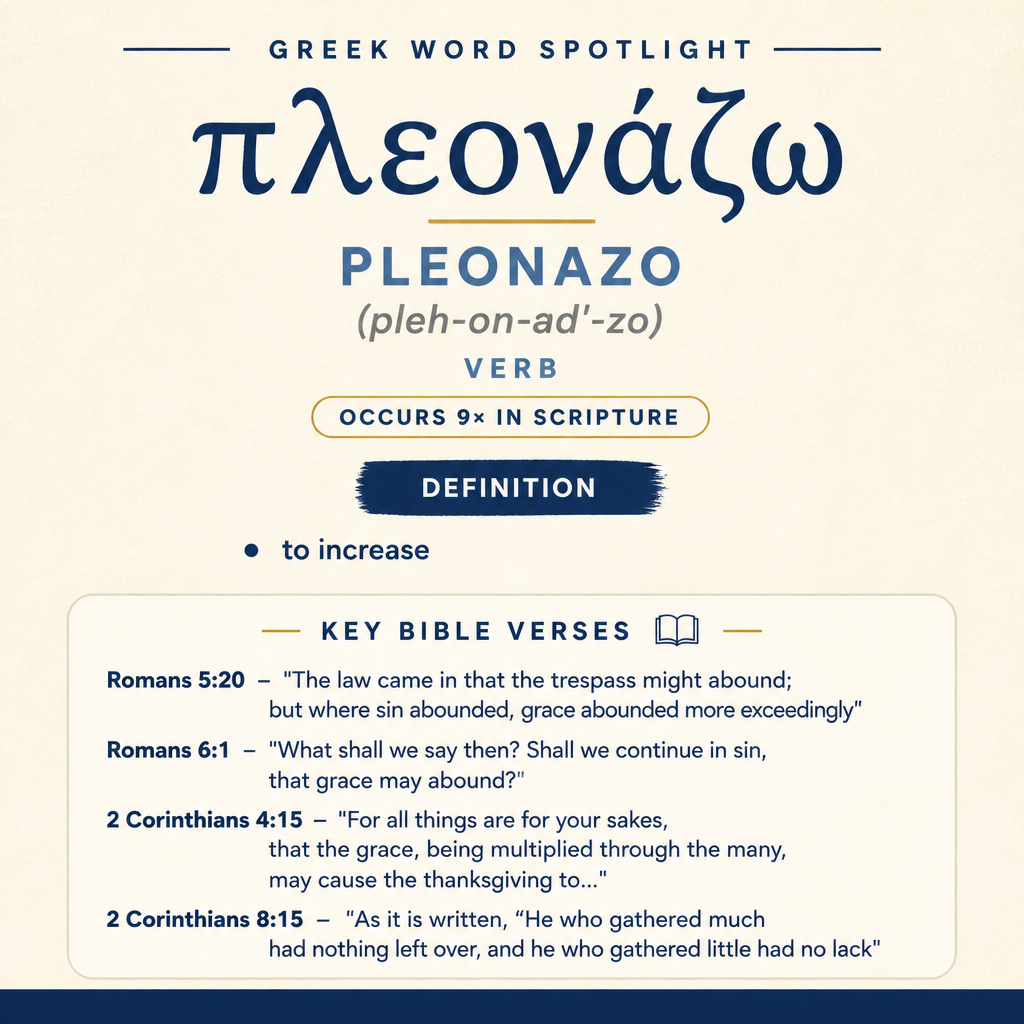
πλεονάζω (Pleonazo) means “to increase” and appears 9 times in Scripture, including Romans, Corinthians, Philippians, Thessalonians, and 2 Peter.
Core Meaning
πλεονάζω means “to increase.” It is used for growth and abounding in multiple contexts across the New Testament.
Learn More →Romans Context
In Romans 5:20, sin “abounded” and grace “abounded more exceedingly.” Romans 6:1 asks whether continuing in sin would make grace abound.
Learn More →Growth & Abounding
The word is used of grace being multiplied (2 Corinthians 4:15) and fruit increasing to an account (Philippians 4:17). It also describes love increasing (1 Thessalonians 3:12) and faith growing exceedingly (2 Thessalonians 1:3).
Learn More →πλεονάζω expresses the idea of increase, and in the New Testament it is repeatedly used to describe something becoming more extensive or more present within a situation. In the passages where it appears, the verb is applied to sin, grace, thanksgiving, “fruit,” love, faith, and the qualities that prevent spiritual unfruitfulness.
Occurrences
Romans 5:20 — “The law came in that the trespass might abound; but where sin abounded, grace abounded more exceedingly;”
Here πλεονάζω frames a contrast of two increases: first “the trespass” is pictured as becoming more, and then “sin” as having abounded. Against that expansion, the verse sets grace as not merely keeping pace but exceeding: “grace abounded more exceedingly.” The verb therefore helps describe a moral and theological landscape in which one reality spreads, only to be surpassed by another within the same field of comparison.

Romans 6:1 — “What shall we say then? Shall we continue in sin, that grace may abound?”
πλεονάζω appears in a question that turns the previous contrast into an ethical challenge. The issue is whether “continue in sin” could be treated as a means to an end—so that grace might increase. In this setting, the verb does not merely describe increase as a neutral fact; it is placed inside a proposed strategy, which the question itself presents as something needing an answer rather than an assumption.
2 Corinthians 4:15 — “For all things are for your sakes, that the grace, being multiplied through the many, may cause the thanksgiving to abound to the glory of God.”
In this verse, the verb is tied to a chain of effects: grace is “multiplied through the many,” and the result is that “the thanksgiving” increases “to the glory of God.” πλεονάζω thus helps describe not an inward change alone but a communal outcome—something grows in a way that can be seen as it spreads through “the many” and expresses itself as more thanksgiving.
2 Corinthians 8:15 — “As it is written, “He who gathered much had nothing left over, and he who gathered little had no lack.””
This citation about gathering “much” and “little” sets a scene of measured provision: abundance is present (“gathered much”), yet it does not become “left over,” and scarcity is prevented (“no lack”). In that context, πλεονάζω contributes to the broader argument by keeping attention on quantities and their outcomes—how “more” and “less” are handled so that neither excess nor deficiency defines the community’s experience.
Philippians 4:17 — “Not that I seek for the gift, but I seek for the fruit that increases to your account.”
Here πλεονάζω is used for “the fruit” that increases, and the increase is directed: it accrues “to your account.” The verb therefore portrays growth as something credited or reckoned in a relational economy between giver and receiver. Paul distinguishes between desiring “the gift” and desiring what grows as a result of giving, so πλεονάζω names the expanding result rather than the immediate transaction.
1 Thessalonians 3:12 — “May the Lord make you to increase and abound in love toward one another, and toward all men, even as we also do toward you,”
πλεονάζω is invoked as something the Lord brings about: “make you to increase.” The sphere of increase is explicitly “love,” and it is not confined to one direction; it is “toward one another, and toward all men.” The wording links internal community life (“one another”) with a wider horizon (“all men”), so the verb helps depict love as something meant to widen and deepen across relationships rather than remain fixed.
2 Thessalonians 1:3 — “We are bound to always give thanks to God for you, brothers, even as it is appropriate, because your faith grows exceedingly, and the love of each and every one of you toward one another abounds,”
In this thanksgiving, πλεονάζω describes love as abounding, set alongside faith that “grows exceedingly.” The verb therefore participates in a portrait of visible spiritual development that warrants gratitude: not only does faith grow, but love becomes more in a way that can be attributed to “each and every one of you toward one another.” The phrasing emphasizes both the corporate reality (“you, brothers”) and the individual participation (“each and every one”).
2 Peter 1:8 — “For if these things are yours and abound, they make you to not be idle or unfruitful in the knowledge of our Lord Jesus Christ.”
Here πλεονάζω is attached to “these things” (qualities referenced by the immediate context of the sentence) and describes them as present and increasing: “are yours and abound.” The increase is practical in effect: when these things abound, they prevent a certain outcome—being “idle or unfruitful”—within “the knowledge of our Lord Jesus Christ.” πλεονάζω therefore functions as a threshold concept: having the qualities is one thing, but their abounding is linked with productivity and fruitfulness.

Sense and Usage
Across these passages, πλεονάζω consistently portrays increase as a dynamic movement within a defined sphere—moral, communal, or practical. In Romans 5:20–6:1 the verb is set within a moral contrast and an ensuing question: sin is described as increasing, grace is described as increasing beyond it, and then the possibility of trying to promote grace’s increase by continuing in sin is raised as a live issue. The verb’s force here lies in its ability to depict expansion and then to expose how talk of expansion can be misused as rationale.
In 2 Corinthians 4:15, increase is outward-facing and doxological: grace, spread “through the many,” yields a corresponding spread of thanksgiving “to the glory of God.” Increase is not merely accumulation; it is multiplication with a communicable result. In 2 Corinthians 8:15, the concern is the social shape of “much” and “little.” The cited line stands as a check on how increase functions in a community: abundance does not necessarily mean surplus “left over,” and scarcity does not necessarily mean “lack.” Even when the verb is not foregrounded in the quotation’s wording, the scene is governed by the same quantitative logic that πλεονάζω expresses elsewhere.
Philippians 4:17 applies the idea of increase to “fruit” that accrues “to your account,” aligning growth with the lasting effect of generosity rather than the immediate reception of a gift. 1 Thessalonians 3:12 and 2 Thessalonians 1:3 apply increase to love in relational terms. The increase is directional (“toward one another” and beyond), and it is observable enough to be prayed for and thanked for. In 2 Peter 1:8, increase is tied to capability: abounding qualities make a person not “idle or unfruitful,” so the verb carries a strongly practical sense—growth that changes outcomes.
Imagery in Context
The passages collectively picture increase as something that can spread through a group (“through the many”), accrue like credit (“to your account”), and overflow in relational life (“love…abounds”). They also picture increase as a contested domain: sin can increase, grace can increase beyond it, and the prospect of manipulating that relationship is raised as a question. In each setting, πλεονάζω helps the reader see not only that something is present, but that it is becoming more—and that this becoming-more carries consequences in conduct, community life, and fruitfulness.
Sources: Lexical data from Strong’s Exhaustive Concordance and the Translators Brief Lexicon of Extended Strongs for Greek (STEPBible, CC BY). Occurrence data from the Translators Amalgamated Greek New Testament (STEPBible, CC BY). Scripture quotations from the World English Bible (public domain).