Exploring the Meaning of Phlox in Greek
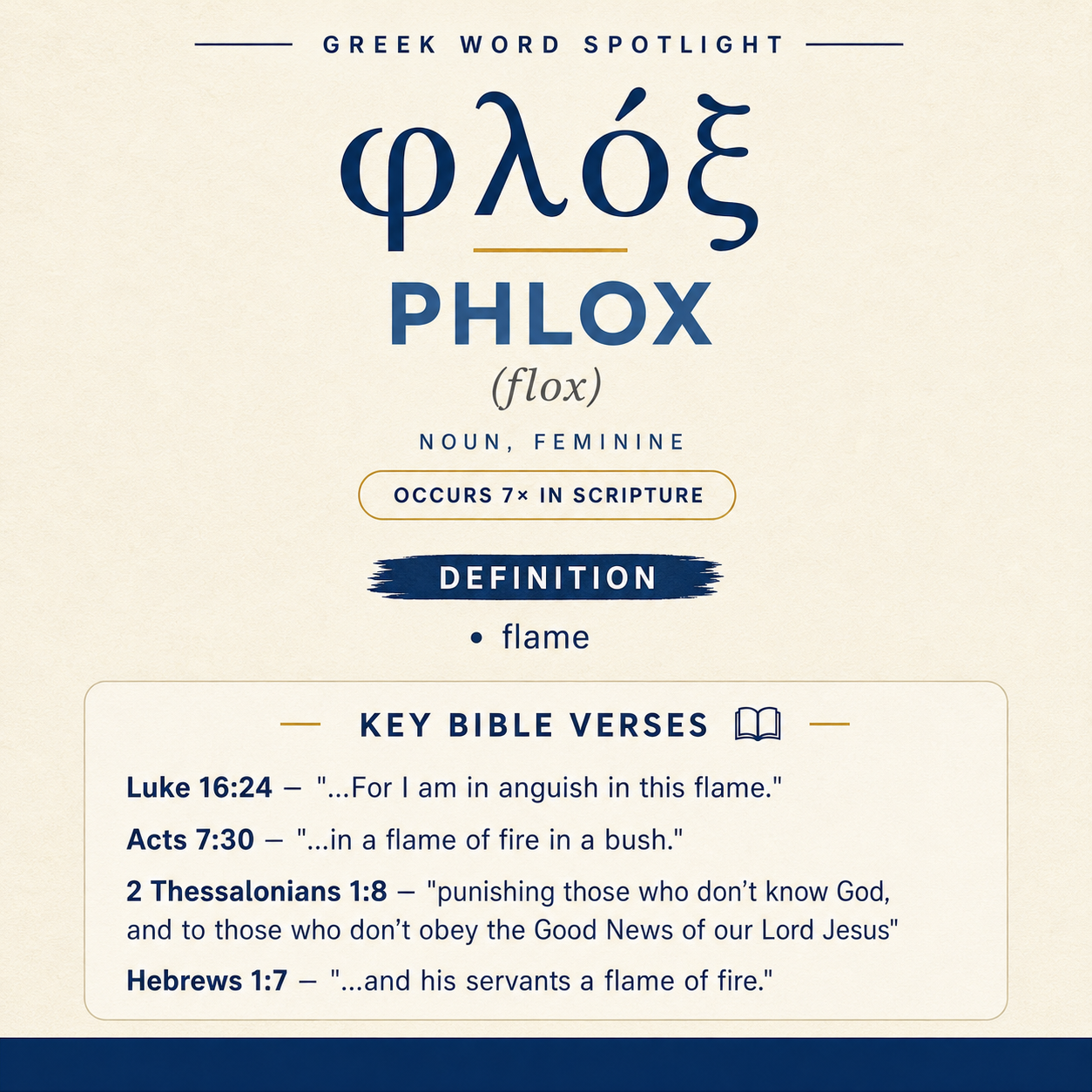
φλόξ means “flame” in Greek and appears 7 times in Scripture, including Luke 16:24, Acts 7:30, Hebrews 1:7, and Revelation.
Where It Appears
It occurs in Luke 16:24 and Acts 7:30, including “a flame of fire.” It also appears in Hebrews 1:7 and multiple places in Revelation.
Learn More →Notable Phrases
Hebrews 1:7 speaks of “his servants a flame of fire.” Revelation describes eyes “like a flame of fire” (Revelation 1:14; 2:18; 19:12).
Learn More →φλόξ means “flame,” a concrete image used for physical fire, for fiery appearance, and for the vivid language of judgment. In the passages where it appears, the term moves from bodily torment to theophanic fire and then to the piercing, fire-like description of the exalted Son of God.
Occurrences
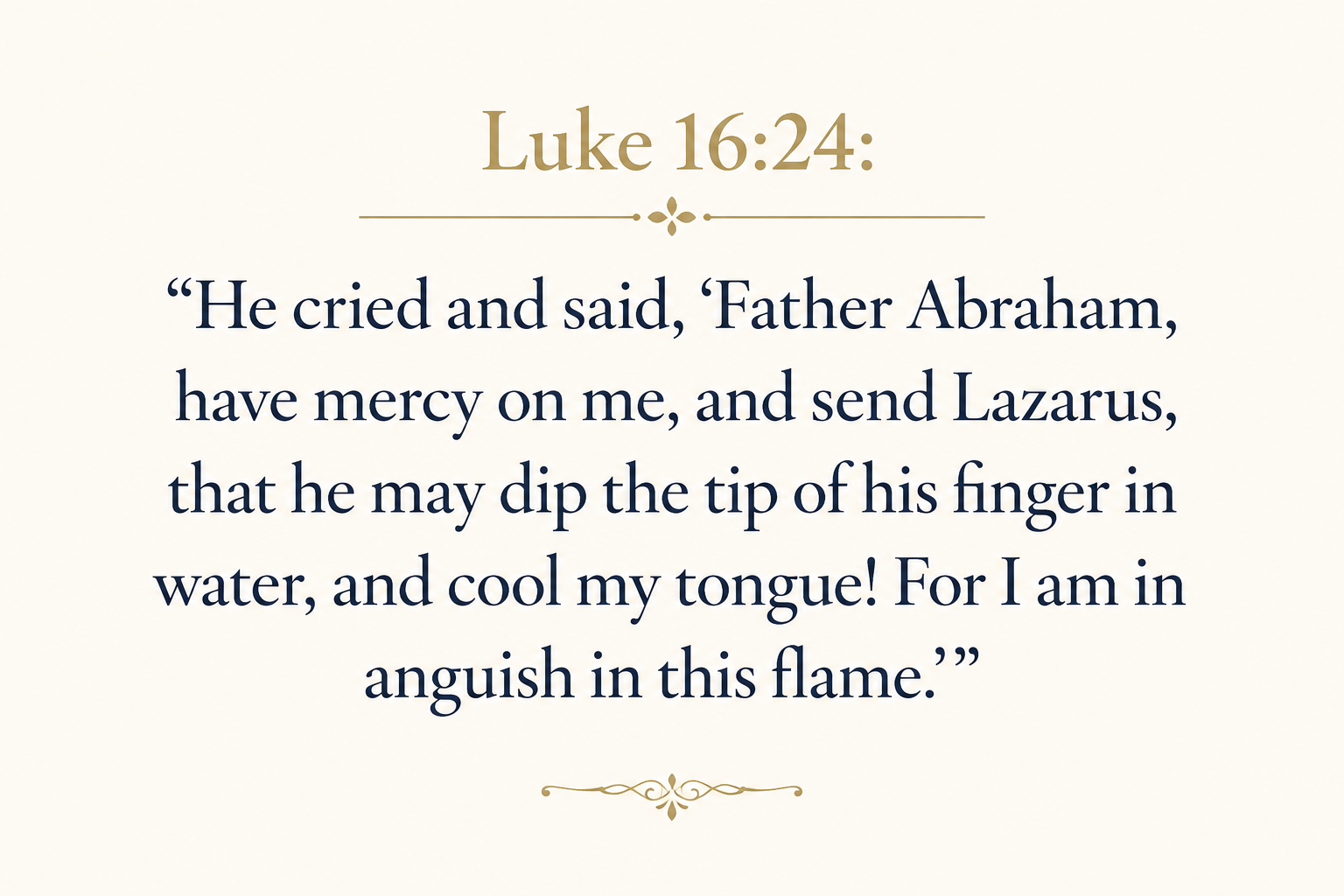
Luke 16:24: “He cried and said, ‘Father Abraham, have mercy on me, and send Lazarus, that he may dip the tip of his finger in water, and cool my tongue! For I am in anguish in this flame.’”
Here φλόξ names the immediate, felt environment of suffering: “anguish in this flame.” The request for a drop of water to “cool my tongue” sets the flame in sharp bodily terms—heat that burns, dries, and torments. The word functions as the tangible agent of distress: the speaker does not merely feel pain; he is located “in this flame,” enclosed by it, with no relief except what he begs for and does not possess.
Acts 7:30: ““When forty years were fulfilled, an angel of the Lord appeared to him in the wilderness of Mount Sinai, in a flame of fire in a bush.”
In Stephen’s retelling, φλόξ describes how the angel’s appearance is mediated: “in a flame of fire in a bush.” The phrase binds flame to a specific setting (“in a bush”) and to a specific event (“appeared to him”), so φλόξ becomes the visible form accompanying revelation. The flame is not presented as accidental fire but as the marked, attention-commanding feature of the encounter in “the wilderness of Mount Sinai.”
2 Thessalonians 1:8: “punishing those who don’t know God, and to those who don’t obey the Good News of our Lord Jesus,”
Within this line, φλόξ belongs to a context of punishment: “punishing those who don’t know God.” Even though the sentence here is brief, the verse situates the word’s use in the language of retribution directed toward two groups characterized by relationship and response—those who “don’t know God,” and those who “don’t obey the Good News of our Lord Jesus.” φλόξ, as “flame,” contributes to the portrayal of punishment as something severe and consuming, matching the seriousness of the stated offenses.
Hebrews 1:7: “Of the angels he says, “He makes his angels winds, and his servants a flame of fire.””
Here φλόξ is part of a comparison that characterizes angelic servants: “his servants a flame of fire.” The word functions descriptively, presenting “flame” as a way to speak about the nature or manner of service—dynamic, powerful, and closely tied to “fire.” Paired with “winds,” φλόξ belongs to a cluster of vivid, elemental imagery, giving the line a sense of speed and intensity without narrating a scene of burning.
Revelation 1:14: “His head and his hair were white as white wool, like snow. His eyes were like a flame of fire.”
In this vision description, φλόξ is used by simile: “His eyes were like a flame of fire.” The flame is not located in a hearth or torch; it is a likeness applied to eyes, emphasizing brightness and the impression of burning intensity. The surrounding description (“white as white wool, like snow”) heightens contrast: whiteness and purity in hair, and a flame-like quality in eyes, producing a picture that is luminous and arresting.
Revelation 2:18: ““To the angel of the assembly in Thyatira write: “The Son of God, who has his eyes like a flame of fire, and his feet are like burnished brass, says these things:”
φλόξ recurs as an identifying feature of “The Son of God”: “eyes like a flame of fire.” This repetition turns the flame imagery into a stable marker of the speaker’s majesty and authority as he addresses an assembly. The flame-like eyes stand alongside “feet… like burnished brass,” a second metallic-bright image; together they present the speaker as dazzling and formidable, with φλόξ supplying the sense of burning radiance concentrated in the gaze.
Revelation 19:12: “His eyes are a flame of fire, and on his head are many crowns. He has names written and a name written which no one knows but he himself.”
Here the description becomes even more direct: “His eyes are a flame of fire.” The earlier simile (“like a flame of fire”) gives way to a predication that presses the imagery into a bold, pictorial statement. The flame quality of the eyes accompanies other signs of sovereignty and mystery: “many crowns,” and “a name… which no one knows but he himself.” In this cluster, φλόξ helps paint an overwhelming presence—regal, unapproachable, and penetrating—without shifting the focus to literal fire in the environment.

Sense and Usage
Across these passages, φλόξ (“flame”) consistently evokes fire as something visibly active and forceful, yet it is applied in more than one way. In Luke 16:24, flame is experiential and locative: a person is “in this flame,” pleading for cooling water. The word anchors the scene in bodily sensation—heat that torments—and makes anguish concrete rather than abstract.
In Acts 7:30, flame becomes the vehicle for an appearance: an angel “appeared… in a flame of fire in a bush.” Here φλόξ is not about destruction or pain but about manifestation. The flame marks the moment as extraordinary and draws the wilderness setting into the event. The expression “flame of fire” intensifies the picture by stacking near-synonyms, so that the viewer is not meant to imagine a mild glow but a vivid, attention-fixing blaze.
In 2 Thessalonians 1:8, the term’s contribution lies in its association with punishment directed at those defined by ignorance of God and disobedience to the good news. Within that judicial context, “flame” carries the weight of severity: it is suited to the portrayal of punitive action that is not gentle or trivial. The word’s concreteness gives the sentence an edge—punishment depicted with fire-language rather than with merely administrative terms.
Hebrews 1:7 uses φλόξ metaphorically to describe “his servants” in parallel with “winds.” The flame here is not a hazard but an image for the character of angelic service—swift, energetic, and intense. The verse does not dwell on what the flame consumes; the emphasis is on what the flame is: a living, moving phenomenon that can represent active agency.
Revelation applies φλόξ to the appearance of eyes—first “like a flame of fire” (Revelation 1:14; 2:18), then “are a flame of fire” (Revelation 19:12). In this visionary usage, flame is a way of speaking about radiance and fearful intensity concentrated in the gaze. The effect is not to place the figure amid flames, but to make the figure himself the source of flame-like brilliance. As the book repeats the description, φλόξ becomes a signature image: the flame is not merely decorative; it signals a presence that is powerful and searching, fitting the authoritative speech (“says these things”) and the royal array (“many crowns”).
Taken together, these uses show φλόξ operating along two main lines: (1) literal flame experienced as torment or displayed as fire in a setting, and (2) flame as a descriptive image applied to persons, especially in vision language. In every case the term keeps its concrete force; even when applied to eyes, it retains the vividness of fire rather than dissolving into a vague idea.
Imagery
The imagery carried by φλόξ in these passages is consistently intense: flame that encloses the suffering (Luke 16:24), flame that frames a supernatural appearance (Acts 7:30), flame that belongs to punishment (2 Thessalonians 1:8), flame that characterizes heavenly servants (Hebrews 1:7), and flame that defines the gaze of the exalted Son of God (Revelation 1:14; 2:18; 19:12). Whether situated “in a bush,” spoken of as what one is “in,” or fixed as the look of a majestic figure, φλόξ supplies an image that is bright, active, and impossible to ignore.
Sources: Lexical data from Strong’s Exhaustive Concordance and the Translators Brief Lexicon of Extended Strongs for Greek (STEPBible, CC BY). Occurrence data from the Translators Amalgamated Greek New Testament (STEPBible, CC BY). Scripture quotations from the World English Bible (public domain).