
Exploring the Meaning of Phluareo in Greek
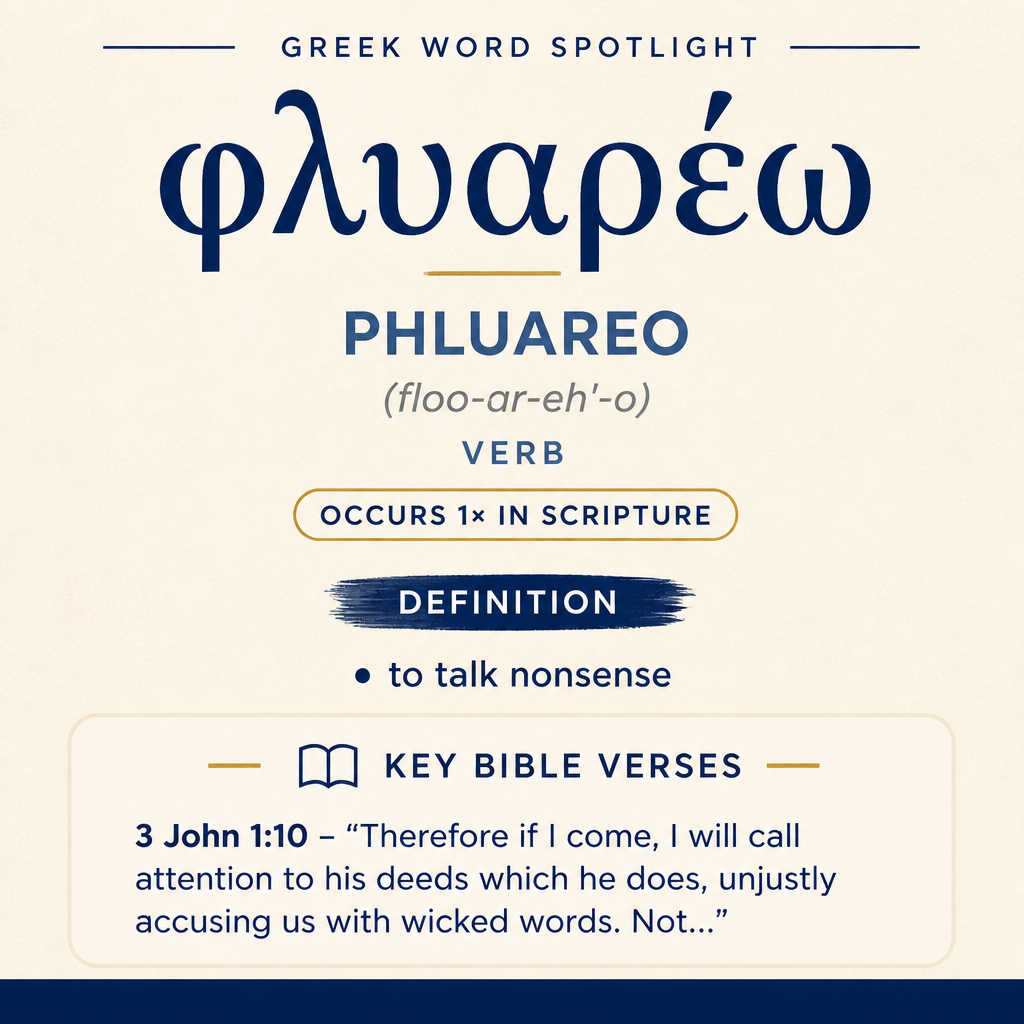
φλυαρέω means “to talk nonsense” and appears once in Scripture, in 3 John 1:10.
Scripture Occurrence
This verb occurs 1 time in Scripture. The occurrence is in 3 John 1:10.
Learn More →Verse Context
In 3 John 1:10, it is connected with unjust accusations made with wicked words.
Learn More →φλυαρέω means “to talk nonsense,” and it appears in the New Testament in a single setting involving speech that harms a church’s fellowship and order. The term is used to characterize a person’s verbal conduct as part of a wider pattern of disruptive deeds.
Root and Related Words
φλυαρέω (Phluareo) is connected with the adjective φλύαρος (phlyaros), meaning “gossipy” (Strong’s G5397). In that relationship, the verb expresses an action associated with the kind of speech the adjective describes.

Occurrences
“Therefore if I come, I will call attention to his deeds which he does, unjustly accusing us with wicked words. Not content with this, neither does he himself receive the brothers, and those who would, he forbids and throws out of the assembly.” (3 John 1:10)
In this verse, φλυαρέω belongs to a cluster of expressions that paint a portrait of destructive talk. The writer speaks of “deeds,” “unjustly accusing,” and “wicked words,” placing the problem first in the realm of speech and then showing how that speech accompanies controlling actions in the community. The verbal misconduct is not an isolated lapse; it functions as part of a sustained campaign against people—“accusing us”—and it colors the atmosphere in which decisions about reception and exclusion are made.
The verse connects the speech to relational breakdown: “neither does he himself receive the brothers,” and he also blocks others—“those who would, he forbids.” Within that flow, φλυαρέω contributes the idea of talk that is empty in substance yet potent in effect: it is presented as the sort of speech that can be used to pressure, discredit, or obstruct. The wording “Not content with this” highlights escalation, suggesting that the person’s “wicked words” are not sufficient for him; the disruptive talk works alongside tangible measures—“throws out of the assembly.” In this context, “talk nonsense” is not portrayed as harmless chatter; it is speech that accompanies accusation and that supports exclusionary behavior.
The author’s response also frames the word’s force. “Therefore if I come, I will call attention to his deeds which he does” shows an intention to expose and confront. The problematic speech is included among the “deeds” that will be addressed, implying that the nonsense-talking is treated as actionable conduct within the life of the church. The writer’s approach is not merely to disagree with what is said, but to bring it into the open as part of a pattern that affects the reception of “the brothers” and the integrity of “the assembly.”
Sense and Usage
With the definition “to talk nonsense,” φλυαρέω describes speech judged to be devoid of proper sense or worth, yet here it is also morally and socially charged by its setting. In 3 John 1:10, the verb stands close to “unjustly accusing” and “wicked words,” so the nonsense is not neutral or playful; it is nonsense deployed in a way that injures others. The verse portrays a person whose speech acts as a vehicle for accusation, and the overall picture is of talk that does not serve truthfulness or communal health but instead feeds a posture of opposition.
The immediate context shows how such talk operates within a community: it can create an environment where relationships are strained (“accusing us”), where hospitality and fellowship are refused (“neither does he himself receive the brothers”), and where others are pressured into compliance (“those who would, he forbids”). The verb’s sense is therefore seen in action: nonsense-talk becomes a tool within a broader effort to control who is welcomed and who is pushed away.
The verse also implies that nonsense-talk can be persistent. The speaker is depicted as “Not content with this,” indicating that the pattern continues and intensifies rather than dissipating after a single outburst. In that light, φλυαρέω points to an ongoing manner of speaking that the author regards as serious enough to warrant direct intervention: “if I come, I will call attention.” The community impact is measurable not only in words exchanged but also in outcomes—people being barred from receiving “the brothers” and being “thrown out of the assembly.”
Because the term occurs within a list of behaviors, it functions as a diagnostic label for a kind of speech that is out of order within Christian fellowship. The nonsense is not described in terms of its topics, length, or style; it is characterized by its role in unjust accusation and by its contribution to exclusion. The verse thus shows φλυαρέω as a verbal practice that accompanies—and helps sustain—fracture in relationships and disorder in communal life.
Imagery
The scene in 3 John 1:10 gives φλυαρέω an image of words that spill over into action: speech that circulates as accusation and then hardens into barriers at the doorway of fellowship. In this single occurrence, “wicked words” and the refusal to “receive the brothers” stand together, so the nonsense-talking is pictured not as empty sound fading away, but as talk that shapes who is welcomed and who is expelled from “the assembly.”
Sources: Lexical data from Strong’s Exhaustive Concordance and the Translators Brief Lexicon of Extended Strongs for Greek (STEPBible, CC BY). Occurrence data from the Translators Amalgamated Greek New Testament (STEPBible, CC BY). Scripture quotations from the World English Bible (public domain).




