
Exploring the Meaning of Phlogizo in Greek
φλογίζω means “to kindle” and occurs twice in Scripture, including in James 3:6.
Scripture Occurrences
This word occurs 2 times in Scripture. One occurrence is in James 3:6.
Learn More →James 3:6 Context
In James 3:6, it appears in a description of the tongue as a fire that defiles the whole body.
Learn More →φλογίζω means “to kindle” and appears in the New Testament in James’s sustained warning about the tongue. In its lone attested verse here, the verb frames speech as a destructive ignition that spreads beyond its point of origin.

Root and Related Words
φλογίζω is related to the noun phlox (φλόξ), “flame” (Strong’s G5395). The verbal form draws on the imagery of flame to express the act of causing something to catch and begin burning.

Occurrences
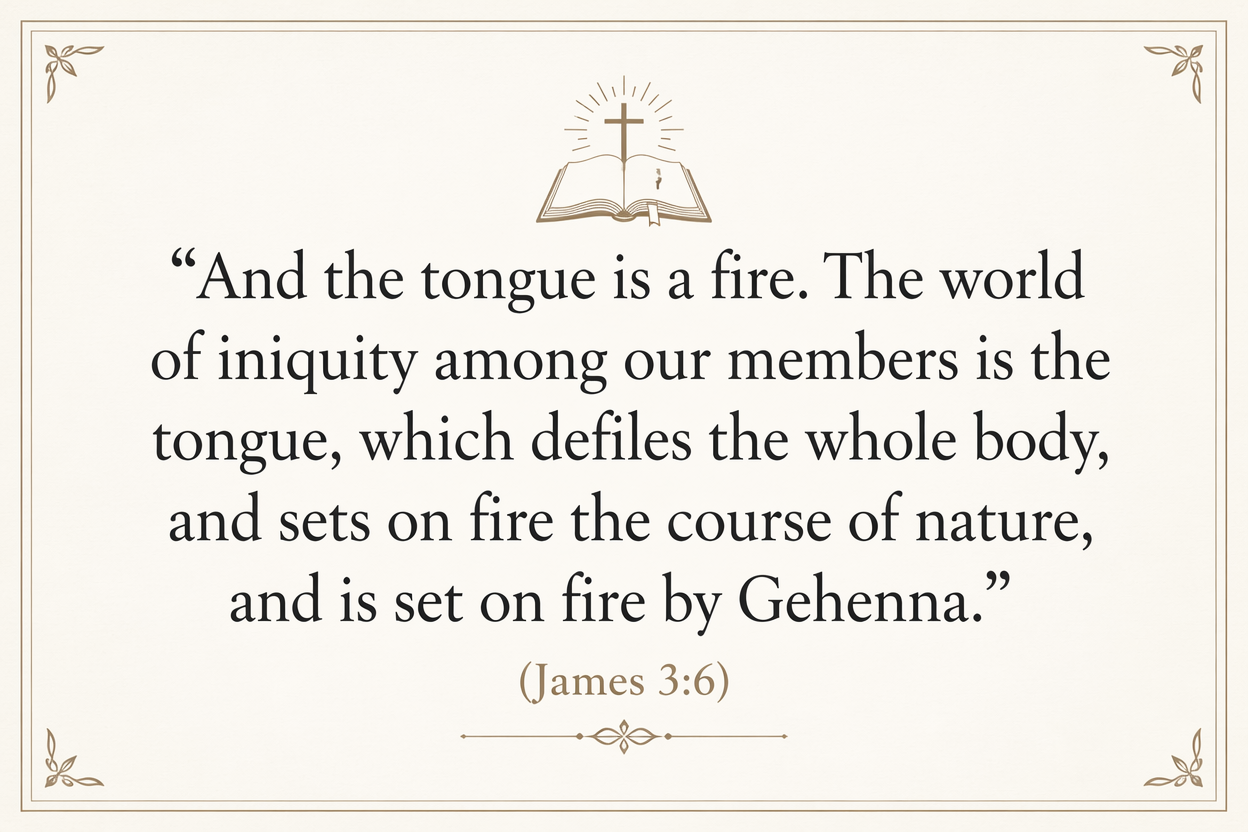
“And the tongue is a fire. The world of iniquity among our members is the tongue, which defiles the whole body, and sets on fire the course of nature, and is set on fire by Gehenna.” (James 3:6)
In James 3:6, φλογίζω appears in a tightly packed chain of fire-images that move from description to consequence. The verse begins with an arresting identification: “the tongue is a fire.” From that starting point, the tongue is not merely compared to something dangerous; it is portrayed as an active agent whose presence among the body’s “members” brings corruption: it “defiles the whole body.” Within this progression, φλογίζω supplies the notion of ignition and spread: the tongue “sets on fire the course of nature.” The phrase presents the tongue’s effect as more than a brief flare-up; it kindles an ongoing course—something with direction and continuity—so that what begins at the tongue extends outward along the path of life.
The verb then appears again in a passive construction: the tongue “is set on fire by Gehenna.” This balances the earlier activity of the tongue with an origin outside it: the tongue kindles, yet it is itself kindled. In the logic of the verse, the tongue’s destructive ignition does not arise from nowhere; it is lit from a source that James names. The two uses of φλογίζω thus frame the tongue as both an instrument and a target of burning: inflamed from one direction and, in turn, igniting what lies in front of it. The verse’s rhetorical force depends on this double movement, making the tongue’s danger both pervasive (“defiles the whole body”) and dynamic (it sparks a broader conflagration along “the course of nature”).
Sense and Usage
The definition “to kindle” is concrete and physical, but James deploys it in moral and communal speech-ethics by attaching it to “the tongue.” The verse does not treat kindling as a neutral act of starting a controlled fire; it is set in a context of contamination and harm. Within the same sentence, the tongue is described as “the world of iniquity among our members,” and the kindling it performs belongs to that moral world: it does not warm, illuminate, or refine in this portrayal; it ignites what should not be burning.
James’s imagery presses two main features of kindling. First, kindling has a small beginning with disproportionate effects. A tongue is physically small among the body’s members, yet by kindling it produces widespread results: it “defiles the whole body” and “sets on fire the course of nature.” The verb captures the moment when a potential for destruction becomes active—when what could have remained inert bursts into burning motion. Second, kindling implies transfer: fire passes from one source to another. That transfer is explicit in the verse’s second clause with φλογίζω: the tongue “is set on fire by Gehenna.” In other words, the tongue’s ignition is not self-originating; it is lit by an external power, and then it becomes the means by which burning spreads further.
The paired uses also highlight agency and receptivity within the same subject. The tongue is the grammatical agent of “sets on fire,” and it is the grammatical recipient of “is set on fire.” This combination is especially fitting to the moral picture James paints. Speech can be active—words spoken, accusations leveled, rumors propagated—yet speech can also be reactive, inflamed by forces that incite it. φλογίζω carries both aspects without changing its basic idea: causing something to begin burning. The shift lies in who performs the kindling and what is kindled, not in a different sense of the verb.
Because James places φλογίζω alongside “defiles,” the kindling is not merely energetic; it is polluting. Fire imagery can sometimes suggest purging, but in this verse it is paired with defilement and “iniquity,” which steers the reader toward a picture of damage that soils rather than cleanses. The tongue’s burning is thus portrayed as spreading corruption through the body’s life, not as consuming impurity for renewal. The phrase “the course of nature” widens the scope beyond isolated incidents. Kindling, as used here, is not restricted to a single outbreak; it reaches into an extended course, suggesting that what the tongue lights can continue and escalate, affecting patterns and trajectories.
Imagery and Weight
James 3:6 compresses a complete fire narrative into one verse: a spark, an ignition, a spreading blaze, and a source that lights it. φλογίζω supplies the crucial turning point in that narrative—the moment when destructive potential becomes burning reality. By pairing the tongue’s ability to kindle with the tongue’s being kindled, the verse portrays speech as a conduit: it receives fire and then passes fire on. The result is a vivid moral warning framed in physical terms: what is lit at the tongue does not stay there, but runs its course through life like fire moving through what can burn.
Sources: Lexical data from Strong’s Exhaustive Concordance and the Translators Brief Lexicon of Extended Strongs for Greek (STEPBible, CC BY). Occurrence data from the Translators Amalgamated Greek New Testament (STEPBible, CC BY). Scripture quotations from the World English Bible (public domain).





