
Exploring the Meaning of Perimeno in Greek
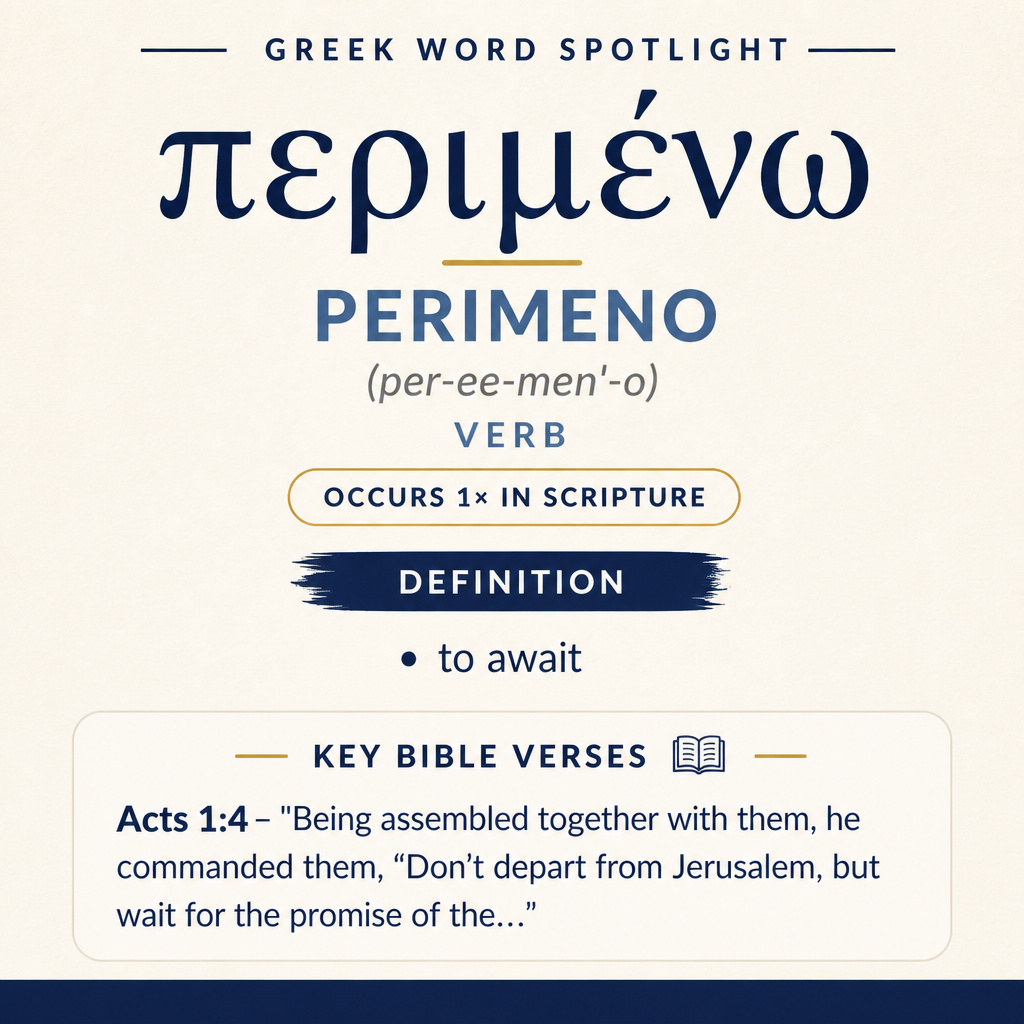
περιμένω means “to await” and appears once in Scripture, in Acts 1:4.
Acts 1:4 Context
In Acts 1:4, the command is “Don’t depart from Jerusalem, but wait for the promise of the Fat”.
Learn More →περιμένω means “to await,” and it appears in the risen Jesus’ command to the apostles just before the events that follow his ascension. In that setting it describes a deliberate, commanded posture of staying put until something promised is given.
Root and Related Words
περιμένω (Perimenō) is formed from περί (peri), “about,” and μένω (menō), “to stay.” The combination places the verb’s action in the sphere of remaining in place with reference to something expected, expressing waiting as a kind of continued staying.

Occurrences
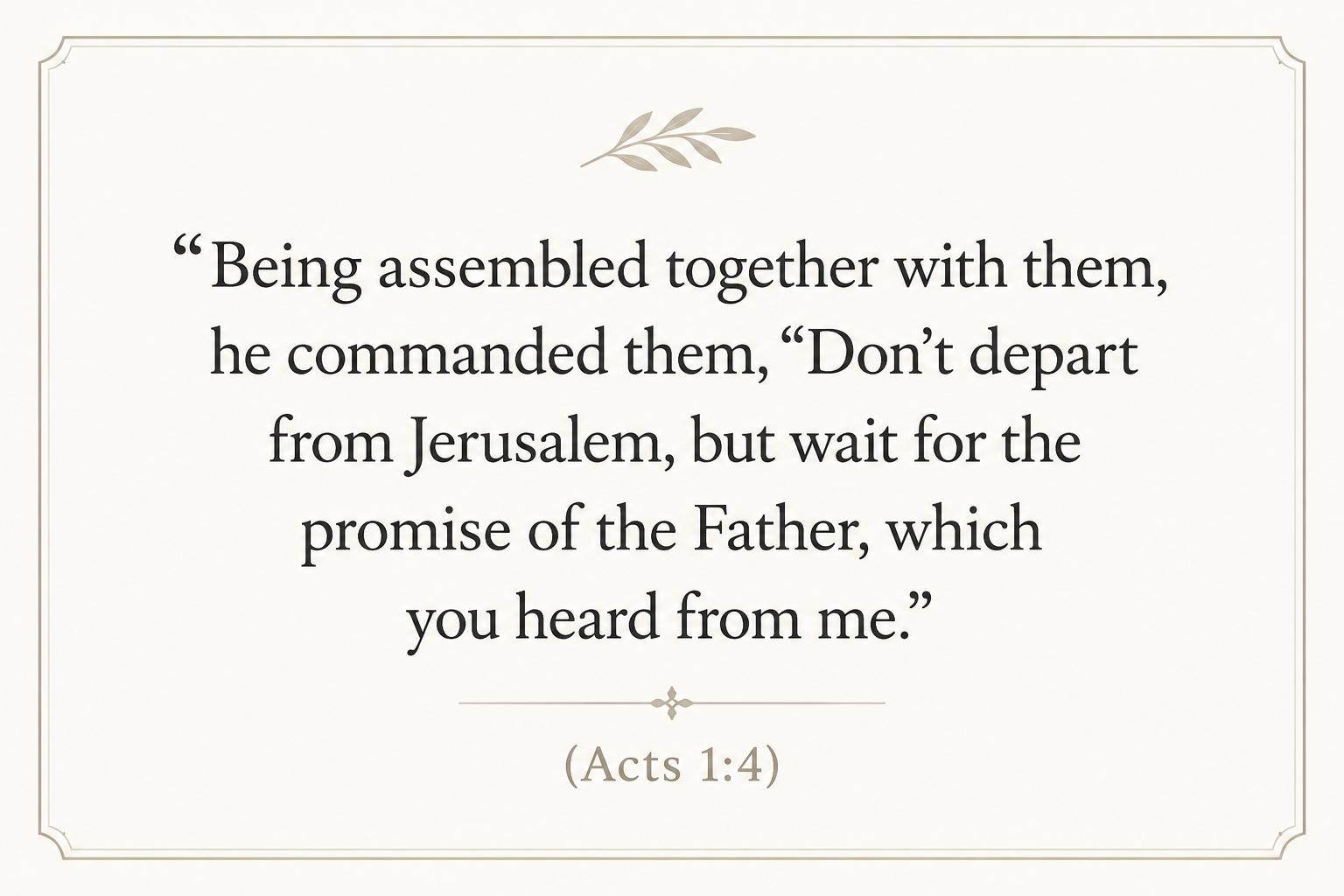
“Being assembled together with them, he commanded them, “Don’t depart from Jerusalem, but wait for the promise of the Father, which you heard from me.” (Acts 1:4)
In Acts 1:4, περιμένω is the key verb that shapes the apostles’ next step: not movement, but restraint. The scene begins with Jesus “assembled together with them,” and his instruction is cast as a command rather than a suggestion. The negative imperative (“Don’t depart from Jerusalem”) is paired with a positive directive (“but wait for the promise of the Father”), and the waiting is therefore defined by contrast with leaving. Here, to await is not a vague attitude but a concrete decision to remain in Jerusalem instead of beginning travel or dispersing.
The object of the awaiting is specified: “the promise of the Father.” This makes the waiting purposeful and oriented toward a particular pledged gift. The phrase “which you heard from me” anchors that promise in prior instruction from Jesus; the apostles are not being asked to wait for an undefined outcome, but for something already spoken of and therefore anticipated. In this verse, the verb carries the weight of obedience: the apostles’ faithfulness in the moment consists in remaining where commanded, holding their course until the promised thing arrives.
The setting in Jerusalem also gives the waiting a spatial frame. Waiting could in many contexts be compatible with going elsewhere and simply delaying action; but in this command it is explicitly tied to not departing. περιμένω thus functions as a directive for controlled delay within a particular location, an awaiting that is measured by staying rather than by searching.
Sense and Usage
The sense “to await” in περιμένω, as illustrated in Acts 1:4, is an active kind of waiting: it is something one does in response to instruction, with a defined focus (“the promise of the Father”) and an immediate behavioral implication (“Don’t depart from Jerusalem”). Awaiting here is not portrayed as passivity or indecision. It is a chosen posture under authority—Jesus “commanded them”—and it is expressed in a disciplined refusal to move on prematurely.
The verse also shows awaiting as relationally grounded. The promise is attributed to “the Father,” and Jesus links the apostles’ present conduct to their past hearing: “which you heard from me.” In that way, περιμένω sits within a chain of communication and trust: a promise has been spoken, the hearers remember it, and they are now instructed to remain in place until it is fulfilled. The verb therefore marks a time of expectation bounded by confidence that what has been promised will be given; the focus is not on predicting timing but on maintaining obedience in the interim.
Because the command pairs “Don’t depart” with “but wait,” the awaiting takes on the nuance of staying put rather than scattering. The verb’s action is concretely tested by geography and plans: Jerusalem is where they must remain, and departure is the alternative they must resist. In this usage, awaiting is a form of readiness that does not seek to force fulfillment by activity. Instead, it preserves the community’s gathered state (“Being assembled together with them”) so that they are together and positioned to receive what is promised.
The verse also frames awaiting as a hinge between instruction and event. Jesus speaks to an assembled group and establishes what will characterize the time immediately ahead: they are to mark that period by waiting. The command implies a sequence: first, remain; then, receive. περιμένω names the interval in which the apostles’ task is not to initiate but to hold, watch, and stay within the boundaries Jesus sets.
Imagery
The imagery carried by περιμένω in Acts 1:4 is the picture of a gathered group held in place by a promise. They are in Jerusalem under a clear prohibition against departing, and their waiting is directed toward something coming from the Father and already spoken of by Jesus. The verb therefore evokes a settled posture: staying where one has been placed, poised for what has been pledged, and letting the promise—not impatience—set the timetable of action.
Sources: Lexical data from Strong’s Exhaustive Concordance and the Translators Brief Lexicon of Extended Strongs for Greek (STEPBible, CC BY). Occurrence data from the Translators Amalgamated Greek New Testament (STEPBible, CC BY). Scripture quotations from the World English Bible (public domain).




