
Exploring the Meaning of Periecho in Greek
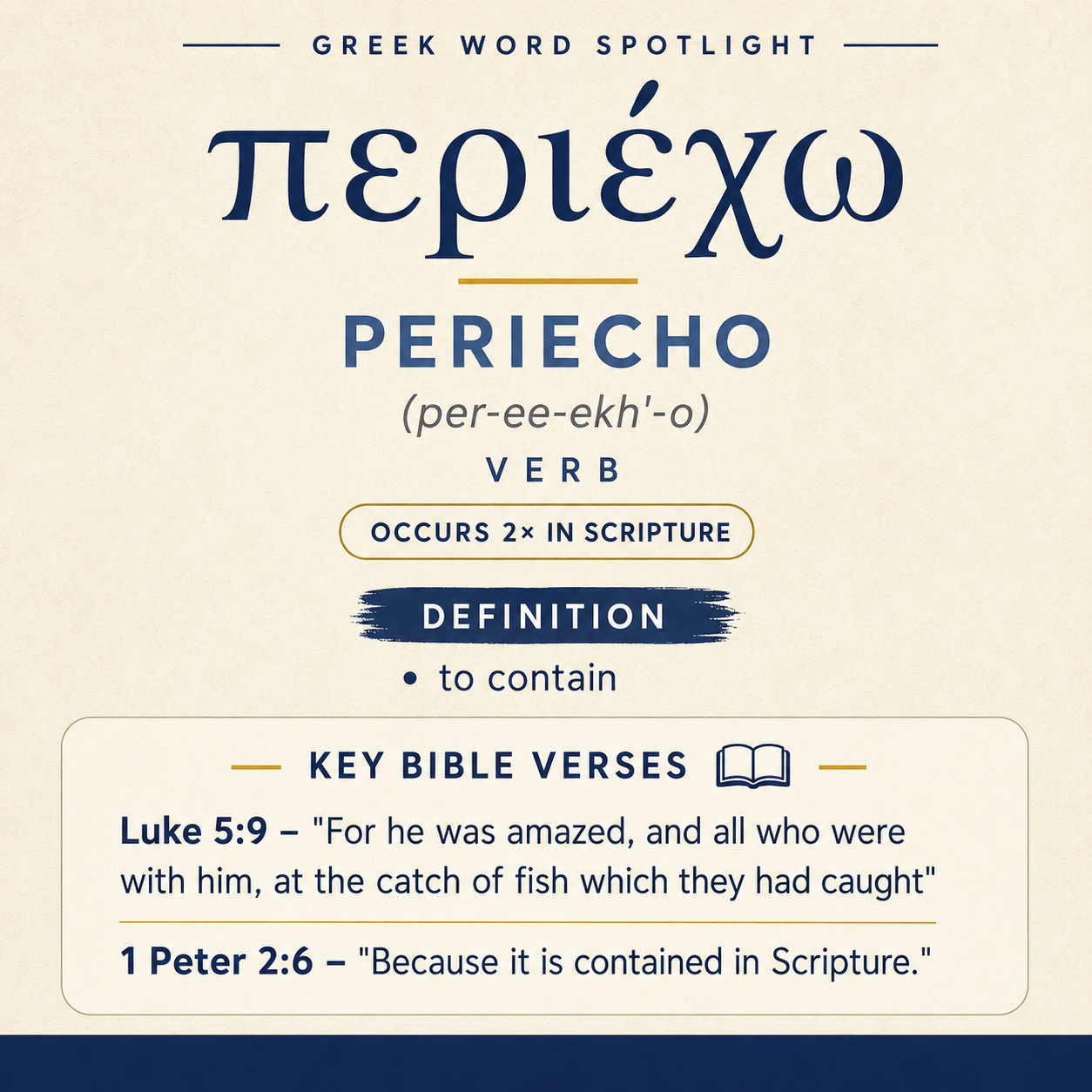
περιέχω means “to contain” and occurs twice in Scripture: Luke 5:9 and 1 Peter 2:6.
Scripture Occurrences
This verb occurs 2 times in Scripture. The references are Luke 5:9 and 1 Peter 2:6.
Learn More →Context Snapshots
In Luke 5:9, it appears in the context of amazement at a catch of fish. In 1 Peter 2:6, it is used with the statement, “Because it is contained in Scripture.”
Learn More →περιέχω speaks of containing—having something within bounds, whether as a physical reality or as something held within a written source. It appears in two New Testament contexts: one in a fishing scene and one in a citation introduced as being contained in Scripture.
Root and Related Words
Periecho (περιέχω) is connected with the verb echo (ἔχω), “to have/be” (Strong’s G2192), and the preposition peri (περί), “about” (Strong’s G4012). Together these elements frame the idea of holding something “around” or having something within an enclosing scope.

Occurrences
“For he was amazed, and all who were with him, at the catch of fish which they had caught;” (Luke 5:9)
In Luke’s account, the setting is a moment of astonishment: “he was amazed, and all who were with him,” and the reason given is “the catch of fish.” The wording highlights an event with a concrete, countable outcome—fish gathered in quantity and held together as a “catch.” In this scene, περιέχω contributes the notion of an event or result that can be spoken of in terms of what it holds: the catch is not merely an action (fishing) but a contained outcome that can impress observers. The amazement of the group is tied to that contained abundance—fish brought in and kept together as a single yield.
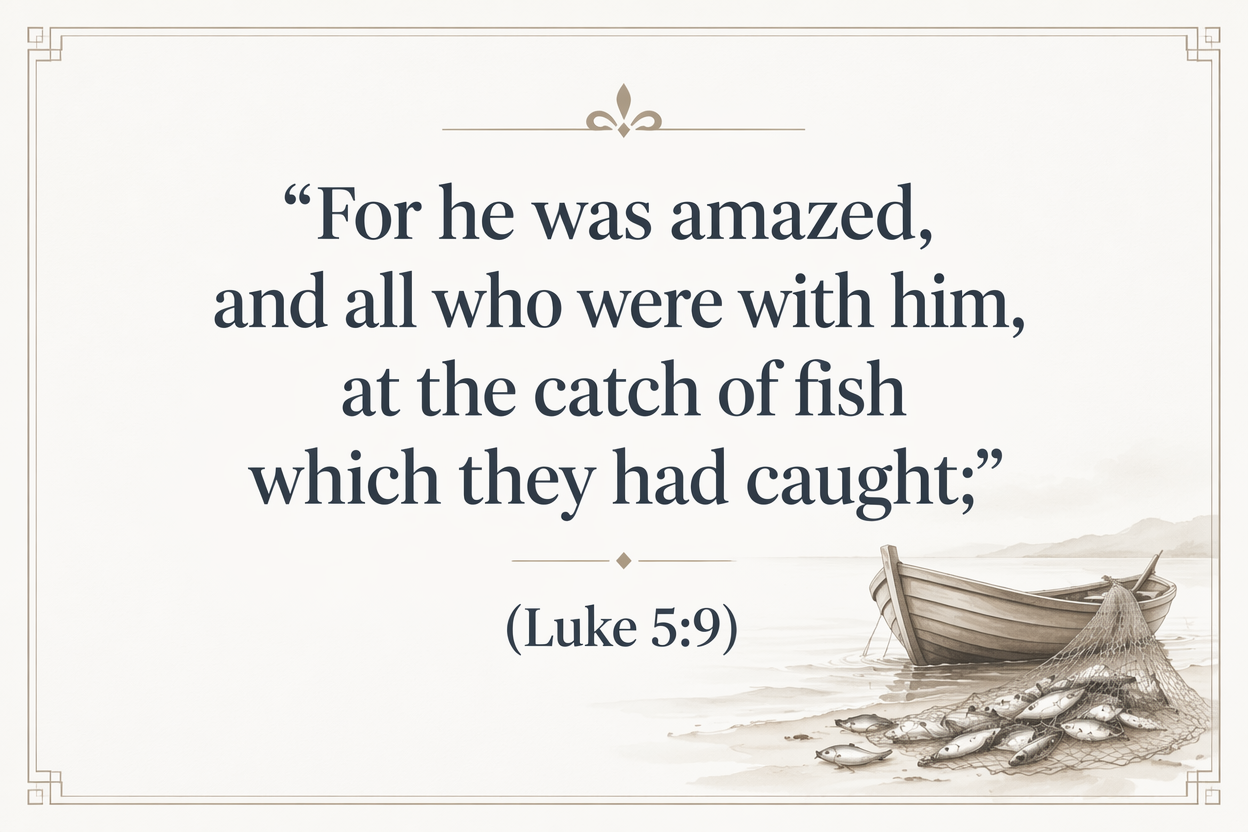
The verse also places the reaction (“amazed”) in direct connection with the contained result (“the catch of fish”). The narrative emphasis falls on what is present within the bounds of that catch. It is this contained reality—fish secured and accounted for—that becomes the immediate, visible ground for the shared astonishment.
“Because it is contained in Scripture, “Behold, I lay in Zion a chief cornerstone, chosen and precious: He who believes in him will not be disappointed.”” (1 Peter 2:6)
In 1 Peter, περιέχω introduces a quotation with an explicit claim about where the words are found: “Because it is contained in Scripture.” Here the containment is literary and canonical. The statement treats Scripture as a bounded repository that holds specific testimony, and the quoted lines are presented as residing within that recognized body of writing.
The immediate function is to anchor what follows in an already-existing, contained witness: “Behold, I lay in Zion a chief cornerstone, chosen and precious: He who believes in him will not be disappointed.” The phrase “contained in Scripture” portrays the quotation as something preserved and locatable, not invented on the spot. Containment, in this frame, is about stable inclusion: the message is held within Scripture’s scope, and that containment is given as the reason (“Because”) for appealing to it. The contained words then describe the laying of a cornerstone in Zion and attach a promise to the one who believes—language treated as secure because it belongs inside Scripture.
Sense and Usage
Across these two passages, “to contain” operates in two distinct but related registers. In Luke 5:9 the concept belongs to the world of tangible outcomes: a “catch of fish” is an assemblage that can be regarded as having contents—fish gathered within the bounds of what has been taken. The emphasis is not on the mechanics of catching but on the resulting collected whole that can be pointed to as a contained reality and that provokes amazement.
In 1 Peter 2:6, the same basic idea shifts from physical inclusion to textual inclusion. Scripture is treated as something that can “contain” specific wording, and the author’s appeal depends on that containment: the quotation carries weight as something already held within Scripture’s recognized limits. The move from nets and fish to Scripture and quotation shows that the verb can frame “containment” both as a matter of what is gathered in an event and as a matter of what is preserved within an authoritative written source.
These uses also show how containment can support explanation. In Luke, amazement is explained by reference to what the catch contains; in 1 Peter, an argument is supported by reference to what Scripture contains. In both cases, the verb serves to point beyond mere assertion to something presented as already there—either a visible haul or an established text—so that the reader is directed to the contents as the grounding reality.
Imagery
The word’s imagery can be felt in the contrast between a contained abundance and a contained testimony. Luke evokes a concrete scene where a single “catch” holds enough fish to amaze multiple observers. Peter evokes a literary scene where Scripture is pictured as holding words that can be brought forward intact—contained speech about a cornerstone in Zion and the assurance that “He who believes in him will not be disappointed.” In both, containment presents something held together and made available: gathered fish for astonished fishermen, and gathered words for instruction and confidence.
Sources: Lexical data from Strong’s Exhaustive Concordance and the Translators Brief Lexicon of Extended Strongs for Greek (STEPBible, CC BY). Occurrence data from the Translators Amalgamated Greek New Testament (STEPBible, CC BY). Scripture quotations from the World English Bible (public domain).




