
Exploring the Meaning of Perioche in Greek
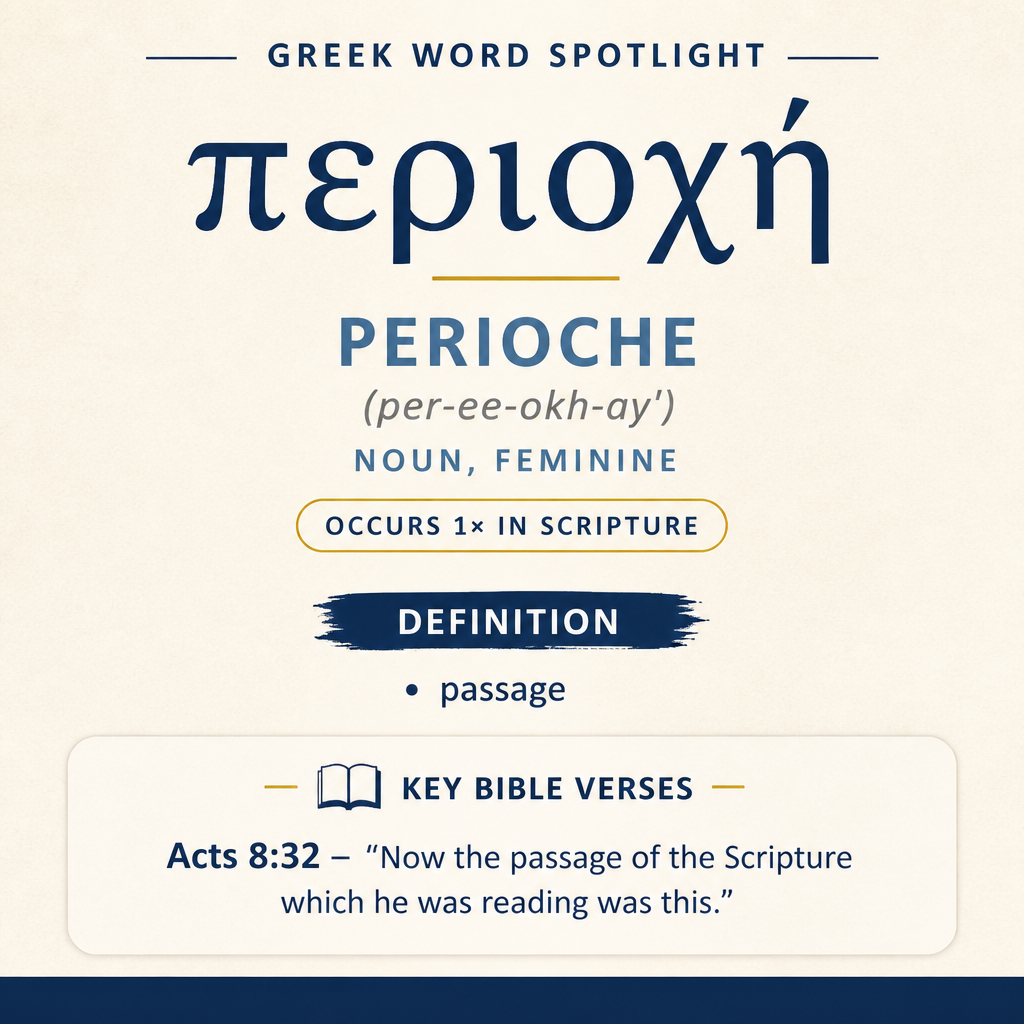
περιοχή means “passage” and appears once in Scripture, in Acts 8:32.
Scripture Occurrence
This word occurs 1 time in Scripture. Its single occurrence is Acts 8:32.
Learn More →Context in Acts
In Acts 8:32, it refers to the passage of Scripture being read. The verse then quotes, “He was led as a sheep to the slaughter...”
Learn More →περιοχή refers to a “passage,” and it appears in the New Testament in a single narrated scene where a specific section of Scripture is being read aloud and cited. In Acts 8:32 it marks off the portion being read as a distinct, identifiable unit of text.
Root and Related Words
περιοχή is related to the verb periecho (περιέχω), “to contain” (Strong’s G4023). This relationship highlights the idea of a bounded textual unit—words held together within definable limits—so that one may speak of the Scripture being read as a particular, contained segment.

Occurrences
Acts 8:32: Now the passage of the Scripture which he was reading was this, “He was led as a sheep to the slaughter. As a lamb before his shearer is silent, so he doesn’t open his mouth.
Here περιοχή functions as a label for the exact section of Scripture under consideration: the narrator does not merely say that Scripture was being read, but introduces the specific excerpt that follows. The wording, “Now the passage of the Scripture which he was reading was this,” sets up a direct quotation, indicating that what comes next is not a general summary but the carefully delimited portion being read at that moment. The term therefore frames the quoted lines as a coherent unit meant to be heard and weighed as one piece—an excerpt with recognizable boundaries rather than scattered phrases.
Within the narrative flow of the verse, the word also serves a practical identifying role. It signals to the reader that the quoted lines—“He was led as a sheep to the slaughter. As a lamb before his shearer is silent, so he doesn’t open his mouth.”—are the content of the reading and the focus of attention. In other words, περιοχή points to the text as an object: a portion of Scripture that can be read, recited, and discussed. The story’s emphasis falls not only on the act of reading but on the specific content read, and the term names that content as a particular “passage.”
The quotation itself contains vivid imagery—an individual compared to a sheep led to slaughter and a lamb silent before its shearer—and the presence of περιοχή foregrounds that imagery as belonging to a defined segment of Scripture. The narrator draws a clear line around this excerpt: it is this portion, these lines, that are being read. Thus the word guides the audience to treat the quotation as a single unit of meaning in its immediate setting.
Sense and Usage
The sense “passage” in Acts 8:32 operates in a strongly textual and referential way. A “passage” is not simply “Scripture” in the broad sense, but a segment of Scripture singled out from the larger body. The verse presents Scripture as something that can be portioned: one may read a particular section, cite it, and use it as the basis for reflection and explanation. By using περιοχή, the narrative moves from the general (“the Scripture”) to the particular (“the passage … was this”), which is a shift from category to instance—from the whole to the excerpt.
In this context, a “passage” is also presented as something that can be introduced formally. The phrase “was this” functions like a pointer, and περιοχή supplies the noun that makes the pointer meaningful: what follows is an excerpted unit, introduced as a quotation with clear boundaries. This usage underscores that the quoted lines are not an accidental snippet but an intentionally identifiable portion. The term therefore supports the act of close attention: it invites the hearer to consider what this specific excerpt says, because the narrative has explicitly singled it out.
Because the “passage” is directly tied to “which he was reading,” the word’s force is also situational: it belongs to a moment of reading. A passage is something encountered in sequence; it is a stretch of text that one reaches and takes up. The verse implies continuity—the reader had been reading and arrived at a particular portion—and περιοχή names the portion currently in view. The concept of a passage fits this temporal aspect of reading: it is the portion at hand, the excerpt presently being voiced and heard.
The content of the cited lines further clarifies how a “passage” can function in discourse. The quotation is not a single word but a compact set of lines with parallel imagery (“sheep to the slaughter,” “lamb … is silent”). A “passage,” then, can be large enough to carry a scene and its comparisons, yet bounded enough to be recited as a unit. The term suits a quotation that contains its own internal cohesion: two linked statements that together portray the subject’s silent submission under suffering. By calling it a passage, the narrative treats those linked statements as belonging together.
In Acts 8:32, “passage” also serves as a bridge between the act of reading and the act of interpretation without itself describing the interpretive step. The word does not comment on the meaning of the quoted lines; it simply identifies the quoted material as a defined portion of Scripture. That identification is foundational: the scene’s attention is directed to a particular excerpt, and any subsequent discussion logically begins with having the excerpt clearly marked. Thus περιοχή helps anchor the conversation in a specific textual base, ensuring that the focus remains on a particular segment rather than on vague references to Scripture in general.
Imagery
Although περιοχή itself is a plain term for a segment of text, in Acts 8:32 it introduces a passage rich in concrete images: “He was led as a sheep to the slaughter. As a lamb before his shearer is silent, so he doesn’t open his mouth.” The word therefore stands at the threshold between written Scripture and the pictured scene within the quotation, marking off a bounded excerpt that carries the reader into a tightly drawn tableau of led animals, impending slaughter, and silence.
Sources: Lexical data from Strong’s Exhaustive Concordance and the Translators Brief Lexicon of Extended Strongs for Greek (STEPBible, CC BY). Occurrence data from the Translators Amalgamated Greek New Testament (STEPBible, CC BY). Scripture quotations from the World English Bible (public domain).




