
Exploring the Meaning of Pentakosioi in Greek
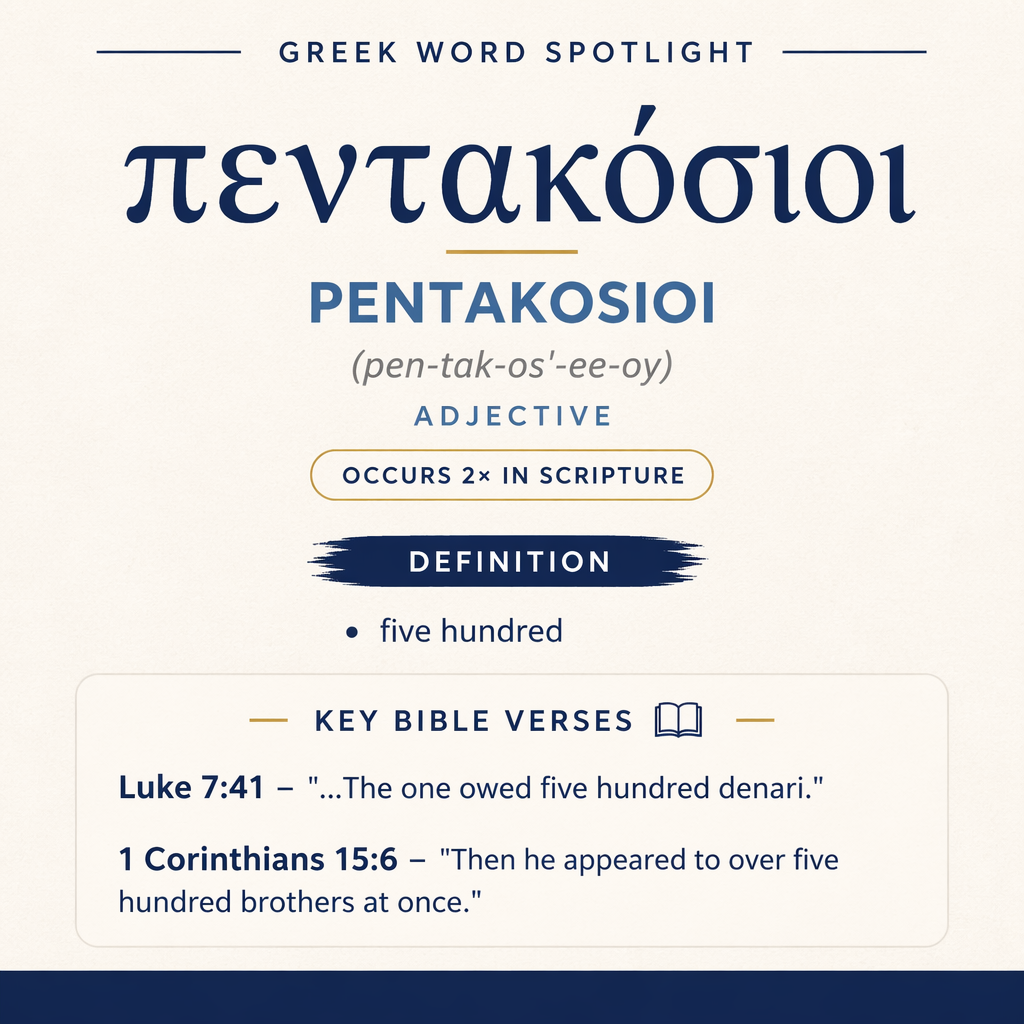
πεντακόσιοι means “five hundred” and appears twice in Scripture: Luke 7:41 and 1 Corinthians 15:6.
Gospel Context
In Luke 7:41, it describes a debt of five hundred denarii owed to a lender.
Learn More →Resurrection Witnesses
In 1 Corinthians 15:6, it refers to over five hundred brothers who saw Jesus appear at once.
Learn More →Pentakosioi means “five hundred” and appears twice in the New Testament: once in a parable about debt in Luke, and once in a report of a large group witnessing an appearance in 1 Corinthians.
Root and Related Words
Pentakosioi is formed from pente (πέντε), “five” (Strong’s G4002), and hekaton (ἑκατόν), “hundred” (Strong’s G1540). The combination expresses a counted total made up of five units of a hundred.
Occurrences
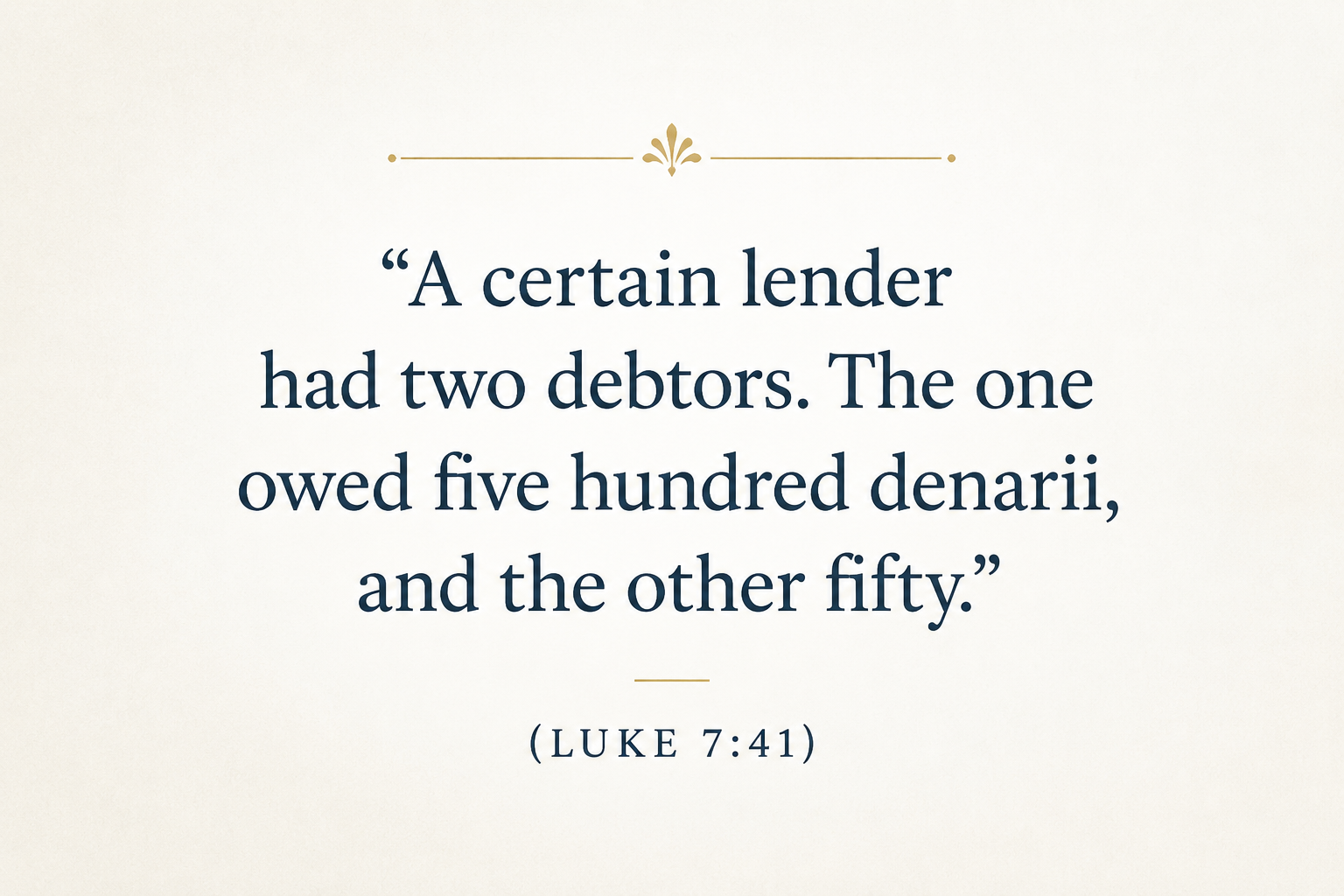
“A certain lender had two debtors. The one owed five hundred denarii, and the other fifty.” (Luke 7:41)
Here pentakosioi sets the larger of two debts side by side with a smaller one (“five hundred denarii” versus “fifty”). The word functions as a precise measurement of obligation, giving the comparison weight by making the disparity numerically clear. In the parable’s opening line, the lender has “two debtors,” and the amounts are introduced immediately; pentakosioi anchors the first debtor’s situation as the heavier burden. Because the unit “denarii” is specified, the number is not an abstract tally but a quantified financial sum, so pentakosioi contributes to the scene by defining the scale of what is owed and framing the contrast that follows in the story.
The placement of the number also matters: the first debtor is described first and is associated with the larger amount, so pentakosioi helps establish a hierarchy within the pair. The parable does not need a vague “much” and “little”; it uses an exact count, and pentakosioi supplies that exactness. The difference between the two amounts is not merely qualitative but calculable, letting the reader feel how far apart the two debts are without additional explanation.
Then he appeared to over five hundred brothers at once, most of whom remain until now, but some have also fallen asleep. (1 Corinthians 15:6)
In this sentence pentakosioi describes the size of the audience for an appearance: “over five hundred brothers at once.” The word thus contributes a large, specific headcount, and the phrase “at once” ties the number to a single shared moment rather than a series of separate occasions. Pentakosioi supports the claim by depicting the appearance as witnessed by a sizeable group, and it does so in a way that is both numerical and communal: these are “brothers,” counted together.
The statement that “most of whom remain until now, but some have also fallen asleep” keeps the number connected to people who had a continuing presence or memory. Within the sentence, pentakosioi does not stand alone as a statistic; it is embedded in a description of the group’s current status—many still living, some deceased—so the number functions as a threshold for thinking about the scale of living remembrance. The modifier “over” also shapes how pentakosioi is heard: the word provides the base figure, while the phrase signals that the total exceeds that figure, emphasizing abundance without changing the core count that anchors the report.
Sense and Usage
Across its two uses, pentakosioi serves as a concrete marker of magnitude. In Luke it measures money owed (“five hundred denarii”), a quantified burden that sets one debtor’s obligation sharply above another’s. In 1 Corinthians it measures persons present (“over five hundred brothers”), a quantified community gathered simultaneously. The word’s meaning is stable, but the contexts show how a single high number can carry different kinds of force: financial weight in one scene and testimonial breadth in another.
The two passages also show pentakosioi working with explicit comparatives. In Luke, it participates in a direct contrast within the same sentence: the “five hundred” amount is set beside “fifty,” making the reader immediately compare the two debtors. In 1 Corinthians, it is paired with “over” and with “at once,” so the comparison is not between two numbers but between what might be expected and what is asserted: not a handful, but a crowd; not scattered, but simultaneous. In both cases pentakosioi keeps the claim tied to countable reality rather than impressionistic language.
Because pentakosioi is a round, composite number (five times a hundred), it also reads naturally as a threshold figure. That effect is seen in Luke’s neat pairing with another round number (“fifty”), and in 1 Corinthians where the text uses the base “five hundred” as the benchmark that the group exceeds. The word therefore often invites the reader to think in terms of scale: how much is owed, how many were present, and how a situation changes when the number is large.
Imagery
In Luke 7:41 pentakosioi evokes the image of an account stated plainly—one debtor facing an amount tallied as “five hundred denarii,” set against another’s smaller sum. In 1 Corinthians 15:6 it evokes a different scene: a single moment shared by “over five hundred brothers at once,” a crowd large enough that the text immediately speaks of their later condition—most still alive, some having “fallen asleep.” In both passages, the number carries a sense of measurable scale that shapes how the reader pictures the situation.
Sources: Lexical data from Strong’s Exhaustive Concordance and the Translators Brief Lexicon of Extended Strongs for Greek (STEPBible, CC BY). Occurrence data from the Translators Amalgamated Greek New Testament (STEPBible, CC BY). Scripture quotations from the World English Bible (public domain).




