Exploring the Meaning of Hekaton in Greek
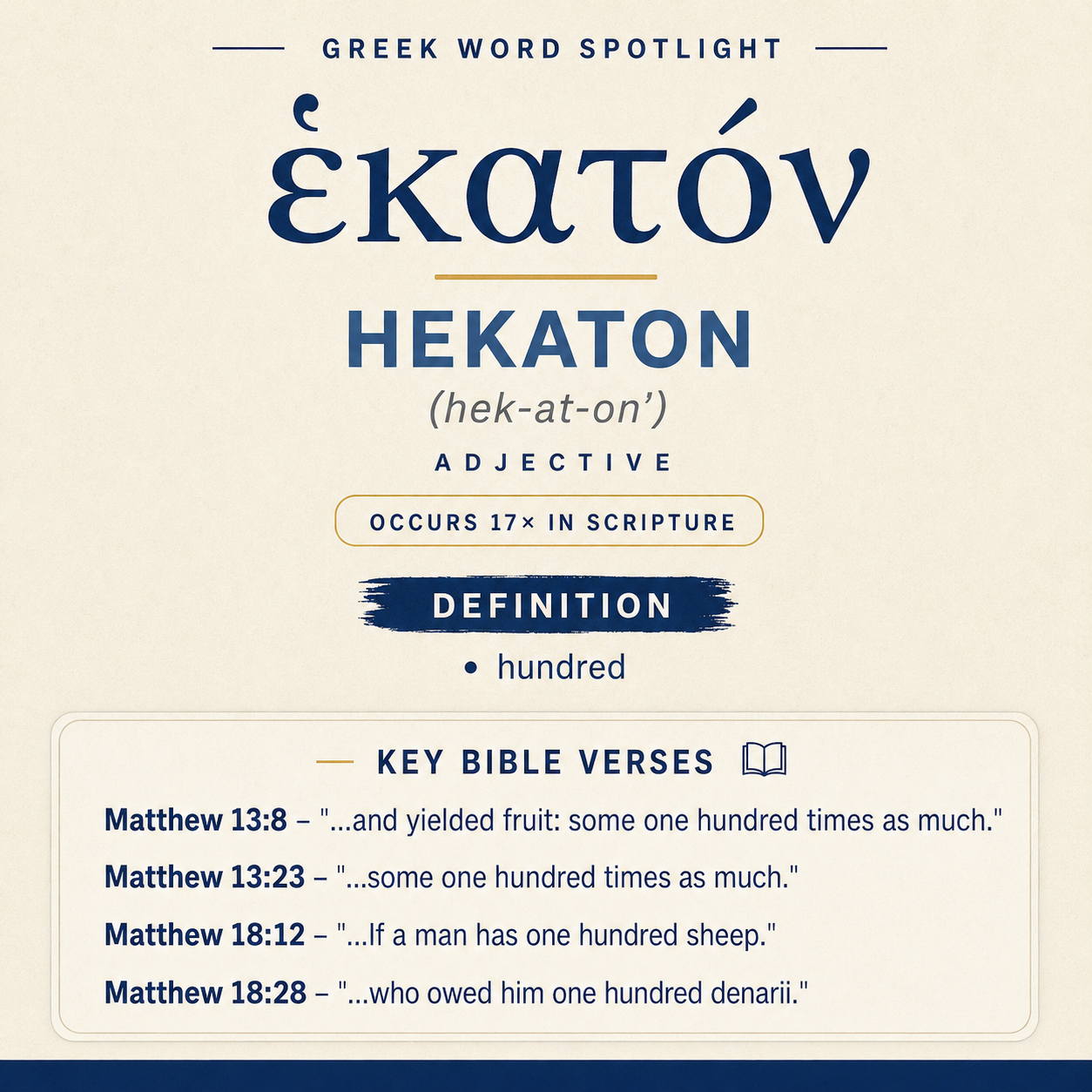
ἑκατόν (Hekaton) means “hundred” and occurs 17 times in Scripture, including Matthew 13:8, Matthew 18:12, Mark 6:40, and Luke 15:4.
Core Meaning
ἑκατόν means “hundred.” It is used for counting and measurement in narrative and teaching.
Learn More →Fruitful Yield
In Matthew 13:8 it describes a yield of “one hundred times as much.” Mark 4:8 also uses it alongside “thirty” and “sixty” in the same teaching.
Learn More →Everyday Counts
Matthew 18:12 and Luke 15:4 mention “one hundred sheep.” Matthew 18:28 refers to “one hundred denarii,” and Mark 6:40 describes groups “by hundreds.”
Learn More →ἑκατόν expresses the number “hundred” and appears in Gospel scenes that range from agricultural yield and herd size to debts, measured commodities, ordered crowds, burial spices, and an exact fish count. In these contexts it functions as a concrete measure that sharpens scale, value, and proportion within each narrative moment.
Occurrences
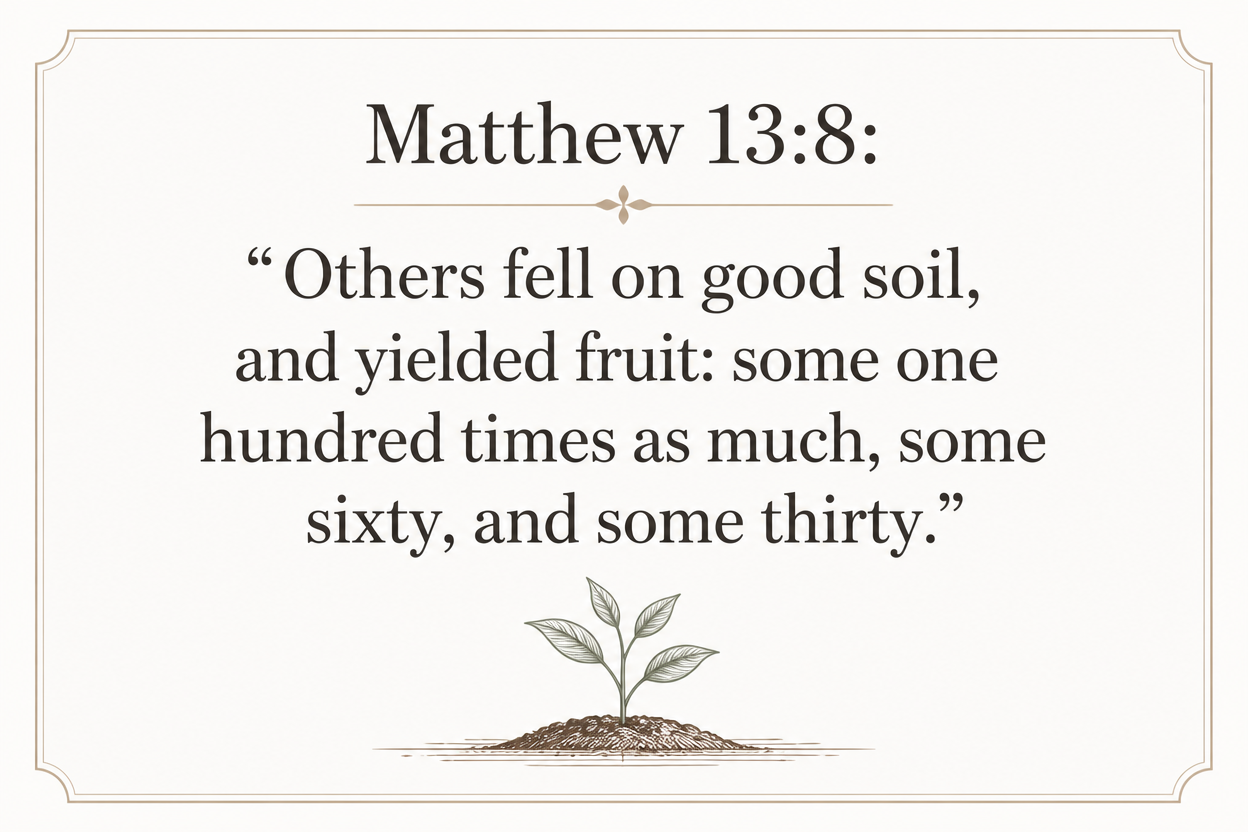
Matthew 13:8: “Others fell on good soil, and yielded fruit: some one hundred times as much, some sixty, and some thirty.”
Here ἑκατόν marks the upper end of a threefold comparison of harvest outcomes. The “one hundred times as much” figure sets a maximum yield that highlights the difference between seed that merely grows and seed that produces extraordinary abundance, contrasted against “sixty” and “thirty.”
Matthew 13:23: “What was sown on the good ground, this is he who hears the word, and understands it, who most certainly bears fruit, and produces, some one hundred times as much, some sixty, and some thirty.”
In this explanation of the earlier image, ἑκατόν again represents the highest production level. Within the same triad (“one hundred… sixty… thirty”), the number functions as a clear, countable way to describe fruitfulness as a measurable outcome, not a vague impression.
Matthew 18:12: “What do you think? If a man has one hundred sheep, and one of them goes astray, doesn’t he leave the ninety-nine, go to the mountains, and seek that which has gone astray?
ἑκατόν sets the total flock size that makes the loss of “one” concrete and the remainder (“the ninety-nine”) explicit. By fixing the whole as one hundred, the saying frames the search as leaving a nearly complete set in order to pursue a single missing animal, emphasizing the logic of action against a clearly defined total.
Matthew 18:28: “But that servant went out, and found one of his fellow servants, who owed him one hundred denarii, and he grabbed him, and took him by the throat, saying, ‘Pay me what you owe!’”
Here ἑκατόν quantifies a debt: “one hundred denarii.” The number gives the obligation a definite size and intensifies the scene’s forcefulness—an amount can be named, demanded, and used as justification for the servant’s aggressive insistence, “Pay me what you owe!”
Mark 4:8: “Others fell into the good ground, and yielded fruit, growing up and increasing. Some produced thirty times, some sixty times, and some one hundred times as much.”
In Mark’s version of the sowing scene, ἑκατόν again stands as the top yield in a graded set. The verse pairs numeric increase (“thirty… sixty… one hundred”) with the description “growing up and increasing,” so the number functions as a visible peak of that increase.
Mark 4:20: “Those which were sown on the good ground are those who hear the word, and accept it, and bear fruit, some thirty times, some sixty times, and some one hundred times.”
Within the interpretive statement, ἑκατόν serves as the highest stated fruit-bearing result. The figure anchors “bear fruit” in a spectrum of outcomes, showing that the same kind of sowing can be described with differing, countable returns.
Mark 6:40: “They sat down in ranks, by hundreds and by fifties.”
ἑκατόν here is used for organizing a crowd: “by hundreds.” Rather than describing produce or possessions, the number functions as a grouping unit, presenting an orderly arrangement (“ranks”) defined by countable blocks alongside “fifties.”
Luke 15:4: “Which of you men, if you had one hundred sheep, and lost one of them, wouldn’t leave the ninety-nine in the wilderness, and go after the one that was lost, until he found it?”
As in Matthew’s parallel illustration, ἑκατόν fixes the full quantity of sheep and makes the subtraction (“lost one… leave the ninety-nine”) vivid. The story logic depends on these exact numbers: the scale of ownership, the magnitude of the loss, and the remaining majority left behind.
Luke 16:6: “He said, ‘A hundred batos of oil.’ He said to him, ‘Take your bill, and sit down quickly and write fifty.’”
ἑκατόν specifies an amount owed in kind—“A hundred batos of oil.” Because the response is to “write fifty,” the initial “hundred” becomes the reference point for a dramatic reduction, with the number functioning as the baseline for the altered bill.
Luke 16:7: “Then he said to another, ‘How much do you owe?’ He said, ‘A hundred cors of wheat.’ He said to him, ‘Take your bill, and write eighty.’”
Again ἑκατόν defines the original debt quantity—this time “A hundred cors of wheat.” The command to “write eighty” makes the hundred a starting figure for renegotiation, giving the scene its sense of calculated adjustment in recorded amounts.
John 19:39: “Nicodemus, who at first came to Jesus by night, also came bringing a mixture of myrrh and aloes, about a hundred Roman pounds.”
Here ἑκατόν measures weight: “about a hundred Roman pounds.” The number conveys the substantial quantity of the “mixture of myrrh and aloes,” turning the act of bringing spices into something with physical heft and scale rather than a token amount.
John 21:11: “Simon Peter went up, and drew the net to land, full of one hundred fifty-three great fish. Even though there were so many, the net wasn’t torn.”
In this fishing scene, ἑκατόν is embedded in a larger total, “one hundred fifty-three,” giving an exact count rather than a rounded estimate. The precision reinforces the description “full” and heightens the contrast that “Even though there were so many, the net wasn’t torn,” tying the large number to the net’s surprising intactness.

Sense and Usage
Across these passages, ἑκατόν functions as a stable numeric anchor that makes comparisons and proportions explicit. In the sowing and fruit-bearing sayings (Matthew 13:8, 13:23; Mark 4:8, 4:20), it sets the top boundary of yield, working within a patterned set of outcomes (“thirty… sixty… one hundred”) that allows fruitfulness to be spoken of in graded, countable terms. The repetition of the triad keeps the focus on relative magnitude: ἑκατόν is not merely a large number, but the upper point of a deliberate scale.
In the sheep illustrations (Matthew 18:12; Luke 15:4), ἑκατόν defines a complete whole from which a single unit is missing. The narrative arithmetic is built into the wording: “one hundred… one… ninety-nine.” The number helps the scene do more than state that something was lost; it frames the loss against a clearly measured total, so the action of leaving the ninety-nine and searching for the one is read against a precise inventory.
In economic and legal settings, ἑκατόν supplies concrete value. “One hundred denarii” (Matthew 18:28) is a stated sum that becomes the object of demand and conflict. In Luke 16:6–7, the word names initial debt quantities in commodities (“oil,” “wheat”), and the instructions to rewrite the bills (“write fifty… write eighty”) turn the hundred into the fixed reference point against which the new recorded amounts are understood. In such scenes, ἑκατόν functions as a measurable base that can be reduced, disputed, or enforced.
Mark 6:40 shows a distinct use: ἑκατόν serves as a unit of organization for people sitting “in ranks.” The number does not measure an object possessed or produced, but the structure of a gathered crowd. It belongs to the practical language of arrangement, paired with another grouping size (“fifties”), presenting order through countable partitions.
In John, ἑκατόν appears in settings where physical quantity matters: weight in burial preparation (“about a hundred Roman pounds,” John 19:39) and an exact catch count (“one hundred fifty-three,” John 21:11). In both, the number intensifies the tangibility of the scene. Weight gives the spices a sense of material abundance; the precise fish count, joined to the remark that “the net wasn’t torn,” underlines the magnitude of what was hauled in.
Imagery
These passages repeatedly place ἑκατόν where scale becomes visible: harvest yield on good soil, a flock counted and recounted, sums owed and rewritten on a bill, a crowd arranged into ordered ranks, a heavy mixture carried for burial, and a net dragged ashore with a numbered catch. The number’s recurring effect is to turn size into something the reader can picture and compare within the scene’s own terms.
Sources: Lexical data from Strong’s Exhaustive Concordance and the Translators Brief Lexicon of Extended Strongs for Greek (STEPBible, CC BY). Occurrence data from the Translators Amalgamated Greek New Testament (STEPBible, CC BY). Scripture quotations from the World English Bible (public domain).