Exploring the Meaning of Pentakis in Greek
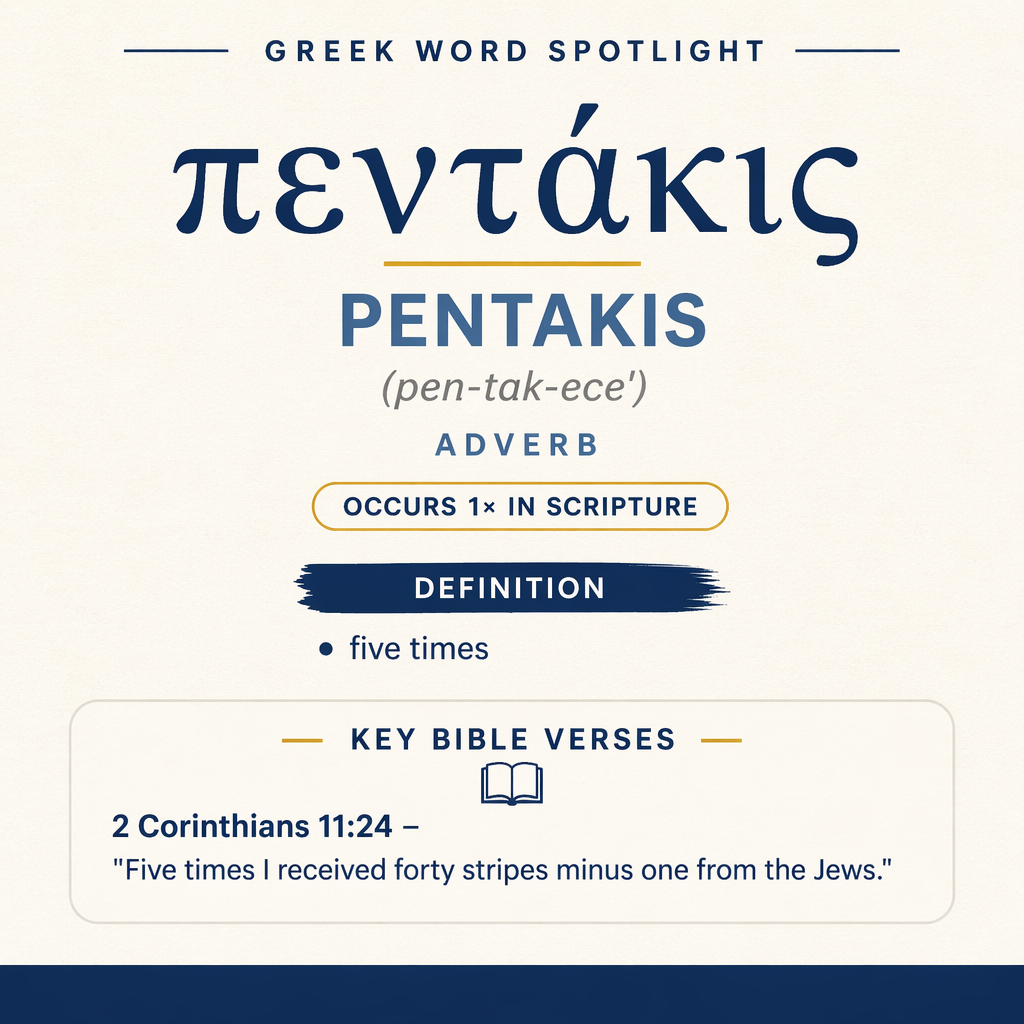
πεντάκις means “five times” and appears in 2 Corinthians 11:24.
Scripture Occurrence
It occurs 1 time in Scripture. The occurrence is in 2 Corinthians 11:24.
Learn More →Verse Context
In 2 Corinthians 11:24, it describes receiving forty stripes minus one from the Jews five times.
Learn More →πεντάκις expresses the idea of something occurring “five times.” It appears in the catalog of sufferings in 2 Corinthians 11:24, where it marks the repeated experience of a specific punishment.
Root and Related Words
πεντάκις derives from pente (πέντε), meaning “five” (Strong’s G4002). The related numeral supplies the count that πεντάκις applies to an action or event.

Occurrences
“Five times I received forty stripes minus one from the Jews.” (2 Corinthians 11:24)
Here πεντάκις sets the frequency for a concrete, bodily experience: receiving “forty stripes minus one.” The statement is not framed as a single incident but as a pattern repeated on five separate occasions. By attaching a precise count to the verb “received,” the adverb turns the line into measured testimony: the speaker is not merely claiming to have suffered, but to have undergone the same kind of beating repeatedly.
The structure of the sentence makes the number function as the headline of the clause. “Five times” stands at the front, shaping how the reader hears everything that follows. What comes after is already severe—“forty stripes minus one”—yet πεντάκις intensifies the picture by multiplying that severity across multiple episodes. In this way the adverb contributes a cumulative force: the pain implied by “stripes” is not a one-off memory but something endured again and again.
πεντάκις also interacts with the phrase “from the Jews.” The adverb does not alter who administered the punishment, but it underscores how often this specific source of hostility resulted in the same outcome. The line therefore reads as a quantified report of repeated conflict: the speaker has been subjected to this penalty in a recurring way, enough times to be counted and stated plainly.
Sense and Usage
As an adverb meaning “five times,” πεντάκις answers a simple question of frequency: how many times did the stated event happen? In 2 Corinthians 11:24 it modifies the act of receiving lashes, giving the reader a definite total. The effect is to move the claim from general impression (“often,” “many times”) to an exact enumeration. That precision matters in a context where credibility and weight are carried by specifics: the number is small enough to be counted, large enough to convey repeated exposure to danger and suffering.
Because πεντάκις is tied to a repeated action rather than a repeated object, it frames experience in terms of occurrences—separate instances that add up. The event described (“received forty stripes minus one”) is itself already numerically shaped, and πεντάκις adds a second layer of counting: not only the number of stripes in a given punishment, but the number of times the punishment occurred. The adverb thus helps the sentence present suffering as both measured and multiplied, without requiring any additional adjectives. The quantifier does the work: it makes the line feel like a tally rather than a vague recollection.
In this verse, “five times” functions rhetorically as a stabilizing detail. Numbers are resistant to exaggeration because they invite the reader to picture discrete events: one beating, then another, and so on until the fifth. πεντάκις thereby carries an implicit sense of accumulation and endurance. The speaker is portrayed as someone who has lived through repeated episodes of the same harsh treatment and can name the count.
Imagery
The word’s imagery is simple but heavy: a repeated action marked by an exact count. In 2 Corinthians 11:24, “five times” evokes not a single moment but a sequence—five separate occasions in which the speaker “received forty stripes minus one.” The adverb’s contribution is to make the suffering feel recurrent and counted, as though each occurrence has been recorded in memory as part of a growing total.
Sources: Lexical data from Strong’s Exhaustive Concordance and the Translators Brief Lexicon of Extended Strongs for Greek (STEPBible, CC BY). Occurrence data from the Translators Amalgamated Greek New Testament (STEPBible, CC BY). Scripture quotations from the World English Bible (public domain).