Exploring the Meaning of Peira in Greek
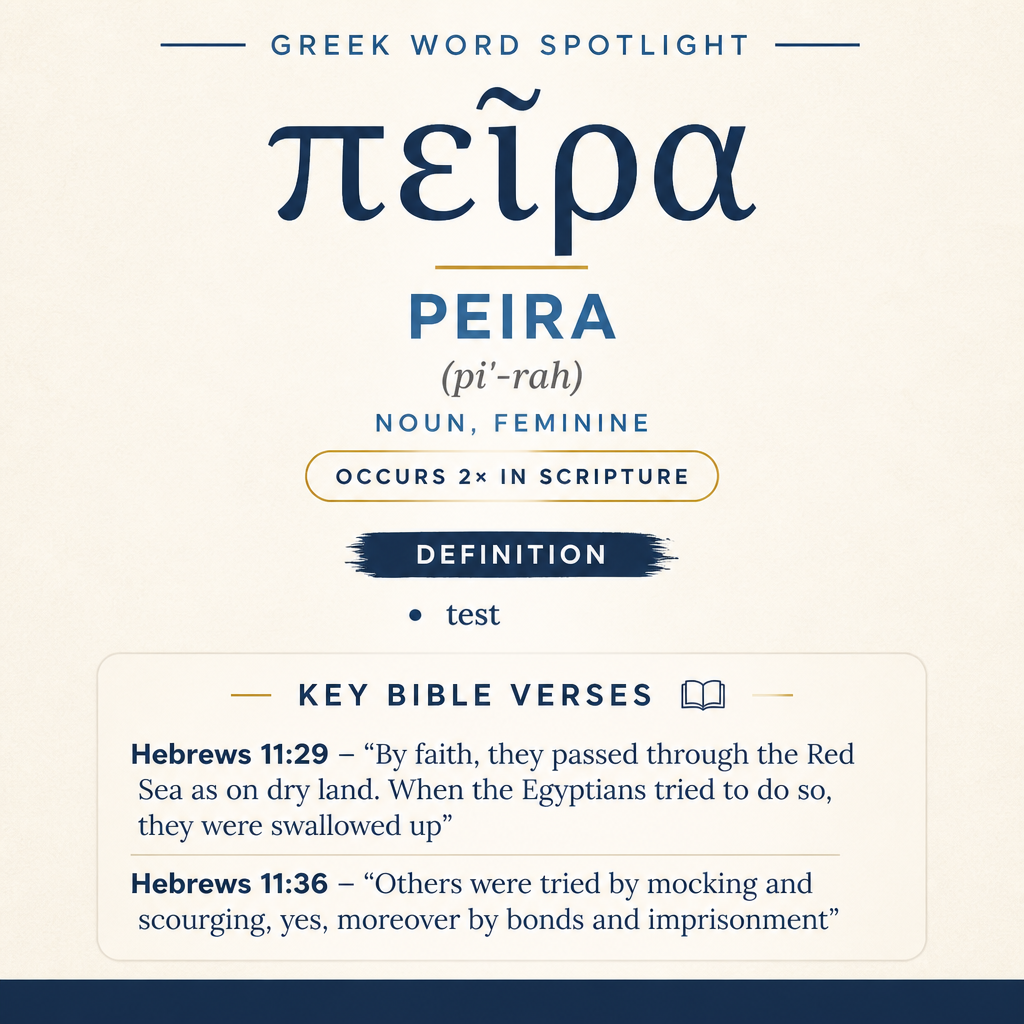
πεῖρα (Peira) means “test” and appears twice in Scripture, in Hebrews 11:29 and Hebrews 11:36.
Scripture Occurrences
πεῖρα occurs 2 times in Scripture. Both occurrences are in Hebrews 11 (11:29; 11:36).
Learn More →Hebrews Context
In Hebrews 11:29, it appears in the account of Israel crossing the Red Sea and the Egyptians being swallowed up. In Hebrews 11:36, it describes others being tried by mocking, scourging, bonds, and imprisonment.
Learn More →πεῖρα expresses the idea of a “test,” appearing twice in Hebrews 11 in scenes that contrast perilous deliverance with sustained suffering. In both places it names an experience that proves something under pressure, whether in a single decisive crisis or through drawn-out hardship.
Root and Related Words
πεῖρα (Peira) is related to peran (πέραν), “other side” (Strong’s G4008).

Occurrences
“By faith, they passed through the Red Sea as on dry land. When the Egyptians tried to do so, they were swallowed up.” (Hebrews 11:29)
In this sentence, the narrative contrast is sharp: “they passed through” while “the Egyptians tried to do so.” πεῖρα belongs to the Egyptians’ attempted crossing, set against Israel’s successful passage “as on dry land.” The verse frames the act as more than movement from one place to another; it is a venture that exposes the outcome of the attempt. The result—“they were swallowed up”—shows the attempt meeting a decisive and fatal end. Within the verse’s own logic, πεῖρα marks a test whose stakes are immediate and whose verdict is rendered by what happens when the attempt is made.
The wording also places the test in a comparative structure: one group’s passage is described as accomplished (“they passed through”), the other group’s action is presented as an attempt (“tried to do so”). This sets πεῖρα in the role of naming the moment where a course of action is put to proof. The test is not described as internal reflection or private evaluation; it is enacted—an undertaken course that reveals its truth in the outcome. In the scene’s imagery, the Red Sea functions as the setting in which the test is faced and resolved.
“Others were tried by mocking and scourging, yes, moreover by bonds and imprisonment.” (Hebrews 11:36)
Here πεῖρα appears in a catalog of sufferings that are explicitly social (“mocking”), physical (“scourging”), and restrictive (“bonds and imprisonment”). The word gathers these experiences under a single description: they constitute a testing. Unlike the sudden finality of being “swallowed up” in the prior verse, this line emphasizes duration and variety—multiple forms of hardship named in sequence. πεῖρα thus frames the listed afflictions not as random misfortunes but as experiences that function as a test when endured.
The construction “were tried by … yes, moreover by …” presents the testing as escalating and multifaceted. Mocking and scourging are joined to bonds and imprisonment, suggesting an intensification from public humiliation and bodily harm into the loss of freedom. In this verse, πεῖρα contributes the unifying idea that these diverse pressures share a single character: they press upon a person’s endurance and thereby serve as a test.
Sense and Usage
Across these two occurrences, πεῖρα consistently names a test as something encountered in lived experience rather than merely contemplated. In Hebrews 11:29, the test is concentrated in an attempted action—entering the same path through the sea that others had traversed. The attempt itself is the point of testing, and the narrative outcome supplies the verdict. The verse’s compact structure—successful passage versus attempted imitation ending in destruction—gives the test a crisp, almost instantaneous profile: the moment of undertaking brings immediate exposure.
In Hebrews 11:36, the test is not a single decisive act but an environment of pressure. The sequence of “mocking,” “scourging,” “bonds,” and “imprisonment” depicts testing as something administered through circumstances and opposition. The emphasis falls on the range of forces that can test a person: words and ridicule, physical punishment, and confinement. The test here is cumulative, forming a sustained condition in which one’s steadiness is weighed over time.
Taken together, the two verses show that a “test” can be bound either to a particular attempt with a clear outcome or to an extended ordeal made up of many forms of suffering. The term accommodates both patterns without changing its basic function: it identifies situations where reality presses in such a way that an outcome—success, failure, endurance, or collapse—becomes manifest. In Hebrews 11’s rhetorical flow, πεῖρα helps distinguish between mere description of events and the portrayal of those events as proving-grounds.
The pairing also highlights how a test may involve agency in different ways. The Egyptians “tried to do so”: the testing is attached to an initiated attempt, a decision to enter the same route. In contrast, “Others were tried” by specified hardships: the testing is attached to what is suffered, pressures coming upon them through ridicule, violence, and restraint. In both, πεῖra belongs to the point where actions and experiences meet constraining reality, whether through an attempted crossing or through externally imposed affliction.
Imagery
In Hebrews 11:29, the imagery of the sea crossing supplies a vivid setting for a test: a dangerous passage that can be undertaken, imitated, and survived—or attempted and end in being “swallowed up.” In Hebrews 11:36, the imagery shifts from waters to human-inflicted pain and confinement, portraying a test through voices that mock, instruments that scourge, and bonds that restrict. Together these scenes present testing as something that can arrive in both dramatic crises and grinding adversity, each with its own texture of pressure.
Sources: Lexical data from Strong’s Exhaustive Concordance and the Translators Brief Lexicon of Extended Strongs for Greek (STEPBible, CC BY). Occurrence data from the Translators Amalgamated Greek New Testament (STEPBible, CC BY). Scripture quotations from the World English Bible (public domain).