
Exploring the Meaning of Paraplesion in Greek
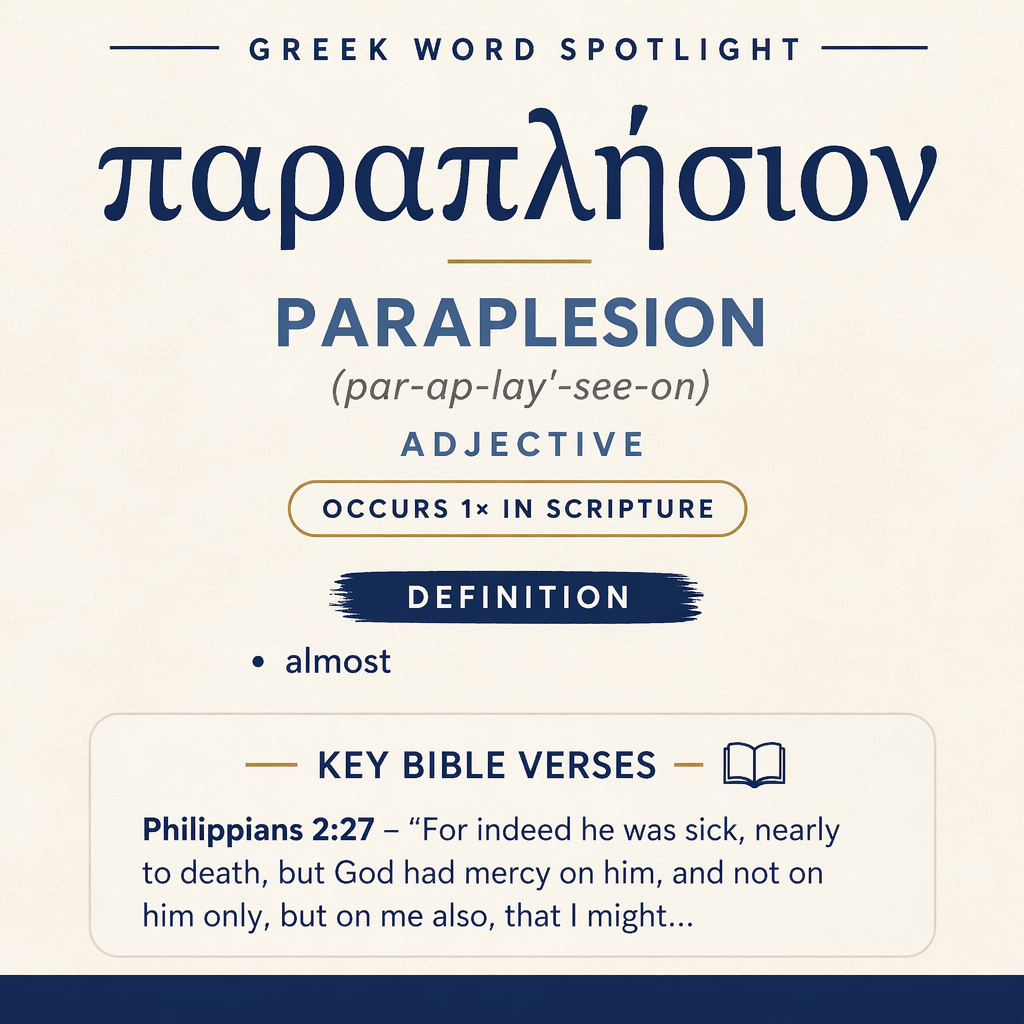
παραπλήσιον means “almost” and appears once in Scripture in Philippians 2:27.
Verse Context
In Philippians 2:27, it describes being sick nearly to death, followed by God’s mercy.
Learn More →παραπλήσιον means “almost” and appears in the description of Epaphroditus’s illness in Philippians. In that setting it marks a situation that came close to a final outcome without crossing into it.
Root and Related Words
παραπλήσιον is associated with παρα (para, παρά), “from/with/beside,” and πλησίον (plesion, πλησίον), “near/neighbor.”

Occurrences
“For indeed he was sick, nearly to death, but God had mercy on him, and not on him only, but on me also, that I might not have sorrow on sorrow.” (Philippians 2:27)
In this sentence the word functions to place Epaphroditus’s sickness at the edge of death: the condition is described as reaching a point “nearly” there, with death looming as the immediate boundary of what could have happened. The phrasing holds together two realities in tight sequence: the severity of the illness (“he was sick”) and the proximity of the danger (“nearly to death”). By doing so, it frames what follows—“but God had mercy on him”—as relief from an outcome that was close enough to be felt as a real possibility, not a distant threat.
The same line also links this near-outcome to Paul’s emotional stakes: mercy toward the sick man becomes mercy toward Paul as well, “that I might not have sorrow on sorrow.” The adverbial idea conveyed by “nearly” supplies the background for this layering of sorrow. If death had occurred, sorrow would have been added to sorrow; since the situation came close without reaching the endpoint, the mercy described is experienced as the prevention of compounded grief. The word therefore contributes to the verse’s emotional logic: it is precisely the closeness of the peril that makes the spared result feel weighty.
Sense and Usage
“Almost” in Philippians 2:27 is used with a limit in view (“to death”). The word’s force lies in its measurement of distance to a boundary rather than in naming the boundary itself: it tells the reader that the boundary was approached closely, while still distinguishing approach from arrival. This is not a vague intensifier detached from any reference point; it is attached to a specific end state and therefore communicates a narrow margin. The narrative effect is to hold the reader in the space between two possible endings—death as an imminent possibility and life as the actual outcome—without collapsing them into the same thing.
The verse also shows how “almost” can carry a double emphasis. First, it underscores seriousness: being sick “nearly to death” is a way of describing sickness at its most critical intensity. Second, it heightens gratitude and relief: the line “but God had mercy on him” is heard against the backdrop of how close the loss was. The word thus sharpens the contrast created by “but,” because the turn is not from mild illness to recovery but from a near-terminal situation to mercy.
Within the sentence, the term is placed early, before any explanation of mercy and sorrow. That ordering makes the closeness of the danger the premise upon which the rest of the statement rests. Mercy is not introduced as a general kindness in abstract; it is tied to a situation that had advanced to the brink. Likewise, Paul’s personal consequence (“that I might not have sorrow on sorrow”) is not presented as a disproportionate reaction but as a natural response to how near the event was to producing irreversible grief.
Because the word appears with “to death,” it functions as a marker of approach toward an ultimate limit that would have ended the situation. The phrase “nearly to death” keeps death outside the line—death is not said to have happened—yet keeps it close enough to dominate the scene’s emotional and theological framing. The mercy described is therefore not merely restorative; it is preservative in relation to a looming end.
Imagery
The imagery carried by “nearly to death” is the image of a life brought to the edge: a person weakened to the point where death is the next step, and then spared. In Philippians 2:27 that edge is felt not only in physical terms (“he was sick”) but also in relational and emotional terms, since Paul’s “sorrow on sorrow” is portrayed as what would have followed if the near-outcome had become actual.
Sources: Lexical data from Strong’s Exhaustive Concordance and the Translators Brief Lexicon of Extended Strongs for Greek (STEPBible, CC BY). Occurrence data from the Translators Amalgamated Greek New Testament (STEPBible, CC BY). Scripture quotations from the World English Bible (public domain).




