
Exploring the Meaning of Parapleo in Greek
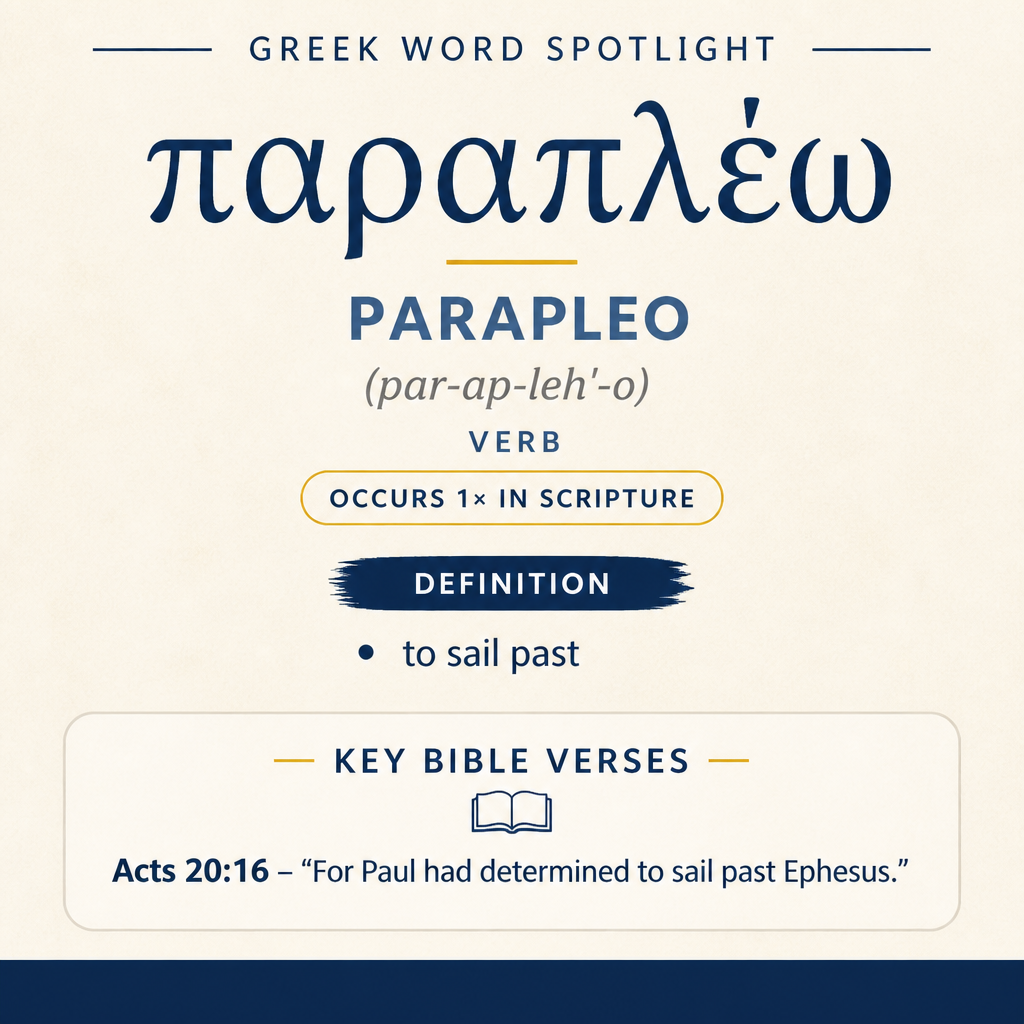
παραπλέω means “to sail past” and appears once in Scripture, in Acts 20:16.
Acts Context
In Acts 20:16, Paul determined to sail past Ephesus so he would not spend time in Asia.
Learn More →παραπλέω means “to sail past,” and it appears once in the New Testament narrative of Paul’s travel plans. In Acts it expresses a deliberate decision to pass a port without stopping, shaping the pace and direction of the journey.
Root and Related Words
παραπλέω is formed from παρά (pará), “from/with/beside” (Strong’s G3844), and πλέω (pléō), “to sail” (Strong’s G4126). The combination naturally suits a sailing context in which movement is not merely toward a destination but along it—near enough to be named, yet treated as a place passed by.

Occurrences
“For Paul had determined to sail past Ephesus, that he might not have to spend time in Asia; for he was hastening, if it were possible for him, to be in Jerusalem on the day of Pentecost.” (Acts 20:16)
In Acts 20:16 the verb marks a strategic choice about route and timing: “Paul had determined to sail past Ephesus.” The clause is framed as an intention (“had determined”), and the action (“to sail past”) is the practical means of fulfilling that intention. The effect is to portray Ephesus as a known, reachable stopping point that is nonetheless intentionally bypassed.
The verse immediately supplies the purpose: “that he might not have to spend time in Asia.” Here “to sail past” functions as a time-saving decision. It is not simply movement on the sea; it is movement that avoids the kinds of commitments that come with arrival—“spend time” in a region. The verb therefore contributes a sense of forward momentum built into the travel plan itself: the ship’s course becomes an instrument for guarding the schedule.
The final clause explains the pressure driving this decision: “for he was hastening, if it were possible for him, to be in Jerusalem on the day of Pentecost.” Within this logic, “to sail past” is tied to haste and a target date. The verb sits at the hinge between geography (Ephesus, Asia) and calendar (Pentecost), showing how a coastal city can become a potential delay when a traveler is aiming for a particular arrival. The narrative does not treat “sailing past” as accidental drift; it is purposeful navigation shaped by a fixed goal.
Sense and Usage
The sense “to sail past” in Acts 20:16 depicts a passing-by that is close enough to be meaningful: Ephesus is explicitly named as the location not entered. The verb therefore conveys more than “to sail” in general; it expresses sailing in relation to a landmark that could have been a stop. The statement presumes awareness of the place and the normal possibility of calling there, while emphasizing the conscious decision not to do so.
Because the only attested New Testament use occurs within an explanation (“that he might not have to spend time…”), the verb is tightly connected to intent and consequence. It serves narrative economy: one word signals both movement and restraint—movement toward another destination and restraint from commitments that would slow progress. In this passage, the choice to pass a known city functions as a practical expression of urgency. The schedule (“to be in Jerusalem on the day of Pentecost”) gives the passing-by its force: the ship does not merely go elsewhere; it goes elsewhere on purpose, with time measured and guarded.
The components pará (“from/with/beside”) and pléō (“to sail”) fit the scene’s spatial nuance. “To sail past” is sailing with reference to a place alongside the route: the ship proceeds near enough that the city is part of the journey’s mental map, yet the journey’s line continues beyond it. In Acts 20:16 this relationship to place helps the reader feel the difference between traveling generally and traveling with disciplined selectivity—choosing not only where to go, but where not to pause.
Imagery
The word evokes the image of a vessel moving along a familiar coastline, a city within sight or reach yet left behind for the sake of a pressing appointment. In Acts 20:16, that image is anchored to purposeful haste: sailing past becomes a visible sign of determination to reach Jerusalem by Pentecost.
Sources: Lexical data from Strong’s Exhaustive Concordance and the Translators Brief Lexicon of Extended Strongs for Greek (STEPBible, CC BY). Occurrence data from the Translators Amalgamated Greek New Testament (STEPBible, CC BY). Scripture quotations from the World English Bible (public domain).




