
Exploring the Meaning of Para in Greek
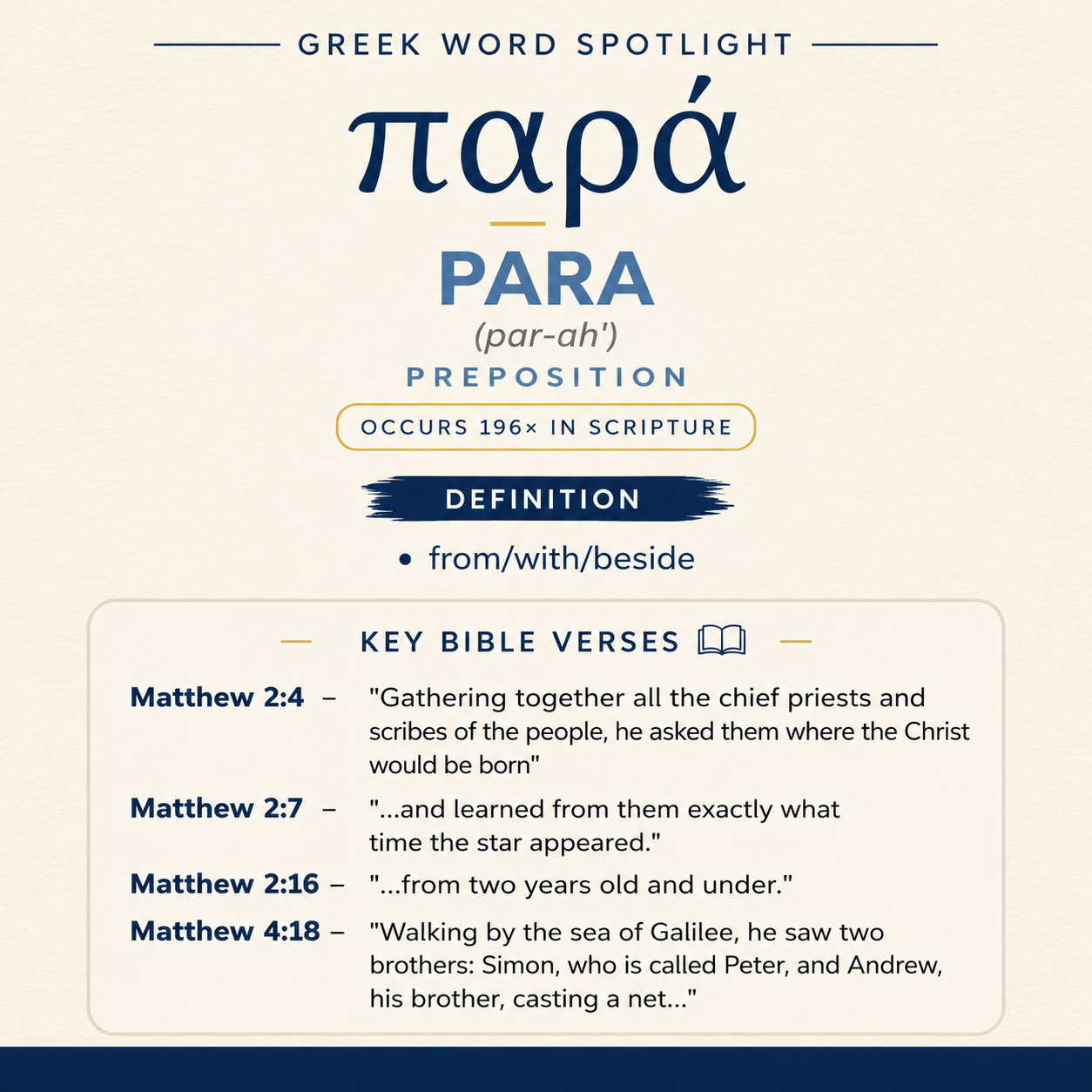
παρά (Para) means “from/with/beside,” occurs 196 times in Scripture, and appears in passages such as Matthew 2:4 and Matthew 13:4.
Core Meaning
παρά means “from/with/beside.” It expresses relation in terms of origin, association, or proximity.
Learn More →Scripture Frequency
παρά occurs 196 times in Scripture. This reflects broad distribution across biblical contexts.
Learn More →Matthew Examples
Matthew shows παρά in varied scenes, including Matthew 2:7 and Matthew 4:18. It also appears in Matthew 6:1 and Matthew 13:1.
Learn More →παρά expresses proximity and relational orientation—movement or position “from/with/beside.” In the passages below it repeatedly shapes scenes of inquiry, location, and presence: information is obtained from others, actions occur beside the sea or roadside, and people seek recognition, help, or agreement with others.
Occurrences
Matthew 2:4 — “Gathering together all the chief priests and scribes of the people, he asked them where the Christ would be born.”
In Herod’s consultation, παρά contributes the “from/with” side of the inquiry: the king’s question is not floating in general, but directed toward others as sources of information. The verse’s scene is built on being “with” assembled experts and drawing an answer “from” them.

Matthew 2:7 — “Then Herod secretly called the wise men, and learned from them exactly what time the star appeared.”
Here παρά frames the wise men as the point “from” whom precise knowledge is obtained. The secrecy of the meeting and the exactness of the time both highlight that the information is not self-generated; it is learned “from/with” these visitors.
Matthew 2:16 — “Then Herod, when he saw that he was mocked by the wise men, was exceedingly angry, and sent out, and killed all the male children who were in Bethlehem and in all the surrounding countryside, from two years old and under, according to the exact time which he had learned from the wise men.”
Within this grim account, παρά again fixes the origin point of Herod’s timing: the “exact time” is something he had learned “from” the wise men. The verse ties a later action to prior information received from a particular group, anchoring cause and calculation in a “from” relationship.
Matthew 4:18 — “Walking by the sea of Galilee, he saw two brothers: Simon, who is called Peter, and Andrew, his brother, casting a net into the sea; for they were fishermen.”
παρά places Jesus in close spatial relation to the sea—he is “by” it as he walks. That nearness sets the stage for what he sees: fishermen at their work, net in the water. The preposition lends the scene a concrete edge-of-water setting rather than an undefined location.
Matthew 6:1 — ““Be careful that you don’t do your charitable giving before men, to be seen by them, or else you have no reward from your Father who is in heaven.”
In this warning about charitable giving, παρά shapes two contrasting relational directions. Giving “before men” focuses attention beside and with human observers—actions done in their presence and aimed at their notice. The closing clause also speaks of reward “from” the Father, pressing the reader to consider where one’s expectation lies: from humans present nearby, or from God as the giver of reward.
Matthew 8:10 — “When Jesus heard it, he marveled, and said to those who followed, “Most certainly I tell you, I haven’t found so great a faith, not even in Israel.”
παρά helps locate where something is found or not found: Jesus’ assessment sets faith in relation to a people and place (“not even in Israel”). The saying works by comparison and location—faith is sought “with/beside” a known community, and the surprising claim is that it is not found there in that measure.
Matthew 13:1 — “On that day Jesus went out of the house, and sat by the seaside.”
παρά marks Jesus’ chosen teaching posture as “by” the sea. The movement out of the house ends at a boundary-space where land meets water, a “beside” location that is public and open, suited to gathering listeners.
Matthew 13:4 — “As he sowed, some seeds fell by the roadside, and the birds came and devoured them.”
In the sowing scene, παρά identifies a marginal landing place—seed that falls “by” the roadside, not in the tilled soil. The “beside” position immediately affects the outcome: exposed and accessible, it is quickly taken by birds. The preposition thus helps draw the line between what lands within a cultivated area and what ends up at its edge.
Matthew 13:19 — “When anyone hears the word of the Kingdom, and doesn’t understand it, the evil one comes, and snatches away that which has been sown in his heart. This is what was sown by the roadside.”
παρά returns in the explanation, keeping the image of “by the roadside” as a key interpretive location. The “beside” placement corresponds to vulnerability: what is sown ends up positioned at the edge rather than settled within understanding, and so it is quickly removed. The preposition keeps the focus on where the seed lies in relation to the path.
Matthew 15:29 — “Jesus departed from there, and came near to the sea of Galilee; and he went up into the mountain, and sat there.”
παρά contributes the approach-and-nearness dimension: Jesus “came near to the sea of Galilee.” The verse sketches a route that includes proximity to the sea and then ascent to the mountain, so that “near/beside” becomes a waypoint in the narrative’s geography.
Matthew 15:30 — “Great multitudes came to him, having with them the lame, blind, mute, maimed, and many others, and they put them down at his feet. He healed them,”
Here παρά supports the “with” relationship: the crowds arrive “having with them” the afflicted. The verse emphasizes accompaniment and burden-bearing—people are brought in company with others, and the needy are set beside Jesus’ feet. The preposition helps portray the crowd not as isolated individuals but as groups arriving together with those they carry and represent.
Matthew 18:19 — “Again, assuredly I tell you, that if two of you will agree on earth concerning anything that they will ask, it will be done for them by my Father who is in heaven.”
παρά marks the source “by” whom the requested action is accomplished: “it will be done for them by my Father who is in heaven.” The saying holds together human agreement on earth and divine action from heaven, using the preposition to assign the effective agency and originating side of the outcome.

Sense and Usage
Across these verses, παρά repeatedly establishes a standpoint—either the side from which something comes, the company with which something is carried out, or the physical edge beside which a person or thing is located. In Matthew 2:4, 2:7, and 2:16, the word is tied to gaining knowledge: Herod asks assembled leaders and learns “from” the wise men, so that the subsequent narrative turns on information received from others rather than discovered alone. The same directional force appears in statements about reward and divine action: Matthew 6:1 contrasts human visibility “before men” with reward “from” the Father, and Matthew 18:19 places the decisive doing of the requested thing “by” the Father.
In the Galilee scenes (Matthew 4:18; 13:1; 15:29), παρά grounds the narrative in boundary spaces—by the sea, near the sea. These are not merely scenic details; the “beside” setting places Jesus where movement, work, and crowds naturally occur. In the parable material (Matthew 13:4, 13:19), “by the roadside” uses the same spatial idea to draw a sharp edge: what is beside the path is exposed and easily taken. The preposition thereby serves as a simple locator that carries narrative consequence: proximity is not neutral; being at the margin affects what happens next.
When the emphasis shifts from place to people, παρά highlights association and accompaniment. Matthew 15:30 pictures multitudes arriving with others in their care—those who cannot come unaided are nevertheless present because they are brought “with” the crowd. In this way the preposition can quietly bind the scene together: persons are not only in the same area but are present in relation to one another—walking beside a shoreline, standing before observers, learning from informants, arriving with those in need, and receiving outcomes done by the Father.
Imagery
Several passages attach παρά to edges and presences: the shoreline where someone walks or sits, the roadside where seed lies exposed, the gathered groups from whom knowledge is drawn, and the crowds arriving with those they carry. The word’s repeated “from/with/beside” orientation gives these scenes their lines—who stands before whom, who receives from whom, and what lies at the edge rather than safely within.
Sources: Lexical data from Strong’s Exhaustive Concordance and the Translators Brief Lexicon of Extended Strongs for Greek (STEPBible, CC BY). Occurrence data from the Translators Amalgamated Greek New Testament (STEPBible, CC BY). Scripture quotations from the World English Bible (public domain).




