Exploring the Meaning of Opse in Greek
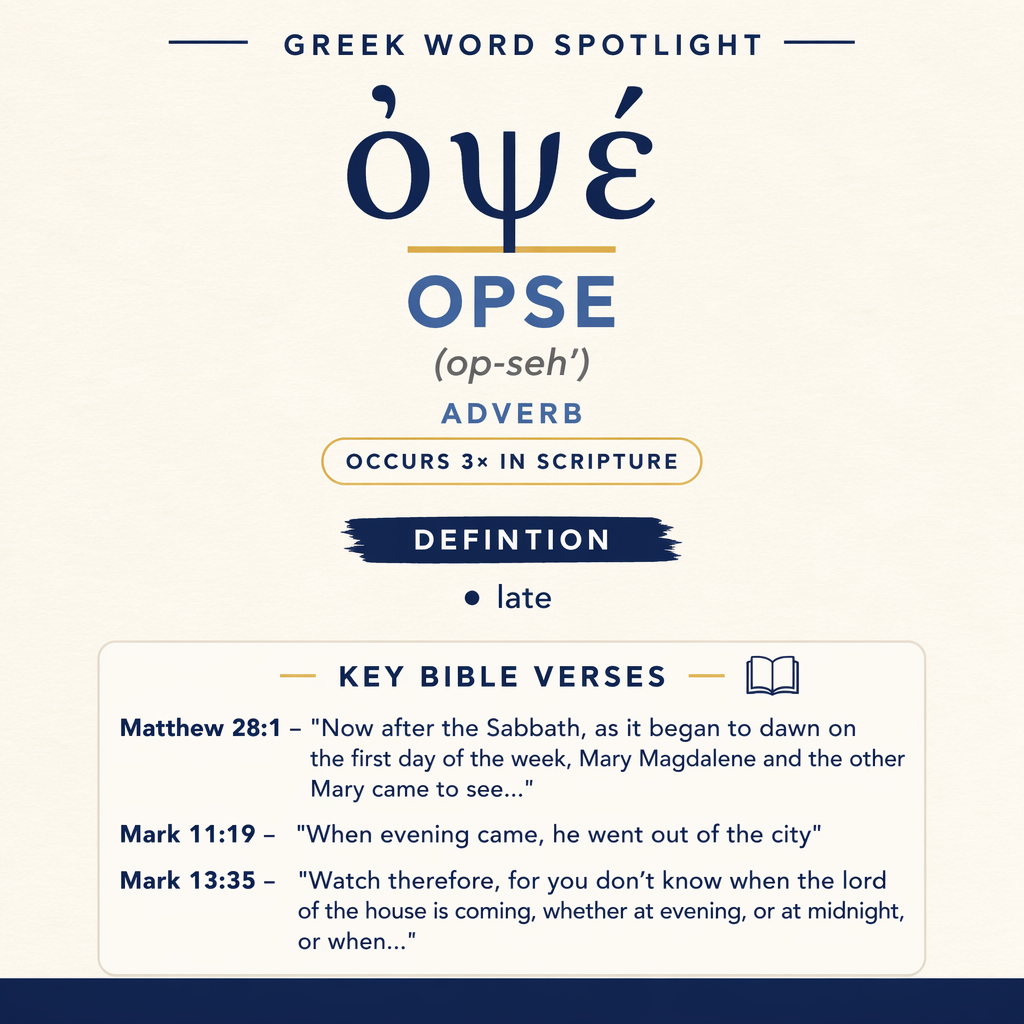
ὀψέ means “late” and appears three times in Scripture: Matthew 28:1; Mark 11:19; Mark 13:35.
Scripture Occurrences
It occurs 3 times in Scripture: Matthew 28:1; Mark 11:19; Mark 13:35.
Learn More →Verse Context
In Mark 11:19 it appears in a setting described as “When evening came.” In Mark 13:35 it is linked with times including “at evening” and “at midnight.”
Learn More →ὀψέ marks time as late, placing an action or expected event toward the latter part of a period. In the New Testament it appears in scenes that move from Sabbath into the first day of the week and from daytime into evening, and it also frames a warning about the uncertainty of a master’s return.
Root and Related Words
ὀψέ is related to the adverb ὀπίσω (opiso), “after” (Strong’s G3694). This relationship highlights a shared orientation toward what comes later in sequence.

Occurrences
Matthew 28:1 — “Now after the Sabbath, as it began to dawn on the first day of the week, Mary Magdalene and the other Mary came to see the tomb.”
Here ὀψέ situates the women’s visit in the late edge of the Sabbath period—at the transition point when the week’s first day is beginning to dawn. The narrative pacing depends on that timing: the Sabbath is over, yet the light of morning is only beginning. Within the verse’s temporal movement (“after the Sabbath” and “began to dawn”), ὀψέ helps hold both sides of the boundary together, indicating that the action occurs not in the middle of the Sabbath or the full brightness of day, but at the late moment when one sacred day has concluded and another day is just starting. The visit “to see the tomb” is thus presented as an early undertaking, but one that follows a late ending—an arrival at the first available time after the Sabbath has passed.
Mark 11:19 — “When evening came, he went out of the city.”
In this brief report, ὀψέ fixes the departure from the city at the late point of the day, the onset of evening. The verse gives no additional details about the journey or destination; its emphasis is the time cue. By locating the movement “when evening came,” ὀψέ provides a natural close-of-day rhythm: the public setting implied by “the city” is left as daylight ends. The effect is to mark a shift in activity, from whatever has taken place during the day to a withdrawal that matches the late hour. The adverb functions almost like a hinge in the narrative, turning the scene from daytime presence to evening absence with a single temporal marker.
Mark 13:35 — “Watch therefore, for you don’t know when the lord of the house is coming, whether at evening, or at midnight, or when the rooster crows, or in the morning;”
In this warning, ὀψέ names one of several possible times for an unexpected arrival: “at evening.” The line is built to stress uncertainty (“you don’t know when”), and the sequence of time options spans a full cycle from evening through midnight, toward the rooster’s crow, and into morning. Within that list, ὀψέ points to the late-day threshold, the moment when the household might begin to settle and watchfulness can easily relax. The admonition “Watch therefore” gains force because the arrival is not tied to a predictable schedule; the master could come at the late time of evening just as readily as at the later night or early morning points that follow in the verse. ὀψέ thus contributes to the breadth of the warning, establishing that the uncertain return could begin as early as evening in the night’s unfolding.
Sense and Usage
Across these passages, ὀψέ consistently functions as a time-setting adverb that pushes attention toward the latter portion of a day or a defined period. In Matthew 28:1, the “lateness” is attached to a calendrical boundary: the Sabbath has run its course, and the action takes place at the point where dawn begins on the first day of the week. The adverb supports the verse’s careful placement of events at a transition—late in relation to what has just ended, and adjacent to what has just begun.
In Mark 11:19, the “late” reference is simpler and more immediate: evening has come. There is no explicit contrast with another period, yet the adverb still cues the reader to a change in conditions and expectations that accompany the day’s close. The verse’s economy makes the time marker carry much of the scene’s weight; the lateness is enough to explain the shift in location (“he went out of the city”) without elaboration.
Mark 13:35 uses ὀψέ as one piece in a structured set of time possibilities. Evening stands at the head of that set, followed by deeper night (“at midnight”), then a pre-dawn sign (“when the rooster crows”), and then daylight (“in the morning”). In that context, ὀψέ participates in a comprehensive sweep that covers the entire night watch, making the command to stay alert applicable at every point in the cycle. The lateness here is not merely descriptive; it is rhetorically functional, broadening the range of plausible times for the master’s return and preventing the listener from assuming a safer, more predictable hour.
These uses show that ὀψέ can anchor time in two complementary ways: (1) as a marker of transition (late Sabbath moving into dawn), and (2) as a marker within a repeating daily rhythm (evening as the late edge of day, and evening as the first segment of a night-long period of uncertainty). In each case the word is economical—one temporal term that reshapes how the surrounding actions are read, whether that action is coming to a tomb, leaving a city, or maintaining watchfulness in a household setting.
Imagery in Context
The imagery connected with ὀψέ in these passages is the imagery of thresholds: the first light after Sabbath in Matthew, the settling of evening in Mark 11, and the opening of the night’s watch in Mark 13. The word repeatedly places events at a time when visibility, activity, and expectation are shifting—moments when a day ends or a new span begins, and the right response (going, leaving, watching) is shaped by the lateness of the hour.
Sources: Lexical data from Strong’s Exhaustive Concordance and the Translators Brief Lexicon of Extended Strongs for Greek (STEPBible, CC BY). Occurrence data from the Translators Amalgamated Greek New Testament (STEPBible, CC BY). Scripture quotations from the World English Bible (public domain).