
Exploring the Meaning of Opheilo in Greek
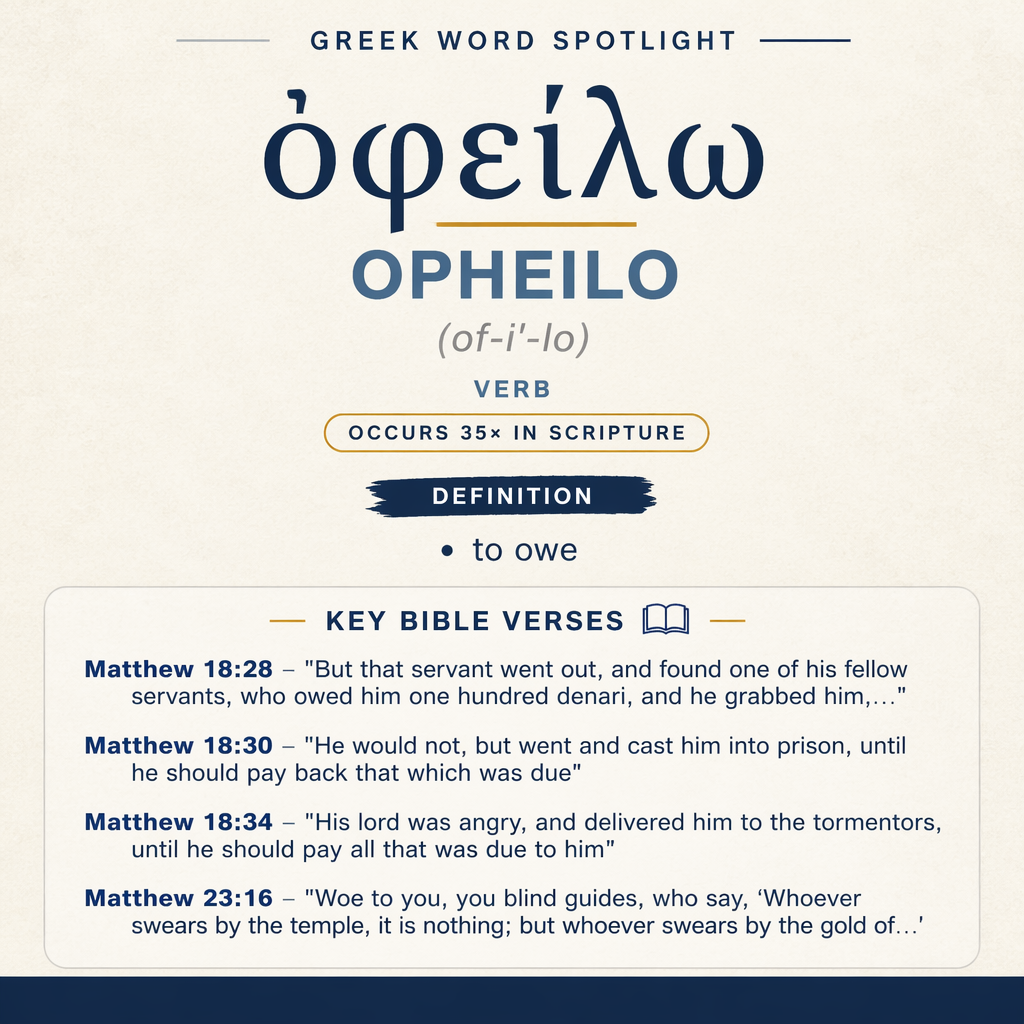
ὀφείλω means “to owe” and occurs 35 times in Scripture, including Matthew 18:28–34, Matthew 23:16–18, and Luke 7:41; 11:4; 16:5.
Core Meaning
ὀφείλω means “to owe.” In the listed passages it describes debts, what is due, and obligation.
Learn More →Debt Scenes
In Matthew 18:28–34 and Luke 7:41; 16:5, it is used for owing denarii and paying what is due. These texts picture debtors and repayment.
Learn More →Obligation Language
In Matthew 23:18 it is used for being obligated. In Luke 11:4 it appears alongside forgiving everyone indebted to us.
Learn More →ὀφείλω means “to owe,” expressing the condition of being under an obligation. In the passages where it appears here, it is used for financial debts in parables and sayings, and also for binding moral or legal obligation.
Occurrences
“But that servant went out, and found one of his fellow servants, who owed him one hundred denarii, and he grabbed him, and took him by the throat, saying, ‘Pay me what you owe!’” (Matthew 18:28)
Here ὀφείλω marks a definite, countable debt: “one hundred denarii.” The word frames the conflict as one of obligation and repayment, which the servant enforces violently (“he grabbed him, and took him by the throat”). The demand “Pay me what you owe!” makes the debt the central issue driving the servant’s actions.
He would not, but went and cast him into prison, until he should pay back that which was due. (Matthew 18:30)
Although ὀφείλω is not echoed in the quoted wording, the scene continues the same obligation by focusing on the debt’s discharge: “pay back that which was due.” The refusal (“He would not”) and the chosen punishment (“cast him into prison”) show how the owing relationship is treated as enforceable until repayment occurs.
His lord was angry, and delivered him to the tormentors, until he should pay all that was due to him. (Matthew 18:34)
The debt-language escalates from a smaller interpersonal claim to a comprehensive settlement: “pay all that was due to him.” Within the parable’s logic, what is owed is not optional; it is an outstanding liability that remains until fully met. The word’s force is felt in the “until,” tying the servant’s fate to the resolution of what is owed.
“Woe to you, you blind guides, who say, ‘Whoever swears by the temple, it is nothing; but whoever swears by the gold of the temple, he is obligated.’” (Matthew 23:16)
In this rebuke, ὀφείλω shifts from money owed to a binding obligation created by speech (“swears”). The contrast (“by the temple, it is nothing” versus “by the gold of the temple, he is obligated”) shows how obligation can be assigned or denied depending on what object the oath is attached to. The verb identifies the person as placed under a requirement by the act of swearing.
“‘Whoever swears by the altar, it is nothing; but whoever swears by the gift that is on it, he is obligated?’” (Matthew 23:18)
The same logic is repeated with different sacred items (“altar” and “gift”), and ὀφείλω again expresses enforceable obligation arising from an oath. The term sharpens the critique: obligations are being treated as selectively binding based on a hierarchy of what is considered weightier. The verb’s role is to label when a person stands under a claim that must be honored.
“A certain lender had two debtors. The one owed five hundred denarii, and the other fifty.” (Luke 7:41)
Here ὀφείλω describes the debtors’ status in relation to the lender, quantified in two amounts. The word is the hinge for the comparison: both are genuinely debtors, but the size of what is owed differs drastically (“five hundred” versus “fifty”). The verb presents owing as a measurable obligation, making the imbalance easy to grasp.
Forgive us our sins, for we ourselves also forgive everyone who is indebted to us. Bring us not into temptation, but deliver us from the evil one.’ ” (Luke 11:4)
In this prayer, the owing concept is applied to interpersonal relations: “everyone who is indebted to us.” ὀφείλω supplies the relational framework that makes forgiveness intelligible as releasing someone from an outstanding claim. The pairing of “Forgive us our sins” with forgiving those “indebted to us” places owing-language alongside moral failure and reconciliation within the same request.
Calling each one of his lord’s debtors to him, he said to the first, ‘How much do you owe to my lord?’ (Luke 16:5)
ὀφείλω appears as the direct question that surfaces the debtor’s exact liability: “How much do you owe to my lord?” The verb implies an accounting context where obligations can be stated, tallied, and negotiated. It also clarifies the social relationship: the debt is owed not merely to the speaker but “to my lord,” underlining whose claim is in view.
Then he said to another, ‘How much do you owe?’ He said, ‘A hundred cors of wheat.’ He said to him, ‘Take your bill, and write eighty.’ (Luke 16:7)
Again ὀφείλω frames the interaction as a matter of quantified obligation (“A hundred cors of wheat”). The command to alter the written record (“Take your bill, and write eighty”) treats what is owed as something that can be reduced on paper, but the narrative tension remains: the verb keeps the focus on the debtor’s obligation and the practical mechanisms by which it is recorded and adjusted.
Even so you also, when you have done all the things that are commanded you, say, ‘We are unworthy servants. We have done our duty.’ ” (Luke 17:10)
Here the concept of owing is expressed as duty in response to commands: after doing “all the things that are commanded,” servants conclude, “We have done our duty.” The underlying idea matches ὀφείλω’s obligation-category: certain actions are not treated as extraordinary merits but as required responses. The saying locates the servant’s work within what is owed as part of service.
If I then, the Lord and the Teacher, have washed your feet, you also ought to wash one another’s feet. (John 13:14)
In this instruction, ὀφείλω grounds a reciprocal obligation in an enacted example: because the Lord and Teacher has washed feet, “you also ought to wash one another’s feet.” The verb makes the response not merely advisable but binding within the relationship created by the Teacher’s action. Owing is expressed as a concrete, humble practice directed toward “one another.”
The Jews answered him, “We have a law, and by our law he ought to die, because he made himself the Son of God.” (John 19:7)
Here ὀφείλω is used in a legal register: “by our law he ought to die.” The obligation is presented as deriving from “a law,” and the verb turns the stated charge (“because he made himself the Son of God”) into a demanded outcome. Owing is no longer a debt to be paid but a judicial necessity asserted by an appeal to legal authority.

Sense and Usage
Across these passages, ὀφείλω consistently identifies a person as standing under an obligation that is conceived as real and enforceable. In the parabolic debt scenes, the obligation is financial and quantifiable: denarii in Matthew 18:28 and Luke 7:41, and commodities with written documentation in Luke 16:7 (“A hundred cors of wheat… Take your bill”). The verb functions like a spotlight: it pinpoints the exact matter at issue—what one party is entitled to receive and what the other is bound to render. This clarity is what allows the narratives to portray various responses to owing: coercion (“took him by the throat”), confinement (“cast him into prison”), and the pressure of an unresolved liability that persists “until” repayment.
In Matthew 23:16 and 23:18, ὀφείλω moves from ledger-books to the binding effect of oath-taking. The obligation is still framed as something one “owes,” but the debt is created by words spoken under solemn conditions (“swears”). The repeated pattern (“it is nothing… he is obligated”) shows how the verb can be used to argue about when an obligation truly attaches. Here, owing is not measured in currency; it is measured in the seriousness assigned to an oath’s referent.
Luke 11:4 uses the indebtedness idea to describe relationships that require forgiveness. The word’s contribution is to portray the offense as an outstanding claim between people, something that can be held or released. Luke 17:10 and John 13:14 present obligation as duty within a role: servants in relation to commands, and disciples in relation to their Lord and Teacher’s example. In both, the verb supports a view of required action as the normal fulfillment of what is owed, not an achievement that places others in one’s debt.
John 19:7 shows that ὀφείλω can express obligation as a demanded consequence under law. The statement “by our law he ought to die” uses the language of owing to press for a verdict: the law is treated as creating a binding requirement that must be satisfied. In this way, the verb can bridge everyday economics, social ethics, and juridical claims, while keeping the same core idea of being bound to render what is due.
Imagery
The passages paint owing in concrete scenes: a hand at the throat demanding payment (Matthew 18:28), a prison door closing “until” a debt is settled (Matthew 18:30), bills being rewritten in an account room (Luke 16:7), and a basin-and-towel act that turns into a stated obligation of mutual service (John 13:14). Even when the obligation is framed by oath or law, the verb keeps the imagery of a claim that presses for satisfaction: something stands over a person as due, and the question is how that due is treated—enforced, reduced, forgiven, fulfilled as duty, or demanded as legal necessity.
Sources: Lexical data from Strong’s Exhaustive Concordance and the Translators Brief Lexicon of Extended Strongs for Greek (STEPBible, CC BY). Occurrence data from the Translators Amalgamated Greek New Testament (STEPBible, CC BY). Scripture quotations from the World English Bible (public domain).




