
‘Obed in Hebrew
Discover the meaning of אֹבֵד (obed) in Hebrew — a word for perishing and destruction. See how it appears in Balaam's oracles and what it says about the end of nations that oppose God.
Root & Meaning
From the verb abad (Strong's H6), 'to perish, be lost.' 'Obed names the perishing itself — destruction, or one who is wretched.
Learn More →Biblical Usage
Appears only 2 times, both in Balaam's oracles in Numbers 24, describing nations whose end is ruin.
See Scripture →Spiritual Significance
A sober word: earthly power set against God does not endure. Its latter end comes to destruction.
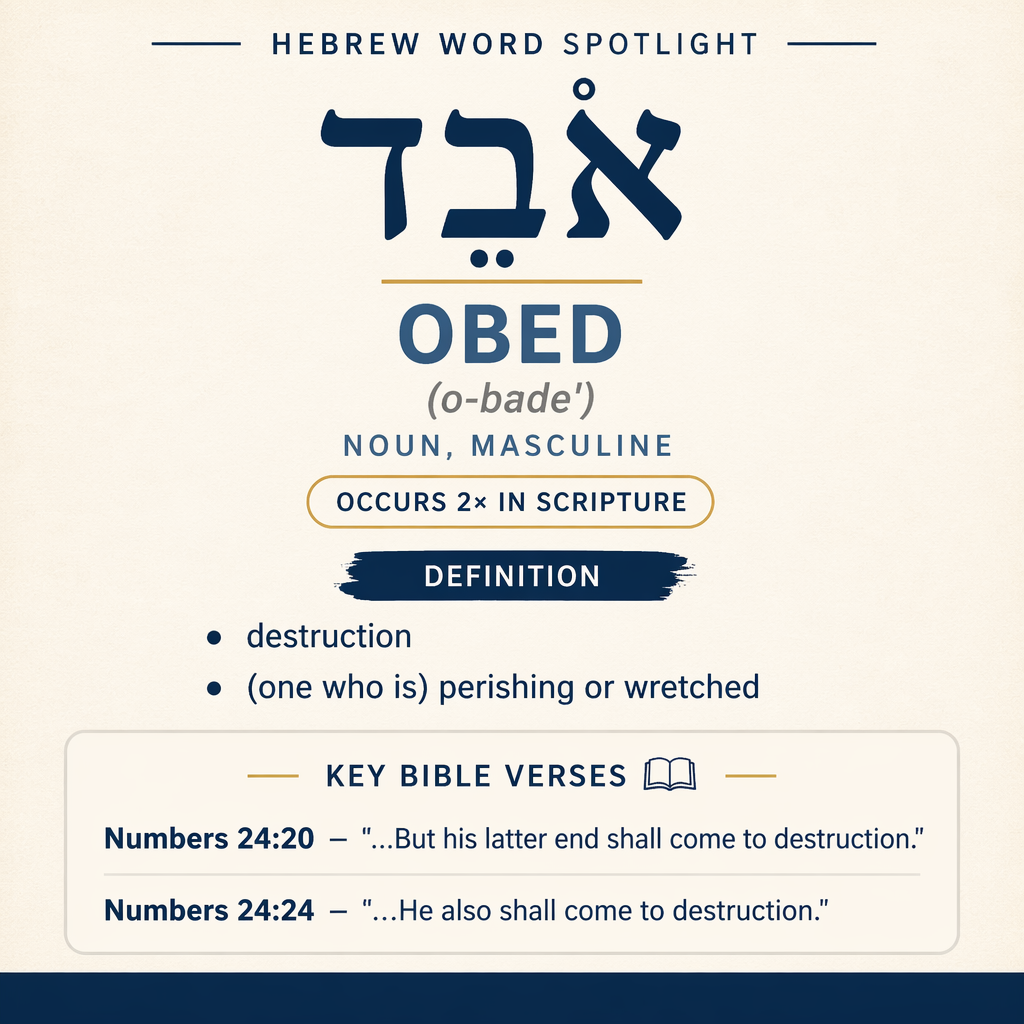
Explore Theme →obed names “destruction” and can also refer to “(one who is) perishing or wretched.” It appears only in Balaam’s oracles in Numbers 24, marking the end-point announced over nations and peoples.
Root and Related Words
obed corresponds to the Hebrew verb abad, “to perish, be lost, be destroyed” (אָבַד; Strong’s H6). In Numbers 24, the noun form functions as a terse outcome-word, drawing the focus away from the process of defeat and onto its final result.

Occurrences
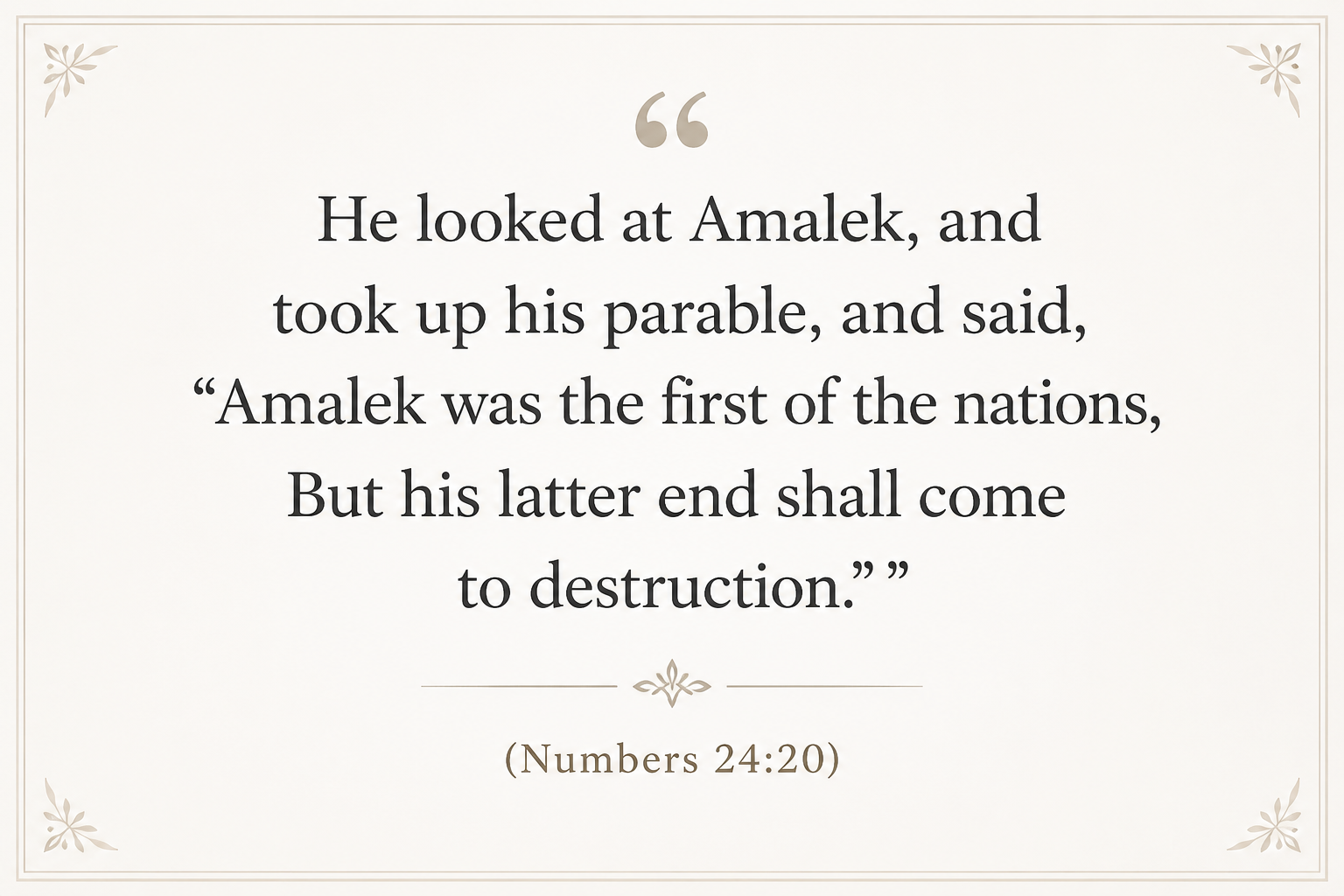
“He looked at Amalek, and took up his parable, and said, “Amalek was the first of the nations, But his latter end shall come to destruction.”” (Numbers 24:20)
Here obed stands at the end of a compact verdict: Amalek’s prominence (“the first of the nations”) is set against a stark future (“his latter end”). The word supplies the final destination of that “latter end,” expressing not merely a setback but a terminal outcome. Its placement after “shall come” makes “destruction” the point toward which the whole line moves: a future arrival, not an immediate description. In this oracle, the contrast is structural and rhetorical: an opening statement of status is answered by an ending statement of fate, and obed gives that fate its blunt, unornamented name.
“But ships shall come from the coast of Kittim. They shall afflict Asshur, and shall afflict Eber. He also shall come to destruction.”” (Numbers 24:24)
In this later saying, the horizon widens to movements and pressures among multiple groups. The verse speaks of “ships” arriving, then repeats the verb “shall afflict” with two objects: “Asshur” and “Eber.” Against that sequence of actions, obed again appears in a concluding clause: “He also shall come to destruction.” The word serves as a final line after the repeated affliction; it signals that the afflicting is not the end of the story. By shifting from “they shall afflict” to “he also shall come,” the verse moves from the agents of harm (“ships” and those connected with them) to the one singled out for an ending described by obed. The noun compresses the result into a single term, making the close of the oracle sound decisive and complete.
Sense and Usage
Across both occurrences, obed functions as an announced endpoint—something arrived at (“shall come to destruction”), not merely something experienced along the way. This repeated phrasing (“shall come to”) frames “destruction” as the terminus of a course of events. In Numbers 24:20, that course is described in terms of time (“his latter end”); in Numbers 24:24, it is described in terms of historical movement and pressure (“ships shall come… They shall afflict…”). In each case, the noun gathers up whatever precedes it and supplies the final category for the outcome.
The definition includes not only the abstract sense “destruction” but also “(one who is) perishing or wretched.” In these two texts, the word is used in the abstract, naming the fate itself rather than labeling a person directly as “perishing” or “wretched.” Even so, the syntax keeps the word closely tied to persons or peoples by speaking of someone’s end and by using a personal subject (“his latter end”; “He also”). The effect is that an abstract noun is made concrete: it is not a floating concept but the predicted finish line for those named in the oracle.
Because obed is tied to the verb abad (“to perish, be lost, be destroyed”), its usage here naturally fits the setting of pronouncements about nations under judgment. Yet the verses themselves emphasize a particular nuance: obed is not explained, detailed, or qualified. No means is specified in Numbers 24:20 beyond the bare prediction; and in Numbers 24:24, the verse narrates affliction by ships but still closes with obed as a separate, final clause. The word thus works as a summary term—an end-state that requires no additional description to carry force in the oracle’s cadence.
Another feature shared by both contexts is the contrast created by the word’s position. In Numbers 24:20, it stands opposite Amalek’s early status (“first”): a beginning answered by an end. In Numbers 24:24, it stands opposite the activity of affliction: repeated actions answered by a final destiny. In both, obed operates as a closing weight, giving the saying a sense of completion. The hearer is not left with ongoing conflict as the last image but with the certainty of an outcome expressed in a single noun.
Closing Imagery
Numbers 24 places obed in oracles that look outward over peoples and forward into their “latter end.” The imagery is broad and public: nations named, ships arriving from a coast, affliction spreading, and then a final, unadorned statement that someone “shall come to destruction.” In these passages, obed has the sound of a last word—short, heavy, and final—set at the end of lines that look beyond present status and present turmoil to the terminus those lines predict.
Sources: Lexical data from Strong’s Exhaustive Concordance and the Open Scriptures Hebrew Lexicon. Occurrence data from the Westminster Leningrad Codex with STEPBible reference data (CC BY). Scripture quotations from the World English Bible (public domain).




