
Exploring the Meaning of ‘Abdan in Hebrew
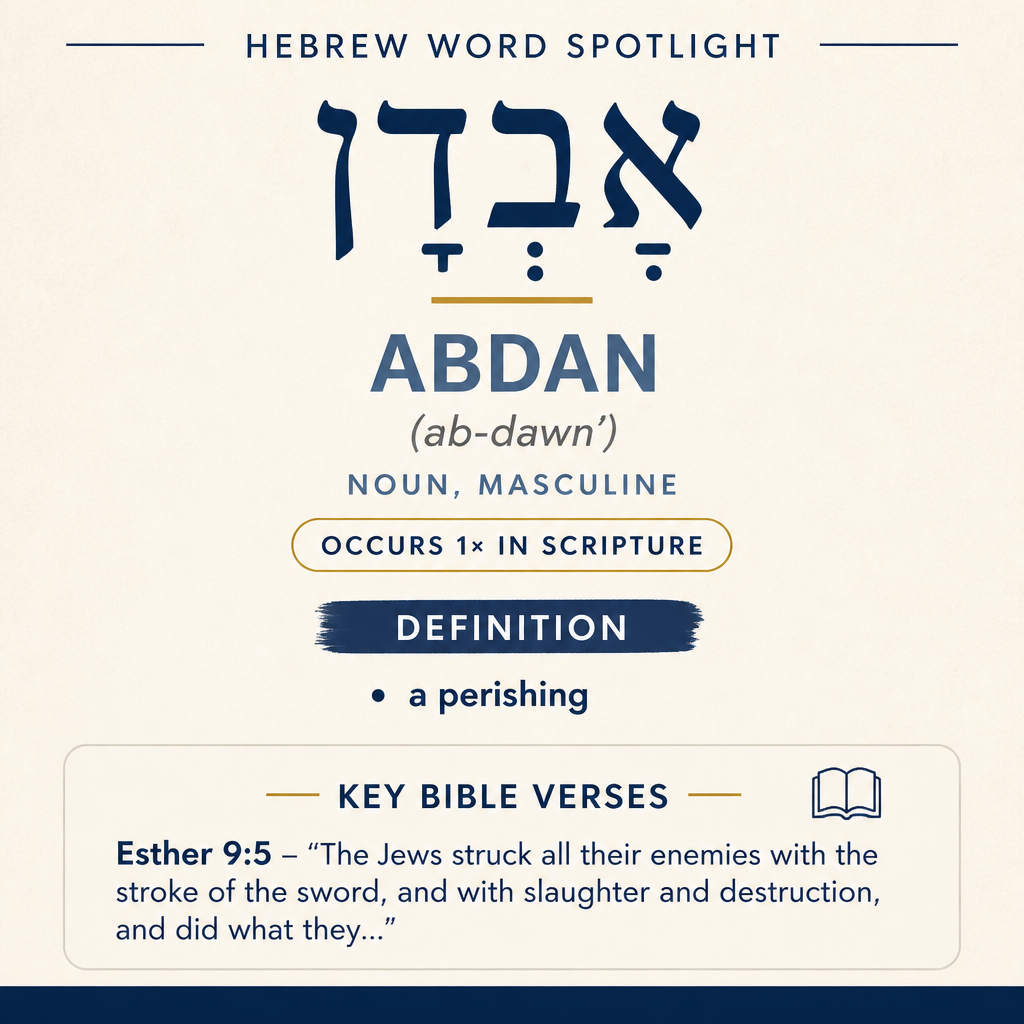
אַבְדָן means “a perishing” and appears once in Scripture, in Esther 9:5.
Biblical Occurrence
אַבְדָן occurs 1 time in Scripture. Its sole reference is Esther 9:5.
Learn More →Context in Esther
In Esther 9:5, it appears in a description of the Jews striking their enemies with slaughter and destruction.
Learn More →אַבְדָן (abdan) denotes “a perishing” and is used in a single biblical occurrence. It appears in the narrative summary of violence in Esther 9:5, where it stands alongside other terms for lethal defeat.
Occurrences
“The Jews struck all their enemies with the stroke of the sword, and with slaughter and destruction, and did what they wanted to those who hated them.” (Esther 9:5)
In Esther 9:5, אַבְדָן is placed within a compact series that reports the outcome of armed conflict: the Jews “struck” their enemies “with the stroke of the sword,” and the verse then piles up nouns—“slaughter and destruction”—to describe what that striking accomplished. Within this list, אַבְדָן contributes the idea of perishing as an end-state of the enemies’ defeat: it names not merely the act of striking but the fatal result that follows from it. The phrasing tightly links action (“stroke of the sword”) and effect (“slaughter and destruction”), so the noun functions as a summary term for the collapse of the enemies’ lives under the assault.
The verse’s structure also shows how the word operates rhetorically. The report is not framed as a duel or a measured skirmish; it is an unembellished statement of comprehensive success: “The Jews struck all their enemies … and did what they wanted to those who hated them.” In that setting, אַבְדָן sits between the concrete instrument (“sword”) and the sweeping scope (“all their enemies”), reinforcing the completeness of the outcome. The word therefore helps the sentence communicate that the conflict ended in perishing for those attacked, not simply in injury, retreat, or temporary setback.
Finally, the placement of the noun in a triadic sequence—“stroke of the sword … slaughter and destruction”—gives it a categorical feel: it is not a detail about one individual or one incident, but a label for what happened across the whole set of enemies mentioned. It participates in the verse’s broad-brush narration, making the report less about isolated blows and more about the overall result of the day’s violence as the enemies’ perishing.

Sense and Usage
Because אַבְדָן appears here as a noun in a coordinated series of results, its sense is best understood as describing the condition that emerges from the violent event. The verse begins with a verb of attack (“struck”) and immediately specifies the means (“with the stroke of the sword”). The sequence of nouns that follows, including אַבְדָן, does not introduce new actions so much as it unfolds the consequences of the strike in increasingly final terms. In this way the word functions as an outcome-word: it depicts the fate produced by the sword’s blow.
The immediate context keeps the word anchored in human conflict. Perishing here is not an abstract meditation on mortality; it is embedded in a report of enemies being struck and overcome. The addition of “and did what they wanted to those who hated them” frames the scene as one in which the victors exercise unopposed control. Within such a sentence, perishing marks the point at which the enemy’s power to resist has ended entirely. The noun thus helps the line communicate decisive reversal: those identified as “enemies” and “those who hated them” are reduced to the status of the perishing.
At the level of style, the verse’s accumulation of terms (“stroke,” “slaughter,” “destruction”) gives the narration an emphatic, summary quality. אַבְדָן fits this compressed style well: as a noun, it can cover many individual deaths under one label. Its use therefore contributes to the verse’s sweeping portrayal of the outcome. The word does not specify manner, duration, or particular victims; it expresses the finality that gathers all the separate events of killing into a single description of what happened to the enemies as a group.
Within the sentence, perishing is also relationally defined: it happens to “their enemies,” to “those who hated them.” The noun is not presented in isolation but as part of a moral and social map of the conflict in which two sides are clearly distinguished. The perishing belongs to the enemy side, and the narrative voice treats that perishing as an accomplished fact, a completed result of the sword-stroke. This placement makes the word carry a strong sense of conclusion: the enmity culminates in perishing, and the verse records that culmination in a single report.
Imagery
The imagery tied to אַבְדָן in Esther 9:5 is starkly concrete: perishing is pictured through the immediate companion phrases “stroke of the sword” and “slaughter and destruction.” The noun therefore evokes the scene of a battlefield or violent street encounter where the sword’s blow brings life to an end. In this verse, perishing is not described with extended metaphor or poetic development; instead, it is folded into a terse inventory of what the sword achieved, giving the word a blunt, report-like force.
Sources: Lexical data from Strong’s Exhaustive Concordance and the Open Scriptures Hebrew Lexicon. Occurrence data from the Westminster Leningrad Codex with STEPBible reference data (CC BY). Scripture quotations from the World English Bible (public domain).




