Exploring the Meaning of ‘Abad in Hebrew
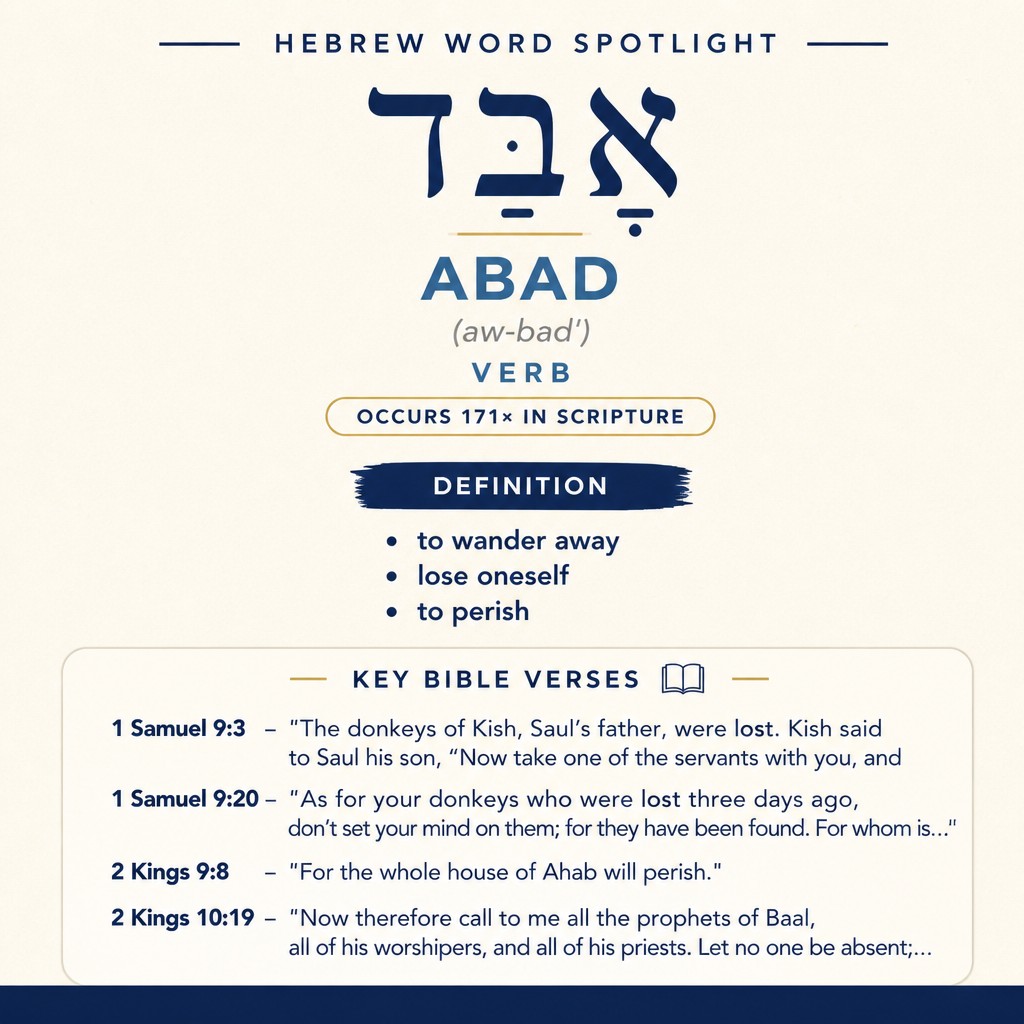
אָבַד (abad) means “to wander away; lose oneself; to perish,” occurring 171 times in Scripture, including 1 Samuel 9 and 2 Kings 9–24.
Core Meaning
אָבַד means “to wander away; lose oneself; to perish.” The sample passages show both loss (donkeys) and perishing (a house).
Learn More →Narrative Usage
In 1 Samuel 9:3 and 9:20 it describes Kish’s donkeys being “lost” and later “found.” The word frames a concrete situation of losing and recovering.
Learn More →Judgment Contexts
In 2 Kings 9:8 it is used of the house of Ahab that will “perish.” It also appears in 2 Kings 10:19; 13:7; 19:18; 21:3; and 24:2.
Learn More →אָבַד (abad) expresses the ideas of wandering away, losing oneself, and perishing, and it appears in narratives, laments, and prophetic announcements of judgment. In the passages below, it ranges from the misplacement of animals and objects to the disappearance of safety, strength, people, and even religious sites and images.

Occurrences
1 Samuel 9:3: “The donkeys of Kish, Saul’s father, were lost. Kish said to Saul his son, “Now take one of the servants with you, and arise, go look for the donkeys.””
In this scene, אָבַד frames a practical problem: animals have gone missing from their owner. The verb highlights the donkeys as no longer where they should be, setting the action in motion (“arise, go look”). The emphasis is not on destruction but on absence and the need to search, fitting the notion of “wandering away” or “losing oneself” within a household economy where livestock matters.
1 Samuel 9:20: “As for your donkeys who were lost three days ago, don’t set your mind on them; for they have been found. For whom is all that is desirable in Israel? Is it not for you, and for all your father’s house?””
Here the same loss is located in time (“three days ago”) and then resolved (“they have been found”). Against that resolved loss, the speaker turns Saul’s attention away from anxious preoccupation (“don’t set your mind on them”) toward a larger question of desire and destiny. The verb serves as a pivot: what was missing is now recovered, clearing the way for the conversation to move to weightier matters.
2 Kings 9:8: “For the whole house of Ahab will perish. I will cut off from Ahab everyone who urinates against a wall, both him who is shut up and him who is left at large in Israel.”
אָבַד here is not mere loss but perishing, spoken as an announced outcome for “the whole house of Ahab.” The verse sets that perishing alongside decisive cutting off, stressing completeness (“everyone”) and total reach (“both him who is shut up and him who is left at large”). The verb contributes the stark endpoint: a line will not simply be reduced; it will be brought to an end in the land.
2 Kings 10:19: “Now therefore call to me all the prophets of Baal, all of his worshipers, and all of his priests. Let no one be absent; for I have a great sacrifice to Baal. Whoever is absent, he shall not live.” But Jehu did deceptively, intending to destroy the worshipers of Baal.
This occurrence sits in a moment of calculated gathering. The language of absence (“Let no one be absent… Whoever is absent, he shall not live”) plays ironically against Jehu’s hidden intention “to destroy the worshipers of Baal.” In this setting, אָבַד belongs to the sphere of elimination: the verb contributes to the pressure of attendance and the threat that those who are “absent” face death, while the narrative exposes that the real danger is not absence but presence at a trap.
2 Kings 13:7: “For he didn’t leave to Jehoahaz of the people any more than fifty horsemen, and ten chariots, and ten thousand footmen; for the king of Syria destroyed them, and made them like the dust in threshing.”
Here אָבַד is expressed through military devastation: the people are reduced to a small remainder, because “the king of Syria destroyed them.” The simile “like the dust in threshing” intensifies the image—what was substantial becomes scattered and insubstantial. The verb’s force is felt in the shrinking of a fighting force and the fragility of a nation’s capacity to resist.
2 Kings 19:18: “and have cast their gods into the fire; for they were no gods, but the work of men’s hands, wood and stone. Therefore they have destroyed them.”
In this verse the object of destruction is “their gods,” explicitly described as man-made materials (“wood and stone”). אָבַד contributes the notion that these objects can be brought to nothing; they can be burned and “destroyed.” The verb functions in an argument: because they are material products, they are vulnerable to perishing in fire and thus cannot be treated as enduring divine powers.
2 Kings 21:3: “For he built again the high places which Hezekiah his father had destroyed; and he raised up altars for Baal, and made an Asherah, as Ahab king of Israel did, and worshiped all the army of the sky, and served them.”
This occurrence looks back to an earlier act of destruction: “the high places” had been “destroyed,” yet now they are rebuilt. אָבַד here marks a prior removal of illicit sites, but the verse shows that destruction of structures does not automatically prevent their return. The verb therefore carries a historical memory in the narrative: what once perished can be reconstructed when leadership shifts.
2 Kings 24:2: “Yahweh sent against him bands of the Chaldeans, and bands of the Syrians, and bands of the Moabites, and bands of the children of Ammon, and sent them against Judah to destroy it, according to Yahweh’s word, which he spoke by his servants the prophets.”
Here אָבַד appears within a theological explanation of political-military assault. Multiple raiding groups are named, and their mission is “to destroy” Judah, an action attributed to Yahweh’s sending and aligned with “Yahweh’s word.” The verb is thus placed in a framework where perishing is not random chaos but an acted judgment that comes through real historical agents.
2 Samuel 1:27: “How the mighty have fallen, and the weapons of war have perished!”
In this lament, the perishing is applied to “the weapons of war.” The line joins two losses: the fall of the mighty and the disappearance of their implements. אָבַד contributes a sense of irreversible defeat—tools that once symbolized strength are now gone, wasted, or no longer functioning as instruments of victory.
Amos 1:8: “I will cut off the inhabitant from Ashdod, and him who holds the scepter from Ashkelon; and I will turn my hand against Ekron; and the remnant of the Philistines will perish,” says the Lord Yahweh.
This prophetic announcement layers actions: cutting off inhabitants and rulers, turning a divine hand against a city, and finally the perishing of “the remnant.” אָבַד here expresses the end of what remains after prior losses. The word presses the point that even surviving fragments (“the remnant”) are not guaranteed continuation; they too can reach the endpoint of perishing.
Amos 2:14: “Flight will perish from the swift; and the strong won’t strengthen his force; neither shall the mighty deliver himself;”
In this line, what perishes is not a person directly but “Flight”—the possibility of escape. The verb portrays a collapse of options: speed fails to provide a way out, strength cannot secure power, and the mighty cannot rescue themselves. אָבַד thus extends to the vanishing of capacity and strategy; perishing includes the loss of the very means by which one might avoid disaster.
Amos 3:15: “I will strike the winter house with the summer house; and the houses of ivory will perish, and the great houses will have an end,” says Yahweh.
Here the perishing concerns “houses”—seasonal residences and luxurious “houses of ivory.” The verse links striking with perishing and with reaching an end, portraying the dismantling of wealth and security. אָבַד contributes the sense that what appears stable (buildings, estates, prestige) can be brought to disappearance; the material markers of status are not permanent.
Sense and Usage
Across these passages, אָבַד moves along a spectrum from being lost to perishing. In 1 Samuel 9 it describes ordinary loss: property is missing and must be sought, and the anxiety of loss can be redirected once recovery happens. In 2 Samuel 1:27 the verb colors grief by naming what has vanished in the aftermath of death and defeat, extending the notion of perishing to the equipment tied to the fallen. In Kings and Amos, the verb is used with heavier weight: it becomes the vocabulary of removal and ending—families cut off, worshipers destroyed, populations reduced, nations targeted, and remnants brought to extinction.
The scenes also show that what “perishes” under אָבַד can be diverse: living people (“the whole house of Ahab”; “the remnant of the Philistines”), military resources (“they… made them like the dust in threshing”), political order (“him who holds the scepter”), religious objects and sites (“their gods… destroyed”; “the high places… destroyed”), and even intangible protections (“Flight will perish from the swift”). This range demonstrates how the verb can name both the disappearance of concrete things and the collapse of functions that ordinarily preserve life and power.
Several occurrences pair perishing with language of completeness and finality. Phrases like “the whole house,” “everyone,” “the remnant,” and “will have an end” sharpen the verb’s force, portraying not partial loss but thorough removal. Yet the narrative in 2 Kings 21:3 shows another angle: a thing once destroyed can be rebuilt, which highlights that the verb can mark a real prior elimination without implying that later generations will not reverse course.
Imagery
The imagery attached to אָבַד in these texts ranges from the quiet absence of stray donkeys to the loud collapse of armies and houses. It can evoke scattering (“like the dust in threshing”), burning (“cast their gods into the fire”), and the stripping away of escape routes (“Flight will perish from the swift”). Together, these portray perishing not only as death but as the broad experience of things—people, strength, objects, and institutions—ceasing to be present, effective, or enduring.