Exploring the Meaning of Nomimos in Greek
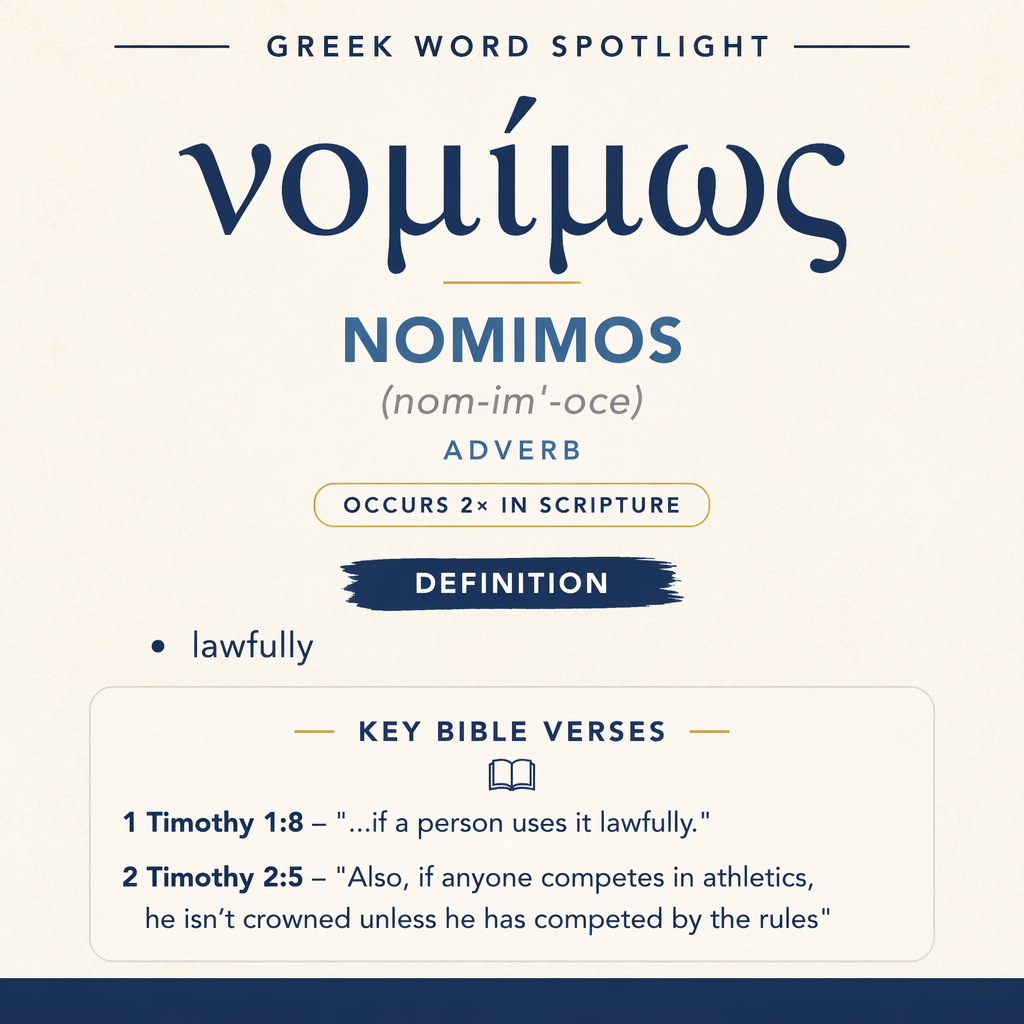
νομίμως means “lawfully” and appears twice in Scripture: 1 Timothy 1:8 and 2 Timothy 2:5.
Core Meaning
νομίμως means “lawfully.” It expresses doing something in a lawful manner.
Learn More →Scripture Occurrences
This adverb occurs 2 times in Scripture. It appears in 1 Timothy 1:8 and 2 Timothy 2:5.
Learn More →Context in Verses
In 1 Timothy 1:8, it describes using the law lawfully. In 2 Timothy 2:5, it describes competing by the rules to be crowned.
Learn More →νομίμως expresses the idea of acting “lawfully,” and it appears in two Pastoral Epistles: once about the use of the law itself and once about the conditions for receiving an athletic crown.
Root and Related Words
νομίμως corresponds to the noun nomos (νόμος), “law” (Strong’s G3551). In both of its New Testament settings, the adverb’s force is tied to the presence of a recognized standard—an established “law”—that governs whether an action counts as properly done.

Occurrences
“But we know that the law is good, if a person uses it lawfully,” (1 Timothy 1:8)
Here νομίμως functions as a qualifier on the clause “uses it,” narrowing the author’s claim about “the law” being “good.” The sentence does not praise the law in the abstract apart from its handling; instead it places a condition on the law’s goodness as it is brought into practice: “if a person uses it lawfully.” In this scene, the adverb makes the evaluation (“good”) depend on the manner of use. It implies that there is a way to employ “the law” that fits the law’s own proper bounds and intent, and that only such use is the kind under discussion. The word therefore gives the line a careful, governed shape: the law’s goodness is affirmed, yet the affirmation is framed by a criterion of lawful use rather than left open-ended. Because the object is “the law” itself, νομίμως naturally points the reader back to the law as the standard that governs its own application—use that aligns with what “law” is, rather than use that merely invokes it.
“Also, if anyone competes in athletics, he isn’t crowned unless he has competed by the rules.” (2 Timothy 2:5)
In this comparison, the adverb stands behind the idea rendered “by the rules,” setting a clear condition for being “crowned.” The image is simple and concrete: an athlete “competes,” and a crown is withheld unless the competition has been conducted within the required boundaries. The point is not about effort alone, since the athlete may “compete” and yet fail to be “crowned”; the decisive factor is whether the contest has been carried out in the law-governed way the competition demands. νομίμως, then, supplies the standard that separates participation from approval: the crown belongs to the one whose competing conforms to the recognized rules of the contest. Within the sentence’s logic, the word gives weight to the “unless,” making the withholding of the crown an issue of lawful procedure rather than arbitrary judgment. It also reinforces the metaphor’s moral clarity: just as athletics has rules that define legitimate competition, so the sphere the author is addressing has standards that define legitimate practice.
Sense and Usage
Across these two passages, νομίμως works as a boundary-marker: it does not introduce a new action, but evaluates how an action is carried out in relation to “law” and to rule-governed order. In 1 Timothy 1:8, the action is “uses it” with “the law” as the object, and the adverb regulates that use. The sentence assumes that the law can be handled in more than one way; the adverb identifies the kind of handling that fits the law’s rightful scope, and it is that fitting use which allows the author to affirm, “the law is good.” The word therefore helps the author both to uphold the law’s goodness and to prevent a careless appeal to the law that would ignore the standards intrinsic to it. The stress falls on correct alignment: the law must be used in a way that remains within the law’s proper order.
In 2 Timothy 2:5, the action is “competes in athletics,” and the adverb governs the legitimacy of the contest itself. The athletic metaphor is particularly well suited to the term because athletics is publicly structured by rules; the word evokes the idea that formal standards are not optional add-ons but the very conditions that make the competition what it is. The crown becomes a sign not merely of victory but of recognized, rule-conforming participation. Within that framework, νομίμως draws a sharp distinction between apparent achievement and achievement acknowledged as valid. The adverb thus supports a logic of legitimate recognition: reward follows not simply from doing a thing, but from doing it in accordance with the rules that define it.
Placed side by side, the two occurrences show νομίμως operating in two related directions. One looks inward to the proper treatment of “the law” itself: the adverb qualifies the interpreter or user’s stance toward the law, insisting that the law’s “good” character is tied to lawful use. The other looks outward to the structure of a contest: the adverb qualifies a competitor’s conduct, insisting that the crown is tied to rule-governed competing. In both, the adverb functions as a criterion of validity. It brings the reader’s attention to standards that are already assumed in the scene—either the standards belonging to “the law” or the standards belonging to “athletics”—and insists that these standards control the outcome: whether the law is treated in a way that warrants the affirmation of goodness, and whether the athlete’s competing warrants the crown.
Because νομίμως is an adverb, its practical impact in each verse is to shape the verb phrase: “uses it lawfully” and “has competed by the rules.” It does not name the rules in detail; instead it supplies the category of lawful conformity, leaving the particulars to the larger context in which “the law” and “the rules” would be understood. The word’s contribution is therefore both precise and restrained: it does not multiply commands, but it requires that whatever is being done must be done in a way that meets the governing standard. That restraint fits both passages, since each is making a focused point: one about a correct posture toward the law, the other about the non-negotiable condition for receiving the crown.
Imagery
The athletic scene in 2 Timothy 2:5 gives νομίμως a vivid picture: an athlete competing under enforceable rules, with the crown held back unless the contest has been conducted within those bounds. Read alongside 1 Timothy 1:8, the imagery reinforces a shared idea: standards are not merely spoken of; they govern outcomes. The “law” is “good” in its lawful use, and the crown is given only where the competition has been carried out in a lawful way.
Sources: Lexical data from Strong’s Exhaustive Concordance and the Translators Brief Lexicon of Extended Strongs for Greek (STEPBible, CC BY). Occurrence data from the Translators Amalgamated Greek New Testament (STEPBible, CC BY). Scripture quotations from the World English Bible (public domain).