
Exploring the Meaning of Nomikos in Greek
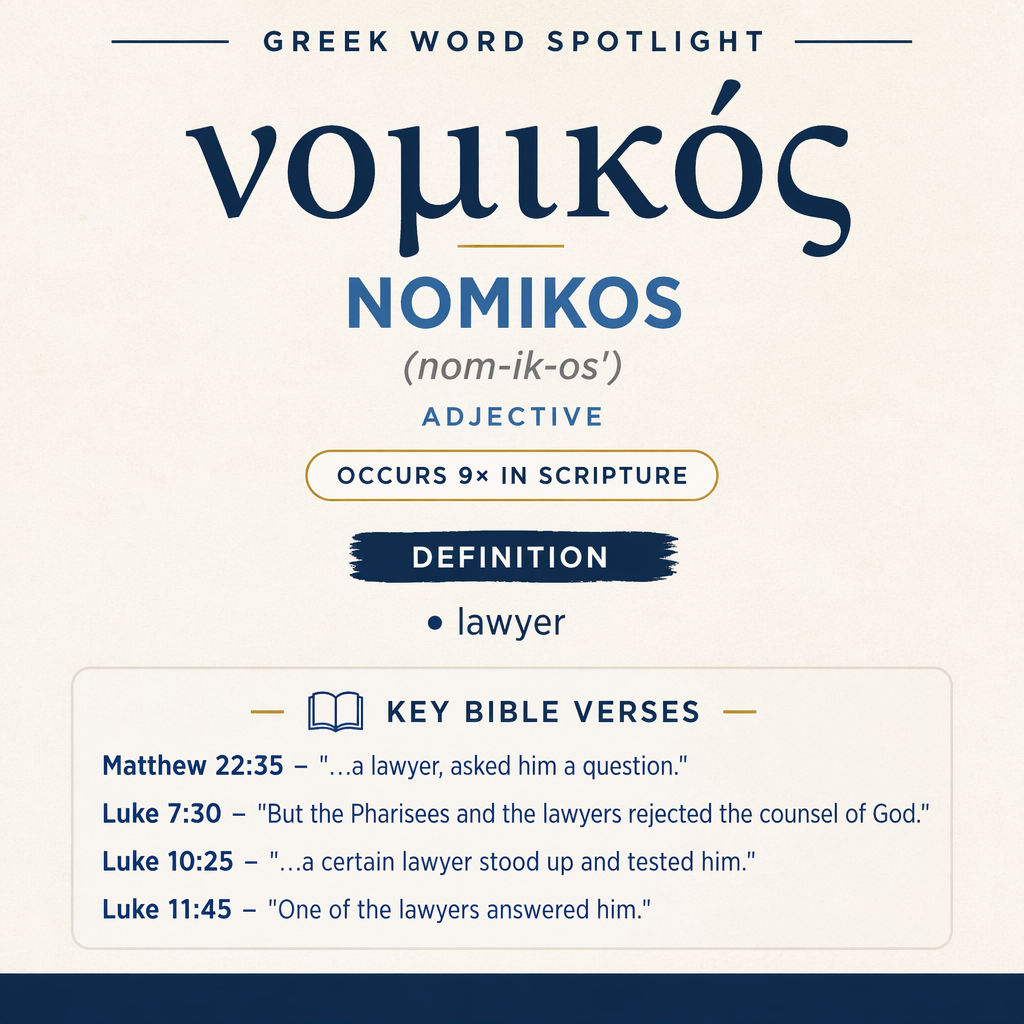
νομικός means “lawyer” and appears 9 times in Scripture, including Matthew 22:35, multiple places in Luke, and Titus 3:9.
Core Meaning
νομικός is defined as “lawyer.” It designates people identified with the law in the New Testament passages listed.
Learn More →Gospel Occurrences
In Matthew 22:35 and Luke 10:25, a lawyer questions Jesus, testing Him. Luke also records lawyers with Pharisees and under Jesus’ woes (Luke 7:30; 11:45–46, 52; 14:3).
Learn More →Later Reference
Titus 3:9 mentions disputes about the law as unprofitable and vain. This is the only occurrence listed outside Matthew and Luke.
Learn More →νομικός refers to a “lawyer,” appearing in Gospel disputes and instruction as well as in a personal reference to an individual named Zenas. In these passages the word marks people whose role and identity are closely bound to questions, judgments, and controversies connected with the law.
Occurrences
“One of them, a lawyer, asked him a question, testing him.” (Matthew 22:35)
Here νομικός singles out one member from “them” by vocation: a lawyer. The term frames the question as more than casual curiosity; it comes from someone positioned to examine and probe, and the verse explicitly pairs the lawyer’s question with “testing him.” The word therefore contributes a social and rhetorical setting: the exchange is an examination initiated by a professional examiner.
“But the Pharisees and the lawyers rejected the counsel of God, not being baptized by him themselves.” (Luke 7:30)
In this scene lawyers are named as a recognizable group alongside “the Pharisees.” νομικός contributes to the portrait of a public rejection: the lawyers’ decision is not merely private opinion but a stance taken by figures associated with the law. Their rejection is shown concretely in conduct—“not being baptized by him themselves”—so the word helps identify whose refusal carries weight within the community’s religious life.
“Behold, a certain lawyer stood up and tested him, saying, “Teacher, what shall I do to inherit eternal life?”” (Luke 10:25)
Again νομικός introduces the speaker and shapes the force of the encounter. The lawyer “stood up,” a physical action that signals a formal challenge, and the verse explicitly repeats the motive: he “tested him.” The question, addressed to “Teacher,” concerns a fundamental issue—“what shall I do to inherit eternal life?”—and the term “lawyer” situates that question as coming from a person accustomed to determining what one should do in light of the law.
“One of the lawyers answered him, “Teacher, in saying this you insult us also.”” (Luke 11:45)
Here νομικός functions as a label of group identity within a tense exchange. One lawyer responds to what Jesus has been saying and perceives it as directed not only at others but at “us also.” The word brings into view a professional class that hears critique as collective: the speaker is not only an individual but a representative voice claiming injury for the lawyers as a group.
“He said, “Woe to you lawyers also! For you load men with burdens that are difficult to carry, and you yourselves won’t even lift one finger to help carry those burdens.” (Luke 11:46)
νομικός is addressed directly in a denunciation: “Woe to you lawyers also!” The term identifies the object of the charge, and the verse itself defines the moral failure in imagery of weight and effort: they “load men with burdens that are difficult to carry” but do not “lift one finger” to help. The word thus contributes a focus on how lawyers, as lawyers, are implicated in practices that impose obligations on others without shared assistance.
“Woe to you lawyers! For you took away the key of knowledge. You didn’t enter in yourselves, and those who were entering in, you hindered.” (Luke 11:52)
In this later “woe,” νομικός again marks the target group, but the imagery shifts from burdens to access. Lawyers are accused of removing “the key of knowledge,” language that pictures knowledge as something opened and entered. The charge is twofold: they themselves “didn’t enter in,” and they actively obstruct “those who were entering in.” The word “lawyers” therefore functions as the identifier of those blamed for both personal refusal and public hindrance in matters tied to knowledge.
“Jesus, answering, spoke to the lawyers and Pharisees, saying, “Is it lawful to heal on the Sabbath?”” (Luke 14:3)
Here νομικός appears in a paired audience: “the lawyers and Pharisees.” The question posed—“Is it lawful to heal on the Sabbath?”—makes the relevance of lawyers immediately plain within the verse itself. By naming them, the narrative signals that the issue is being placed before people expected to have an answer about what is “lawful.” The word contributes an implicit courtroom-like setting: a disputed act is evaluated under a legal standard.
“but shun foolish questionings, genealogies, strife, and disputes about the law; for they are unprofitable and vain.” (Titus 3:9)
Although νομικός is not presented as a character here, it belongs to the same word-family idea in that the verse explicitly speaks of “disputes about the law.” In this context, the relevance of “lawyer” is thematic: the verse warns against a pattern of argument—“foolish questionings… strife… disputes about the law”—and evaluates such controversies as “unprofitable and vain.” The contribution is a practical boundary: law-related disputes can become a kind of unproductive wrangling to be avoided.
“Send Zenas, the lawyer, and Apollos on their journey speedily, that nothing may be lacking for them.” (Titus 3:13)
Here νομικός functions as an identifying description attached to a named individual: “Zenas, the lawyer.” Unlike the Gospel scenes of testing and denunciation, this verse places a lawyer within cooperative mission travel: he is to be sent “on their journey speedily,” with material support—“that nothing may be lacking for them.” The word contributes simple identification and shows that a lawyer can be a helpful participant rather than an opponent in debate.

Sense and Usage
Across these passages, νομικός consistently marks a person defined by relationship to the law, and that identity shapes the kinds of speech and interaction the narratives highlight. In Matthew 22:35 and Luke 10:25, the lawyer’s presence is tied to a specific posture toward Jesus: he asks a question “testing him.” The word “lawyer” therefore functions as more than a job title; it establishes a context where questions are put forward as examinations, not simply requests for instruction. Even when the lawyer addresses Jesus respectfully as “Teacher” (Luke 10:25), the narrative’s explicit note about “testing” keeps the encounter in the register of scrutiny.
Luke broadens the portrayal by presenting lawyers as a visible group within the religious landscape. In Luke 7:30 they stand alongside Pharisees as collective rejecters of “the counsel of God,” and the rejection is evidenced in refusal to be baptized. In Luke 11:45, a lawyer reacts to criticism with solidarity—“you insult us also”—showing that the label can function socially: to speak to one is to be heard as speaking to “us.” Luke 11:46 and 11:52 then give the sharpest depictions, where “lawyers” are charged with actions that affect others: laying “burdens” on “men” without helping, and hindering access by taking away “the key of knowledge.” In these verses the word’s sense is embedded in the effects of their conduct. A lawyer is portrayed as someone whose handling of law and knowledge can either assist or obstruct others; in these particular scenes it is obstruction and imposition that are emphasized.
Luke 14:3 highlights how naturally lawyers belong in debates over what is “lawful.” The question “Is it lawful to heal on the Sabbath?” is addressed to “the lawyers and Pharisees,” linking legal expertise with the evaluation of religious practice. The verse does not present the lawyers’ answer, but it positions them as the kind of people to whom such a question is appropriately put.
In the Pastoral context, Titus 3:9 speaks to the culture of argument that can attach to the law: “disputes about the law” are to be shunned as “unprofitable and vain.” This aligns with the Gospel scenes where lawyers appear in contentious testing and insult-taking; yet Titus 3:13 shows a different, concrete use of the term—personal identification of Zenas as “the lawyer,” who is to be supported. Together these verses allow νομικός to carry both public and personal force: it can name an argumentative class associated with disputes, and it can simply describe a coworker whose travel needs are to be met.
Imagery in Context
The passages surrounding νομικός repeatedly picture law-related influence through tangible images: a challenger “stood up” to test (Luke 10:25), heavy “burdens” laid on others without assistance (Luke 11:46), and a “key” that controls entry, removed and used to hinder (Luke 11:52). Even when the word is used neutrally of Zenas (Titus 3:13), the broader set of occurrences leaves an impression of the lawyer as someone whose words and judgments can either open a way forward or turn discussion into strife and obstruction (Titus 3:9).
Sources: Lexical data from Strong’s Exhaustive Concordance and the Translators Brief Lexicon of Extended Strongs for Greek (STEPBible, CC BY). Occurrence data from the Translators Amalgamated Greek New Testament (STEPBible, CC BY). Scripture quotations from the World English Bible (public domain).




