Exploring the Meaning of Meter in Greek
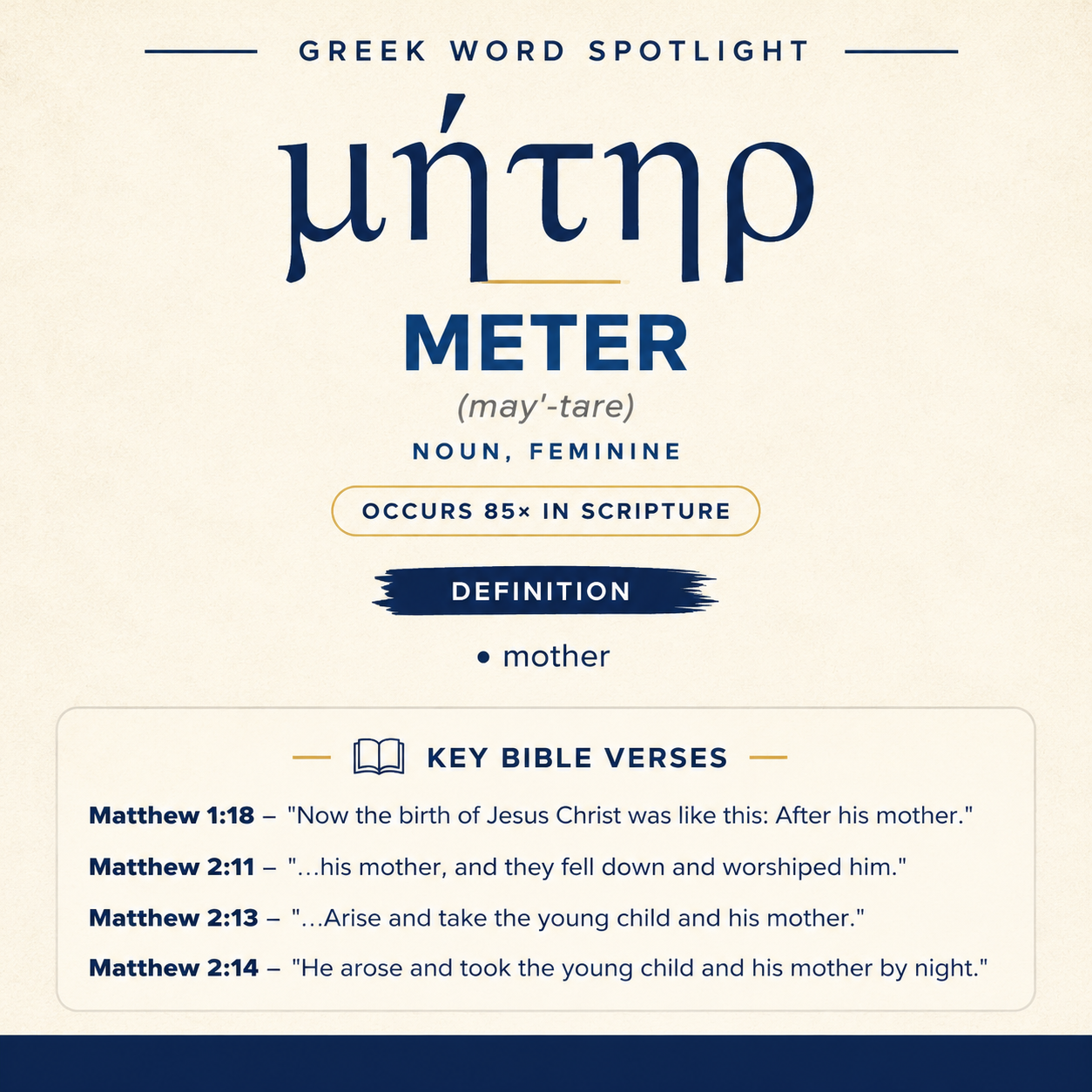
μήτηρ means “mother” in Greek and occurs 85 times in Scripture, including Matthew 1:18 and Matthew 2:11–21.
Core Meaning
μήτηρ is defined as “mother.” In Matthew 1:18 it refers to Mary as Jesus Christ’s mother.
Learn More →Matthew Narratives
In Matthew 2:11–21, μήτηρ appears repeatedly in phrases like “the young child and his mother.” These passages describe Mary with the child Jesus.
Learn More →Family Relations
In Matthew 10:35–37, μήτηρ is used in teachings about family relationships, contrasting a daughter with her mother and love for father or mother.
Learn More →μήτηρ names a mother, marking both the family bond that places someone in relation to a child and the relational claims that can be made through that bond. In the passages below it appears in narratives about Jesus’ early life, in sayings about divided households and loyalty, and in a scene where Jesus redefines who may be addressed with family language.
Occurrences
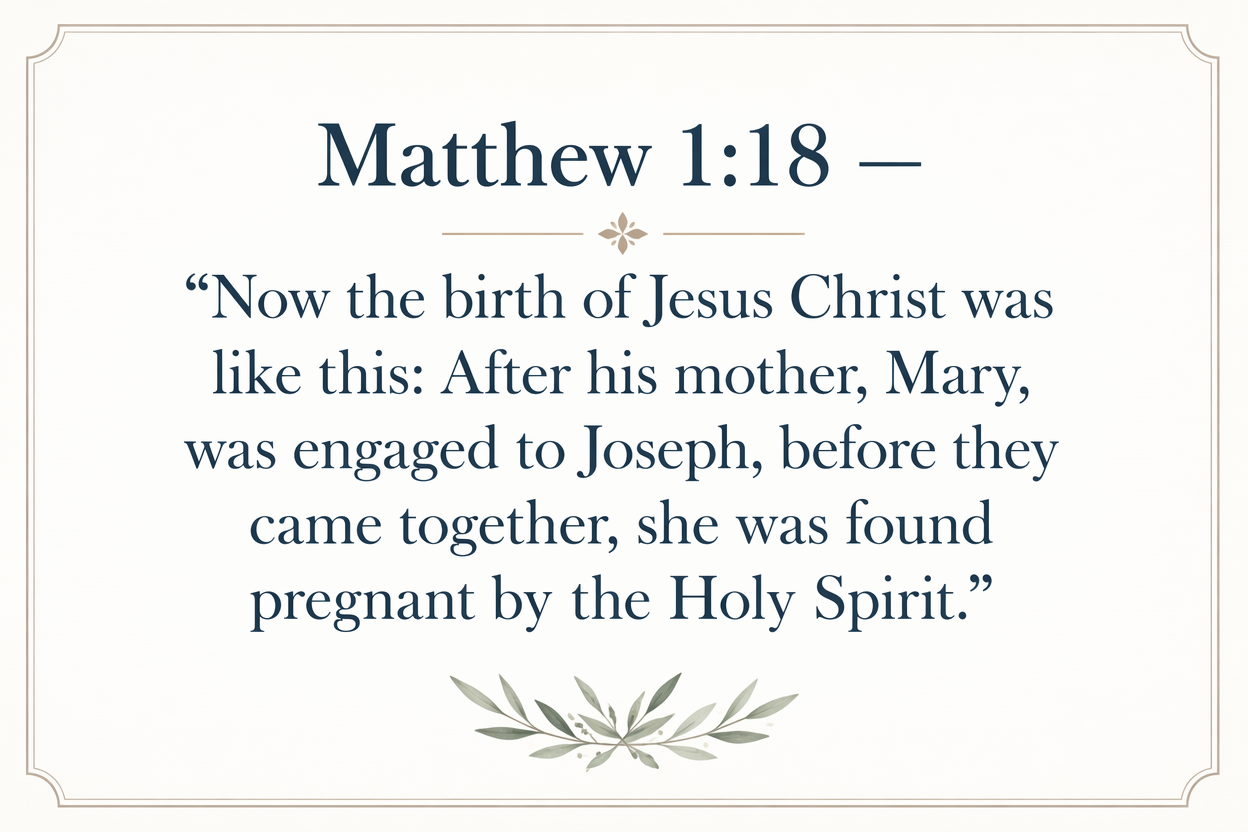
Matthew 1:18 — “Now the birth of Jesus Christ was like this: After his mother, Mary, was engaged to Joseph, before they came together, she was found pregnant by the Holy Spirit.”
Here μήτηρ anchors Jesus’ identity in a concrete family situation: Mary is named explicitly as “his mother.” The word helps frame the timing (“engaged to Joseph,” “before they came together”) and highlights that the pregnancy concerns the mother prior to the household’s formal union, making the maternal relationship the immediate human point of reference in the birth account.
Matthew 2:11 — “They came into the house and saw the young child with Mary, his mother, and they fell down and worshiped him. Opening their treasures, they offered to him gifts: gold, frankincense, and myrrh.”
In this scene μήτηρ situates Mary beside “the young child,” presenting mother and child together as the visitors enter the house. The term does not draw attention to Mary independently; it identifies her by her relationship to the child, while the action of worship and giving gifts is directed “to him,” the child.
Matthew 2:13 — “Now when they had departed, behold, an angel of the Lord appeared to Joseph in a dream, saying, “Arise and take the young child and his mother, and flee into Egypt, and stay there until I tell you, for Herod will seek the young child to destroy him.””
μήτηρ appears within an urgent instruction, pairing the child with “his mother” as a single unit that must be moved to safety. The phrase “take the young child and his mother” treats the mother as inseparable from the endangered child, and the directive to flee defines the mother’s place within a threatened household under Joseph’s immediate care.
Matthew 2:14 — “He arose and took the young child and his mother by night, and departed into Egypt,”
This verse narrates the obedience to the dream-command using the same pairing: “the young child and his mother.” μήτηρ contributes to the picture of hurried departure (“by night”) and underscores that the flight involves not only the child but also the mother who accompanies him.
Matthew 2:20 — ““Arise and take the young child and his mother, and go into the land of Israel, for those who sought the young child’s life are dead.””
Again μήτηρ belongs to the repeated formula of relocation, now reversing the direction of travel. The mother is included in the restoration of movement back toward Israel, and her inclusion keeps the focus on the child’s immediate family circle as the danger passes.
Matthew 2:21 — “He arose and took the young child and his mother, and came into the land of Israel.”
μήτηρ continues to mark the mother’s presence in the action of return. The expression is brief and factual, but it maintains the consistent identification of Mary as “his mother” as the child’s circumstances change from flight to resettlement.
Matthew 10:35 — “For I came to set a man at odds against his father, and a daughter against her mother, and a daughter-in-law against her mother-in-law.”
Here μήτηρ appears in a saying about household conflict. The word serves to name the closest family relationship in a line of kinship pairings: father/son, mother/daughter, mother-in-law/daughter-in-law. Within the sentence, “mother” functions as one of the key relational points along which division can run, not a distant or abstract tie but an intimate one capable of being set “at odds.”
Matthew 10:37 — “He who loves father or mother more than me is not worthy of me; and he who loves son or daughter more than me isn’t worthy of me.”
In this statement μήτηρ is grouped with “father,” representing parental attachment as a strong and natural object of love. The term contributes to a comparison of loyalties: the mother-child bond is assumed to carry real weight, so that preferring “father or mother” becomes an intelligible measure for what it means to love someone “more than” Jesus.
Matthew 12:46 — “While he was yet speaking to the multitudes, behold, his mother and his brothers stood outside, seeking to speak to him.”
μήτηρ identifies a particular person in the narrative—“his mother”—arriving with “his brothers.” The word helps set up the spatial and relational tension of the moment: she is part of Jesus’ immediate family and yet is “outside,” seeking access while he is engaged in teaching “to the multitudes.”
Matthew 12:47 — “One said to him, “Behold, your mother and your brothers stand outside, seeking to speak to you.””
Here μήτηρ is used in direct address: “your mother.” The term conveys an appeal based on family claim and expected priority—someone informs Jesus that his mother is present and requesting conversation, implying that her relationship to him matters for how he should respond.
Matthew 12:48 — “But he answered him who spoke to him, “Who is my mother? Who are my brothers?””
In Jesus’ reply μήτηρ becomes the key term in a question that challenges default assumptions about family identity. The form “my mother” keeps the biological relationship in view while opening it to examination: the question does not deny the category but asks how it is to be recognized in the present setting.
Matthew 12:49 — “He stretched out his hand toward his disciples, and said, “Behold, my mother and my brothers!”
μήτηρ is applied in an unexpected direction: Jesus gestures “toward his disciples” and uses family language—“my mother and my brothers”—to identify them. The word thus contributes to a reclassification of relational belonging within the scene: those physically present as disciples are publicly designated with the same family term that had just been used for the woman standing outside.

Sense and Usage
Across these passages μήτηρ functions first as a straightforward designation of maternal relationship, particularly in narrative sequences where mother and child are treated as a pair. The repeated phrasing “the young child and his mother” (Matthew 2:13–14, 2:20–21) gives the word a steady, almost formula-like role: it identifies Mary in relation to the child and keeps the reader’s attention on the child’s immediate familial unit as it moves from house to flight to return. In Matthew 1:18 and 2:11 the same relationship provides a frame for key moments—Jesus’ birth circumstances and a house visit where the child is honored—showing how the mother-child bond is part of the narrative’s ordinary human setting.
In the sayings of Matthew 10, μήτηρ marks one of the strongest natural ties within a household. The structure of Matthew 10:35 uses “mother” in parallel with other close kin, making it a focal line of potential conflict (“a daughter against her mother”) and showing that disruption can reach the most intimate spaces of family life. Matthew 10:37 then treats “mother” as a weighty object of love; the term is paired with “father” to represent parental affection as a serious competing allegiance. The word thus carries relational force even without narrative detail: the mother relation is assumed to be emotionally and socially significant.
Matthew 12:46–49 places μήτηρ at the center of a boundary-marking exchange. The narrative first presents the mother as physically “outside” and seeking speech, then repeats the relational claim in second person (“your mother”), and finally turns it into a question (“Who is my mother?”). The concluding gesture toward the disciples assigns the family term to those gathered around Jesus in the teaching setting. Within these verses μήτηρ becomes a tool for defining belonging: it can refer to a familiar biological relationship, but it can also be used in public speech to name a different circle, depending on the relational criteria implied by Jesus’ action and words in the moment.
Imagery
The word evokes two main pictures in these texts. One is domestic and protective: a mother present beside a child in a house, then carried along a night journey and resettlement as circumstances demand (Matthew 2:11–14, 2:20–21). The other is social and communal: the mother waiting outside while a teacher speaks, and a circle of disciples inside being addressed with family language (Matthew 12:46–49). Together these scenes show μήτηρ operating both as an ordinary household designation and as a term that can be spoken to reshape who is publicly recognized as family within the immediate context.
Sources: Lexical data from Strong’s Exhaustive Concordance and the Translators Brief Lexicon of Extended Strongs for Greek (STEPBible, CC BY). Occurrence data from the Translators Amalgamated Greek New Testament (STEPBible, CC BY). Scripture quotations from the World English Bible (public domain).