Exploring the Meaning of Mete in Greek
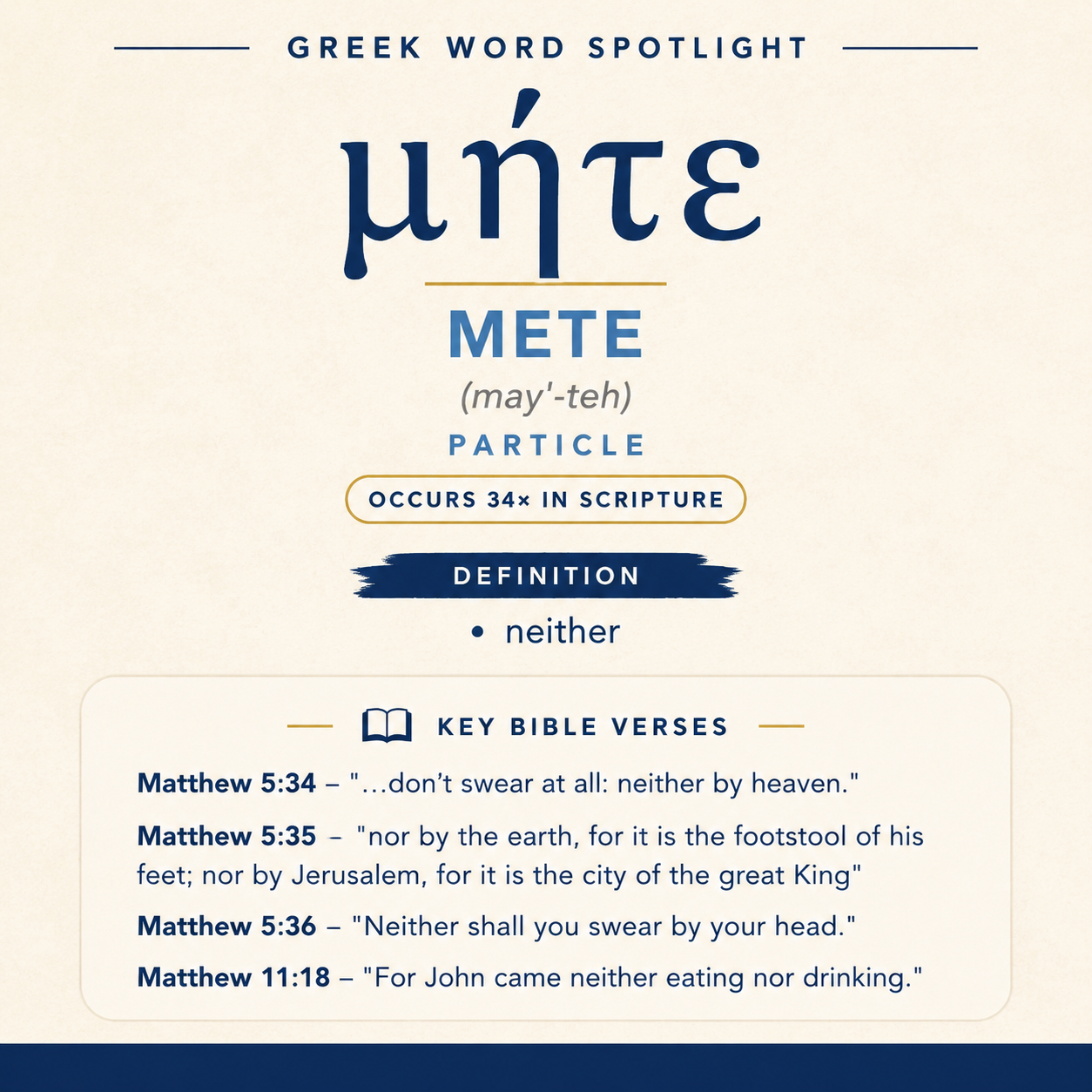
μήτε means “neither” in Greek and occurs 34 times in Scripture, including Matthew 5:34–36, Matthew 11:18, Luke 7:33, Luke 9:3, and Acts 23:8.
Gospel Examples
In Matthew 5:34–36 it appears in a series of prohibitions: “neither… nor… neither.” In Matthew 11:18 and Luke 7:33 it describes John as “neither eating nor drinking.”
Learn More →Acts Examples
In Luke 9:3 it is used in travel instructions: “Take nothing… no… nor… nor….” In Acts 23:8 it lists denials: “nor angel, nor spirit.”
Learn More →μήτε sets up a paired denial: it marks one item as excluded, and anticipates another exclusion alongside it. In the New Testament passages below, it shapes speech by closing off alternatives—whether objects of oaths, patterns of behavior, provisions for travel, doctrinal claims, violent vows, or sources of assurance.
Occurrences
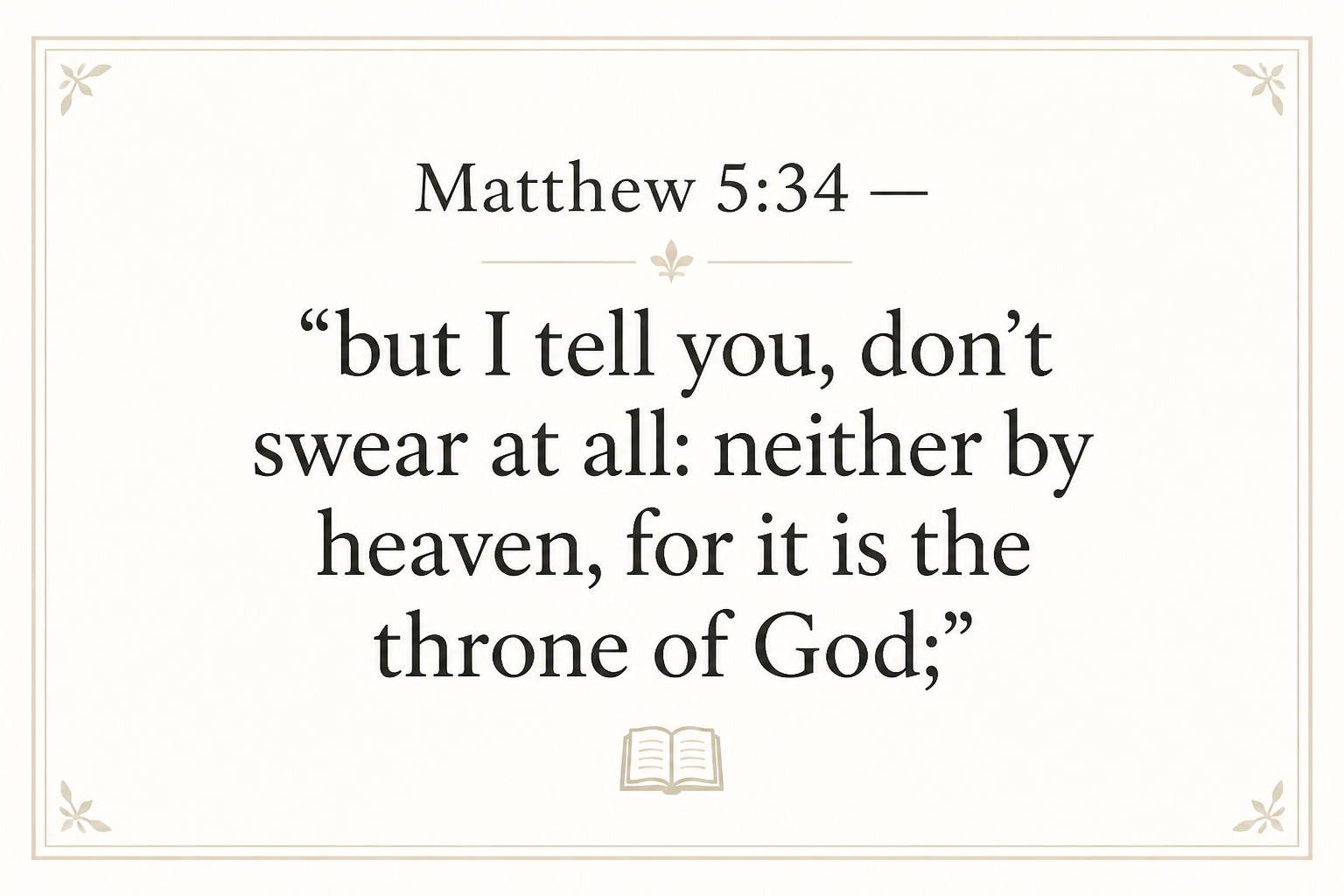
Matthew 5:34 — “but I tell you, don’t swear at all: neither by heaven, for it is the throne of God;”
Here μήτε begins a series of prohibited oath-formulas. The point is not merely “do not swear,” but also “do not redirect swearing to an acceptable substitute.” The clause that follows (“for it is the throne of God”) supplies the reason the first alternative is rejected: it is too closely associated with God’s rule to be treated as a safe stand-in.
Matthew 5:35 — “nor by the earth, for it is the footstool of his feet; nor by Jerusalem, for it is the city of the great King.”
In this continuation, μήτε (expressed in English as repeated “nor”) keeps the prohibition moving from one proposed oath-object to the next. Earth and Jerusalem are treated the same way as heaven: each is ruled out as a supposed workaround. The explanatory phrases (“footstool of his feet,” “city of the great King”) underline why these alternatives are not neutral props; they remain bound up with God’s authority.
Matthew 5:36 — “Neither shall you swear by your head, for you can’t make one hair white or black.”
μήτε also bars a more personal oath, shifting from cosmic or civic referents to the individual body (“your head”). The reason given is practical and humbling: a person lacks control even over a single hair’s color. The particle helps draw a boundary around the whole range of oath-swapping—from heaven down to one’s own head.
Matthew 11:18 — “For John came neither eating nor drinking, and they say, ‘He has a demon.’”
μήτε frames John’s lifestyle as a double negation: he is characterized by abstention in two ordinary activities (“eating” and “drinking”). The paired denial sharpens the contrast between John’s conduct and the accusation leveled against him. The report “and they say, ‘He has a demon’” shows how his refusal of both behaviors becomes fodder for hostile interpretation.
Luke 7:33 — “For John the Baptizer came neither eating bread nor drinking wine, and you say, ‘He has a demon.’”
Luke presents the same kind of paired denial, with added concreteness: not eating “bread” and not drinking “wine.” μήτε binds these two abstentions into a single portrait. In this setting, the particle contributes to the rhetorical force of Jesus’ complaint: even a life marked by refusing common staples is met with a dismissive charge.
Luke 9:3 — “He said to them, “Take nothing for your journey—no staffs, nor wallet, nor bread, nor money. Don’t have two coats each.”
In Jesus’ travel instructions, μήτε (rendered as “nor”) strings together a list of items the disciples are to exclude from their preparations. The command is not a general call to simplicity alone; it is made specific by enumerating what must not be taken. μήτε helps create the cadence of repeated negation—staffs, wallet, bread, money—so that “Take nothing” is unpacked in tangible, everyday terms.
Acts 23:8 — “For the Sadducees say that there is no resurrection, nor angel, nor spirit; but the Pharisees confess all of these.”
Here μήτε carries doctrinal denial across a triad: resurrection, angel, spirit. The particle’s contribution is to present the Sadducean position as a linked set of refusals rather than a single dispute. Against that cluster of negations stands a contrasting affirmation: “the Pharisees confess all of these.” μήτε thus helps map the fault line by listing what is rejected.
Acts 23:12 — “When it was day, some of the Jews banded together, and bound themselves under a curse, saying that they would neither eat nor drink until they had killed Paul.”
In the conspiracy against Paul, μήτε intensifies the vow: the plotters deny themselves two basic necessities as a single, coordinated pledge. The paired abstention (“neither eat nor drink”) depicts determination and desperation. The particle ties their self-imposed deprivation directly to their violent goal—sustenance is withheld “until they had killed Paul.”
Acts 23:21 — “Therefore don’t yield to them, for more than forty men lie in wait for him, who have bound themselves under a curse to neither eat nor drink until they have killed him. Now they are ready, looking for the promise from you.”
μήτε appears again in the report to the commander, repeating the conspirators’ vow to highlight its seriousness and to warn against cooperation. The doubled abstention functions as evidence: these men are not merely making threats; they have framed their plan with a severe commitment. By restating the “neither…nor…” structure, the speaker underscores both the number involved (“more than forty”) and their readiness for action.
Acts 27:20 — “When neither sun nor stars shone on us for many days, and no small storm pressed on us, all hope that we would be saved was now taken away.”
In the storm at sea, μήτε marks the disappearance of two navigational lights—sun and stars—over an extended time (“for many days”). The paired negation does more than describe gloomy weather; it depicts a total loss of customary orientation. Set alongside “no small storm,” the “neither…nor…” clause helps explain why “all hope” collapses: light is absent above, and pressure is unrelenting around them.
2 Thessalonians 2:2 — “not to be quickly shaken in your mind, and not be troubled, either by spirit, or by word, or by letter as if from us, saying that the day of Christ has already come.”
In this pastoral warning, μήτε contributes to a list of possible sources of disturbance. The concern is agitation produced through different channels—“spirit,” “word,” “letter as if from us.” The particle’s role is to close off each avenue as an acceptable basis for panic, guarding the community’s stability (“not to be quickly shaken… and not be troubled”) against multiple forms of influence.
1 Timothy 1:7 — “desiring to be teachers of the law, though they understand neither what they say, nor about what they strongly affirm.”
μήτε here exposes a twofold deficiency in would-be teachers: they lack understanding both of their own speech (“what they say”) and of the assertions they press (“what they strongly affirm”). The paired denial is diagnostic, not merely rhetorical. It frames their problem as comprehensive confusion: words and emphases alike are disconnected from understanding.
Sense and Usage
Across these passages, μήτε functions as a coordinator of exclusions. It is most at home in paired structures (“neither…nor…”) but also extends naturally into longer chains (“nor…nor…nor…”), keeping each additional item under the same umbrella of negation. The effect is cumulative: instead of a vague rejection, the speaker methodically shuts doors one by one.
In Matthew 5:34–36, the particle supports ethical instruction by preventing substitutions. If swearing is forbidden, then swearing “by heaven,” “by the earth,” “by Jerusalem,” or “by your head” is likewise barred; μήτε makes the reasoning concrete by listing typical alternatives. In Luke 9:3, it performs a similar concretizing role, translating “Take nothing” into specific omissions that shape how the disciples travel.
In narrative settings, μήte often heightens intensity by pairing basic realities that normally go together. John’s “neither eating…nor drinking” (Matthew 11:18; Luke 7:33) paints an austere profile that still attracts suspicion. The conspirators’ “neither eat nor drink” (Acts 23:12, 21) shows how denial of necessities can be weaponized as a pledge. In Acts 27:20, the absence of both “sun” and “stars” conveys not a partial dimming but a comprehensive loss of external guidance, which feeds the resulting despair.
In argumentative or corrective contexts, μήτε can mark a set of rejected claims or sources. Acts 23:8 uses the repeated “nor” to define a party’s doctrinal boundaries through what it denies, while 2 Thessalonians 2:2 uses a similar pattern to block multiple channels of misinformation. In 1 Timothy 1:7, the particle exposes a mismatch between ambition (“desiring to be teachers of the law”) and competence, with ignorance spanning both speech and confident assertion.
Imagery
μήτε frequently gathers force from the everyday images it links: heaven, earth, a city, a head with hair; bread and wine; a traveler’s wallet and coats; sun and stars over a storm. By tying such paired or listed realities together under a single negation, the particle makes the denial feel complete—leaving no obvious exception, no convenient substitute, and no overlooked alternative.
Sources: Lexical data from Strong’s Exhaustive Concordance and the Translators Brief Lexicon of Extended Strongs for Greek (STEPBible, CC BY). Occurrence data from the Translators Amalgamated Greek New Testament (STEPBible, CC BY). Scripture quotations from the World English Bible (public domain).