
Exploring the Meaning of Metecho in Greek
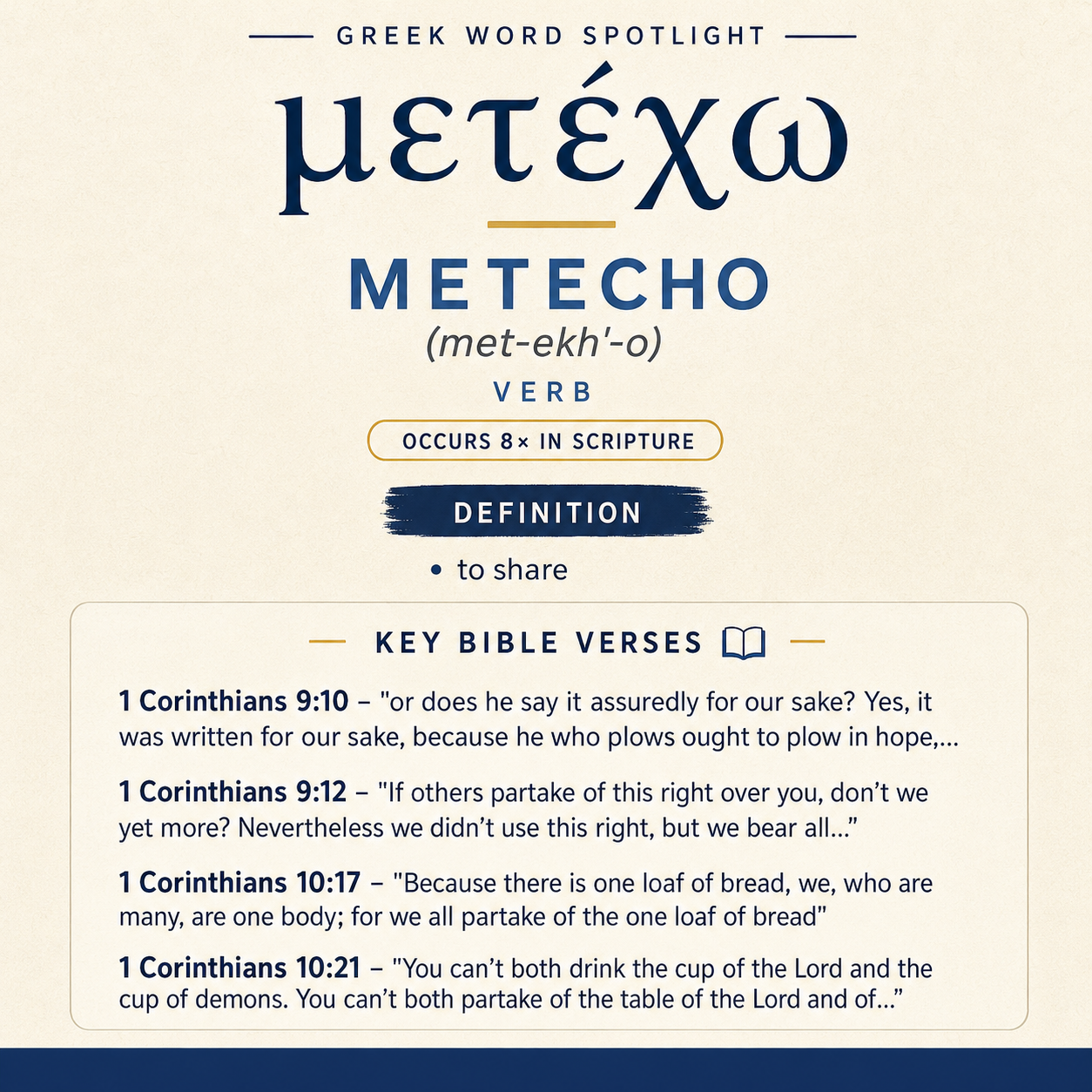
μετέχω (Metecho) means “to share” and occurs 8 times in Scripture, including 1 Corinthians 9–10 and Hebrews 2, 5, and 7.
Core Meaning
μετέχω is defined as “to share.” In the listed verses it is translated with ideas like “partake” and “shared.”
Learn More →Paul’s Letters
In 1 Corinthians 9–10, μετέχω describes partaking in a right, one loaf, and the table and cup. It contrasts sharing in the Lord’s table with the table of demons (1 Corinthians 10:21).
Learn More →Hebrews Usage
Hebrews 2:14 uses μετέχω for sharing in “flesh and blood,” and says Christ partook of the same. Hebrews 5:13 and 7:13 also contain the verb in the provided occurrence list.
Learn More →μετέχω expresses participation: taking part in something that is held, given, or set before others. In the passages where it appears, it describes sharing in hoped-for benefits, practical rights, a common loaf, competing tables, thankful eating, and even the Son’s participation in “flesh and blood.”
Occurrences
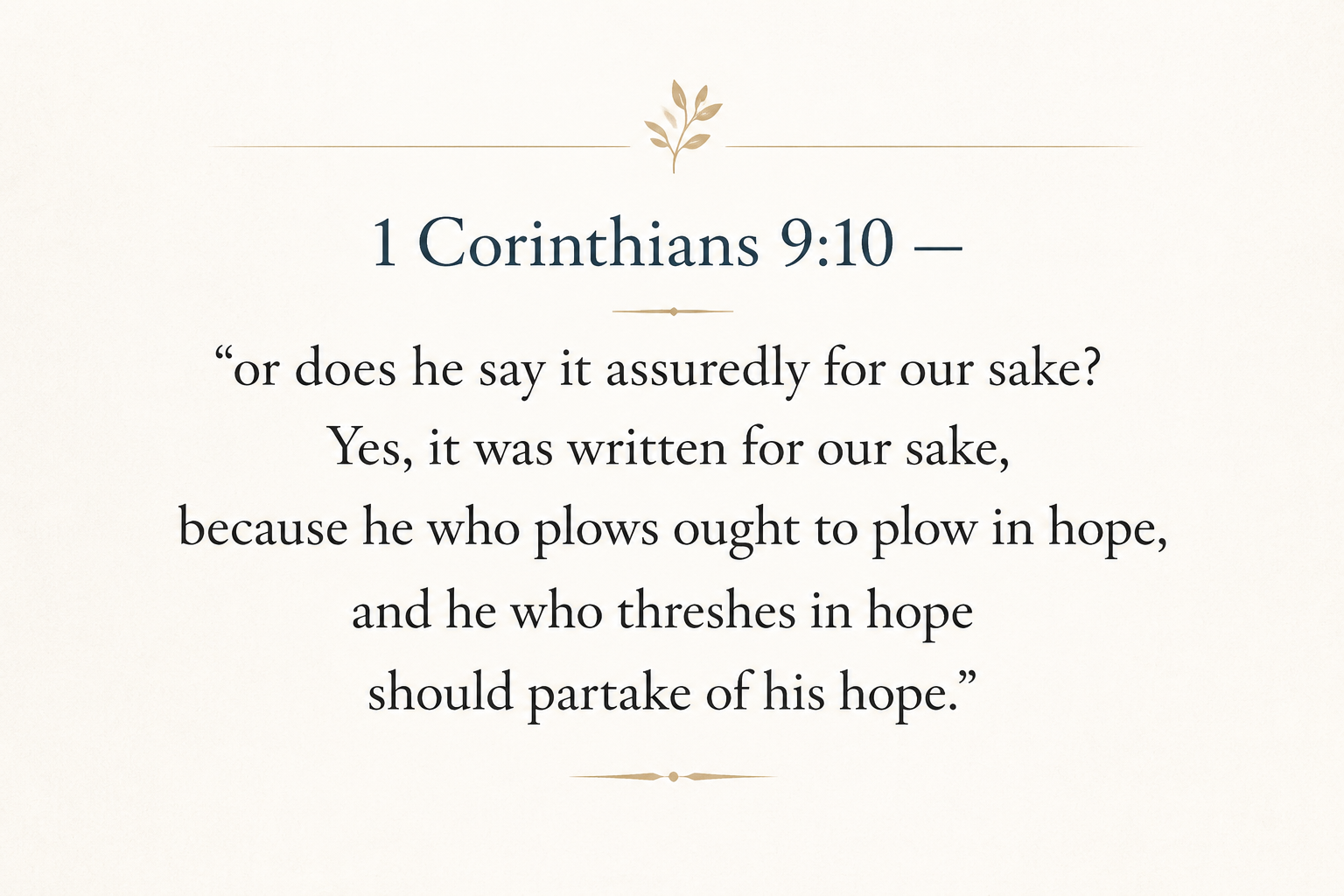
1 Corinthians 9:10 — “or does he say it assuredly for our sake? Yes, it was written for our sake, because he who plows ought to plow in hope, and he who threshes in hope should partake of his hope.”
Here μετέχω marks the expected share that corresponds to labor. The plowman and the thresher work “in hope,” and the verb frames the outcome of that hope as something one can participate in—an anticipated portion that properly belongs with the work described. The thought is not merely that hope exists, but that the worker should have a real stake in what that hope looks toward.
1 Corinthians 9:12 — “If others partake of this right over you, don’t we yet more? Nevertheless we didn’t use this right, but we bear all things, that we may cause no hindrance to the Good News of Christ.”
With “this right,” μετέχω moves into the realm of entitlement or privilege: a “right” can be participated in and exercised. The line of argument contrasts participation (“If others partake…”) with voluntary restraint (“we didn’t use this right”), showing that sharing in a legitimate claim is possible without insisting on it. The verb helps frame the right as something one can hold in common or enjoy, even if one chooses not to press it.
1 Corinthians 10:17 — “Because there is one loaf of bread, we, who are many, are one body; for we all partake of the one loaf of bread.”
In this tightly connected statement, μετέχω describes a shared act that corresponds to a shared identity. The “one loaf” is the concrete object of participation, and the fact that “we all partake” provides the reasoning for being “one body” despite being “many.” Participation is pictured as communal and unifying: many individuals share in one and the same loaf, and the verb ties that common sharing to the oneness asserted in the sentence.
1 Corinthians 10:21 — “You can’t both drink the cup of the Lord and the cup of demons. You can’t both partake of the table of the Lord and of the table of demons.”
Here μετέχω draws a boundary: participation is exclusive when the objects of participation are opposed. The parallel with “drink the cup” clarifies that “partake of the table” is not a vague association but a concrete engagement in what the table represents and offers. By repeating “You can’t both… and…,” the verse treats participation as a decisive alignment; one cannot share in both tables at once.
1 Corinthians 10:30 — “If I partake with thankfulness, why am I denounced for something I give thanks for?”
In this rhetorical question, μετέχω is attached to an attitude: participation “with thankfulness.” The speaker’s act of sharing in something (in context, something received and eaten or enjoyed) is characterized by gratitude, reinforced by “I give thanks.” The verb sets up the logic of the question: if the participation is accompanied by thanksgiving, denunciation seems inconsistent with the acknowledged gratitude for the same thing.
Hebrews 2:14 — “Since then the children have shared in flesh and blood, he also himself in the same way partook of the same, that through death he might bring to nothing him who had the power of death, that is, the devil,”
In this verse, μετέχω speaks of participation in the common human condition named “flesh and blood.” The children’s prior “shared in” establishes a state already true of them, and then “he also himself in the same way partook of the same” presents the Son’s participation as deliberate and matching: “in the same way… of the same.” The verse then links that participation to purpose (“that through death…”), so the verb carries weight not only as description but as the means by which the subsequent “through death” action becomes possible within the flow of the sentence.
Hebrews 5:13 — “For everyone who lives on milk is not experienced in the word of righteousness, for he is a baby.”
This statement depicts dependence and immaturity through the image of “lives on milk.” Within that picture, μετέχω contributes the idea of taking part in what sustains someone: the diet becomes a marker of the person’s stage (“he is a baby”) and a reason for being “not experienced in the word of righteousness.” Participation here is habitual and defining—one’s share in “milk” corresponds to a lack of developed experience.
Hebrews 7:13 — “For he of whom these things are said belongs to another tribe, from which no one has officiated at the altar.”
The verse uses belonging and association language: “belongs to another tribe.” In such a setting, μετέχω frames the relationship as participation in a group identity, not merely proximity to it. The statement’s force depends on the connection between tribal belonging and eligibility for altar service (“from which no one has officiated at the altar”), so participation in a tribe is treated as a determinative affiliation with real implications in the argument.

Sense and Usage
Across these passages, the core idea of participation shows several consistent features. First, μετέχω regularly takes a clearly identified object of participation: “his hope,” “this right,” “the one loaf of bread,” “the table of the Lord,” “flesh and blood,” and, in the imagery of Hebrews 5:13, a sustaining fare like “milk.” The verb is not abstracted into mere feeling; it points to a share in something definite—benefit, entitlement, communal meal, embodied condition, or defining association.
Second, the verb often carries implications about relationship. In 1 Corinthians 10:17, participation in a single loaf is used to explain communal oneness (“we, who are many, are one body”). In 1 Corinthians 10:21, participation is treated as mutually exclusive across rival tables, so sharing is not neutral; it signals a binding connection. Hebrews 7:13 similarly presents participation as belonging: being connected to “another tribe” shapes what may be done “at the altar.” In these uses, μετέχω points beyond an individual act to the relational or communal meaning of sharing.
Third, μετέχω can mark both legitimate claim and voluntary restraint. In 1 Corinthians 9:12, sharing in “this right” is acknowledged as real (“If others partake… don’t we yet more?”), yet the speaker refuses to “use this right” for a larger aim (“that we may cause no hindrance…”). The verb thus supports reasoning about what one may rightly share in, even when one chooses not to press the participation to its fullest expression.
Finally, Hebrews 2:14 demonstrates the verb’s capacity to describe participation that is both comprehensive (“of the same”) and purposeful within the line of thought (“that through death…”). The participation is presented as fully aligned with the condition shared by “the children,” and it functions within the verse’s argument about what follows from entering that shared reality. The result is that μετέχω can describe participation as a decisive sharing that makes later actions within the sentence coherent.
Imagery
The word’s imagery is especially vivid where participation is pictured through eating and drinking. A “one loaf of bread” shared by “many” makes participation visible as a common act with communal consequences, while “the table of the Lord” versus “the table of demons” portrays participation as choosing a place of fellowship that cannot be doubled. Alongside this, “flesh and blood” provides a different but equally concrete image: participation not in a meal but in embodied life itself, expressed as sharing “of the same.”
Sources: Lexical data from Strong’s Exhaustive Concordance and the Translators Brief Lexicon of Extended Strongs for Greek (STEPBible, CC BY). Occurrence data from the Translators Amalgamated Greek New Testament (STEPBible, CC BY). Scripture quotations from the World English Bible (public domain).




