Exploring the Meaning of Kopria in Greek
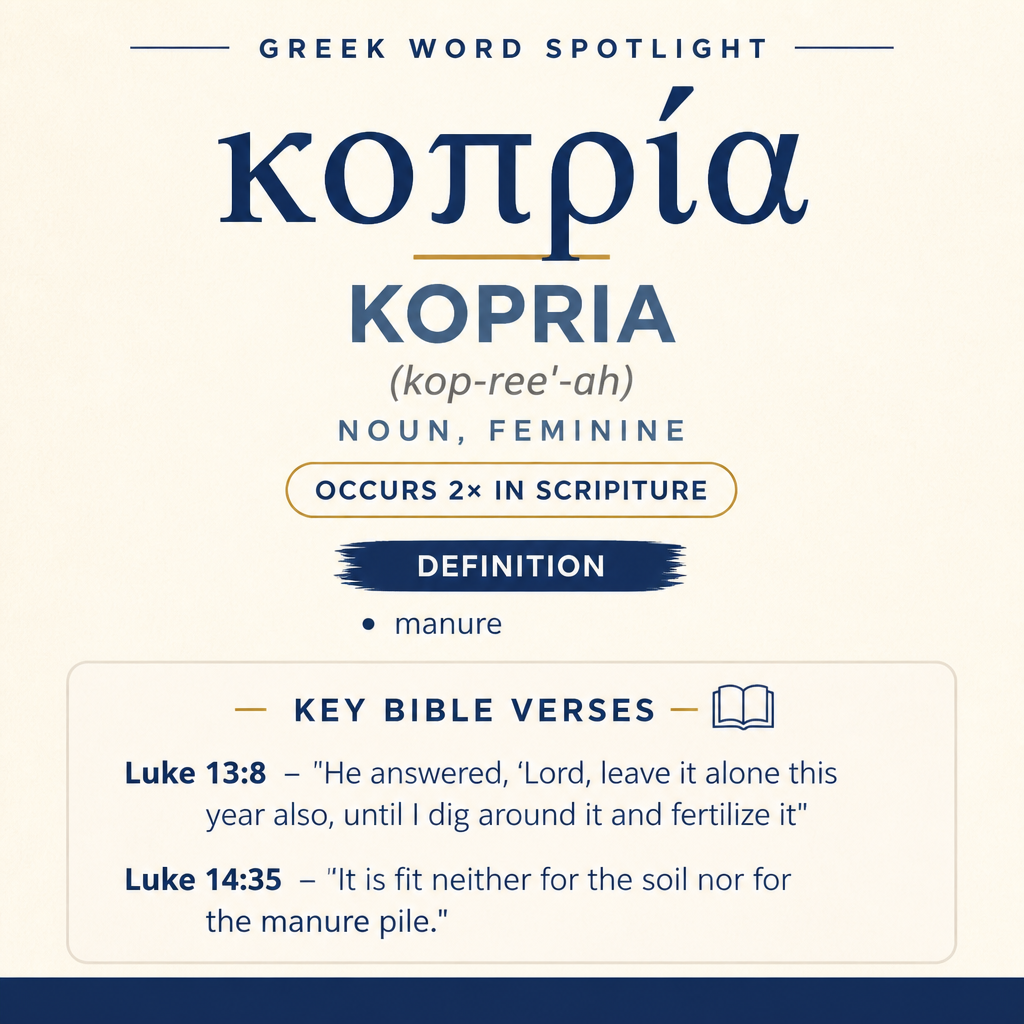
κοπρία means “manure” and appears twice in Scripture, in Luke 13:8 and Luke 14:35.
Gospel Occurrences
This word occurs two times in Scripture. Both occurrences are in the Gospel of Luke.
Learn More →Context in Luke
In Luke 13:8 it refers to fertilizing a tree after digging around it. In Luke 14:35 it appears in the phrase “manure pile.”
Learn More →κοπρία refers to manure. In the New Testament it appears in two Lukan contexts: one in a brief agricultural request about a fruitless tree, and one in a saying about something so useless it is discarded.
Occurrences
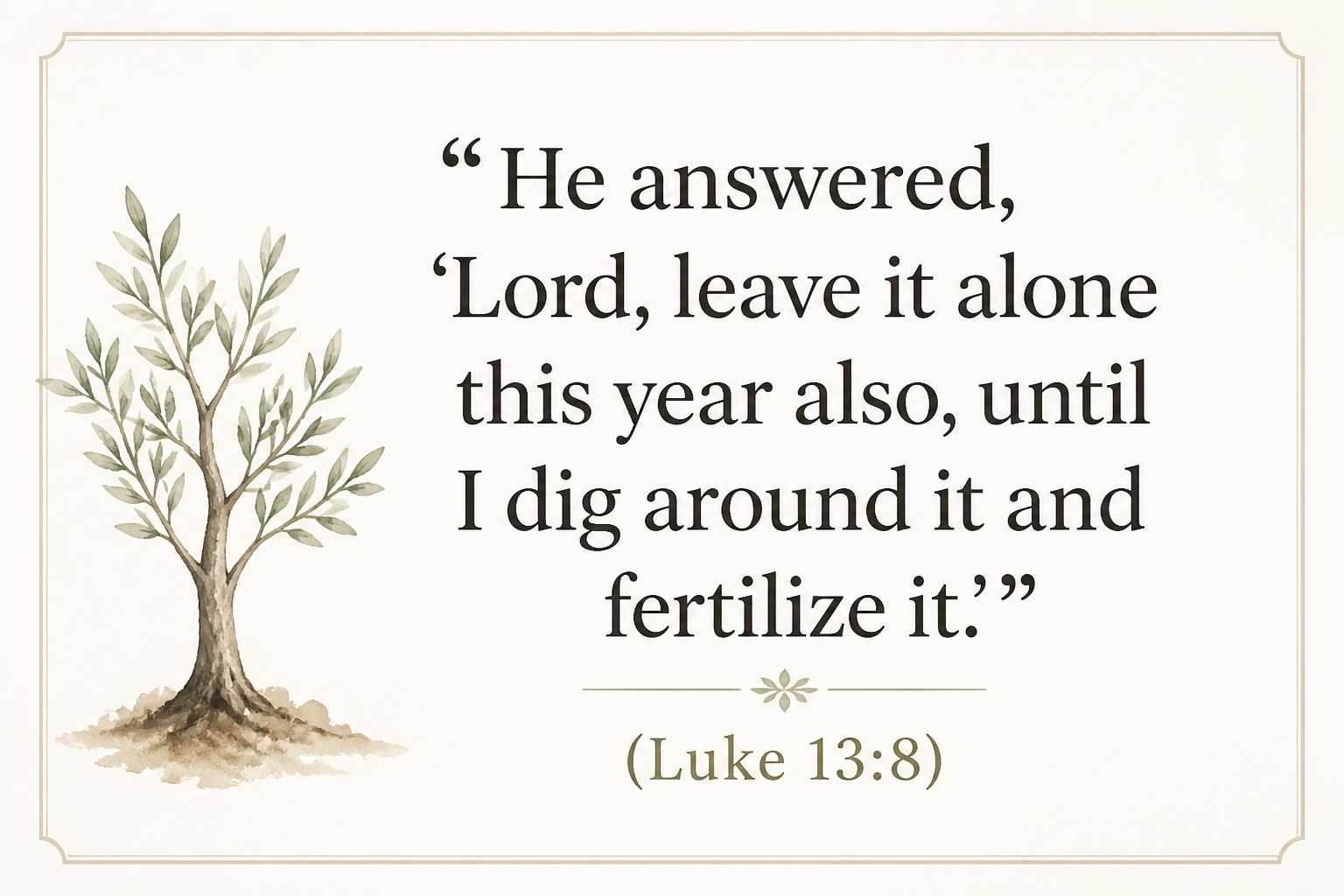
“He answered, ‘Lord, leave it alone this year also, until I dig around it and fertilize it.” (Luke 13:8)
In this sentence the word sits inside a practical plan for rescuing what has not been productive. The speaker asks for time—“this year also”—and pairs that extension with concrete action: “until I dig around it and fertilize it.” κοπρία here belongs to the work of cultivation. It presumes a living plant in place, ground that can be opened up, and the ordinary means by which a gardener strengthens growth prospects. Within the line’s structure, “dig around” and “fertilize” function together: loosening soil and applying manure are complementary steps aimed at changing the tree’s conditions rather than merely waiting for improvement. The word therefore contributes an earthy realism: the hope for fruit is tied to labor, contact with the soil, and an input associated with the farmyard rather than the marketplace.
The request “leave it alone” gains weight from this specific measure. The delay is not framed as indulgence or neglect but as an opportunity to undertake a remedy. The mention of manure underscores that the proposed remedy is not decorative; it is an intervention that can be messy and physical. In the scene’s logic, κοπρία marks a deliberate attempt to alter what the tree draws from its immediate environment, implying that the answer to barrenness is sought through intensified care and enrichment at the roots.
“It is fit neither for the soil nor for the manure pile. It is thrown out. He who has ears to hear, let him hear.” (Luke 14:35)
Here κοπρία appears in a negative evaluation: “fit neither for the soil nor for the manure pile.” The saying sets up two ordinary destinations for material meant to benefit the land. “Soil” points to the field itself; “manure pile” evokes a place where manure is gathered. Against these, the subject in the verse is judged unsuitable for either. By naming the manure pile, the line assumes that manure has a recognized, constructive role in agriculture: it belongs somewhere and is useful in a particular way. The point of the comparison, within the verse, is to highlight the opposite condition—something that does not even qualify for that basic usefulness.
The verdict is immediate and final: “It is thrown out.” The mention of κοπρία sharpens this by contrasting two kinds of “outness.” Manure, though unpleasant, is not “thrown out” in the sense of being wasted; it is put where it can serve the land. But the item described in the saying is not even fit to be treated as manure, so it is discarded altogether. The concluding call, “He who has ears to hear, let him hear,” frames the statement as more than an observation about farm practice. The agricultural categories—soil and manure pile—carry the weight of a moral or evaluative warning within the saying’s rhetoric: there are ends that count as purposeful placement, and there is an end that is sheer removal.

Sense and Usage
Across these two occurrences, κοπρία consistently carries its plain agricultural sense and does so in ways that highlight manure’s functional place in rural life. In Luke 13:8 it is an applied input: it is used to “fertilize” a tree that needs help. The word thus aligns manure with patient cultivation and the expectation that increased care can lead to change. The action is directed at the base of the tree, coordinated with digging, and oriented toward future fruitfulness. In that setting, manure is not a symbol floating free of its literal referent; it is part of the ordinary means by which the ground is improved for a living plant.
In Luke 14:35 manure remains the reference point of usefulness, but now by contrast. The “manure pile” functions as a benchmark for what even lowly material can be good for. The line assumes that manure has an appropriate place in a working landscape: it belongs either spread into “the soil” or gathered where it can later be used. When something is “fit neither for the soil nor for the manure pile,” the comparison implies a collapse of purpose: it has no appropriate agricultural destination. The word therefore helps the verse draw a sharp boundary between what can still serve a constructive end—however humble or unpleasant—and what must simply be cast away.
These two uses also show how the same concrete noun can support opposite rhetorical movements. One movement is restorative: manure is part of a plan to preserve and improve. The other is dismissive: manure is invoked to emphasize that some things are beyond even the lowest rung of practical value. In both, κοπρία is bound to the real economy of land and growth. It is not presented as a luxury good or a neutral substance; it is a common, earthy material that nevertheless has a recognized role—either as an applied fertilizer or as something that properly resides in a “pile” for agricultural use.
Because the word’s two contexts both assume cultivation, κοπρία brings with it a cluster of associations that arise directly from the scenes: proximity to soil, bodily labor (“dig around it”), and the management of what is ordinarily considered waste. Manure’s value in these sayings is inseparable from its purpose. Luke 13:8 depicts manure as value added to a living tree’s environment. Luke 14:35 depicts manure as a category of value so basic that being unfit even for it signals complete worthlessness in the comparison. In both cases, the imagery depends on manure being recognizable as a real thing with a real agricultural end.
Imagery
The imagery carried by κοπρία in these passages is intentionally down-to-earth. Luke 13:8 places manure beside digging and waiting, making the prospect of future fruit hinge on a gardener’s willingness to work the ground with ordinary materials. Luke 14:35 places manure beside “soil” and “thrown out,” using the manure pile as a vivid reference point for usefulness and placement. Together, these sayings make manure serve as a concrete measure of practical purpose: either it is applied to support growth, or it stands as a standard that some things cannot even meet.
Sources: Lexical data from Strong’s Exhaustive Concordance and the Translators Brief Lexicon of Extended Strongs for Greek (STEPBible, CC BY). Occurrence data from the Translators Amalgamated Greek New Testament (STEPBible, CC BY). Scripture quotations from the World English Bible (public domain).