Exploring the Meaning of Kopetos in Greek
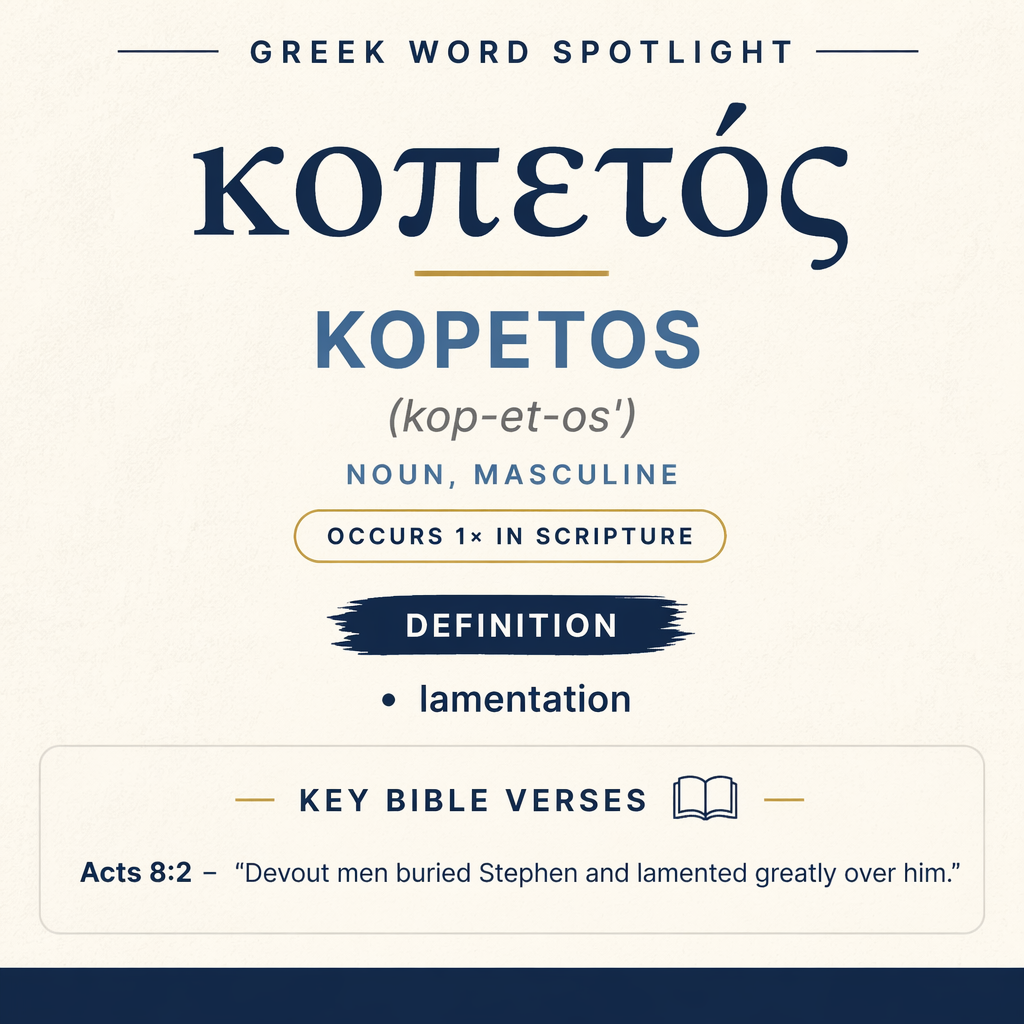
κοπετός means “lamentation” and appears once in Scripture in Acts 8:2.
Scripture Occurrence
This word occurs 1 time in Scripture. Its single occurrence is in Acts 8:2.
Learn More →Context in Acts
In Acts 8:2, devout men buried Stephen. They lamented greatly over him.
Learn More →κοπετός denotes “lamentation,” an expression of grief voiced or enacted in response to death. It appears once, in the narrative of Stephen’s burial in Acts 8:2.
Root and Related Words
κοπετός corresponds to the verb kopto (κόπτω), “to cut/mourn” (Strong’s G2875). The noun presents lamentation as the event or outworking associated with that verbal action.

Occurrences
“Devout men buried Stephen and lamented greatly over him.” (Acts 8:2)
In Acts 8:2 κοπετός gathers the community’s response into a single, weighty act: lamentation. The verse holds together two actions performed by “Devout men”: they “buried Stephen” and they “lamented greatly over him.” The placement of lamentation alongside burial anchors it in the concrete aftermath of death; it is not presented as a private feeling merely inferred, but as an identifiable occurrence in the public life of the group.

The lamentation is explicitly intensified: they “lamented greatly.” This intensifier does not change the kind of act signaled by κοπετός, but it does shape how that act is imagined within the scene. It points to lamentation that is not perfunctory or minimal, but expansive—an outpouring appropriate to the gravity of what has happened to Stephen. The wording “over him” keeps the lamentation directed: the grief has a clear object, bound to the person whose burial has just taken place.
Because the subject is plural (“Devout men”), the lamentation is also communal. The verse frames grief as something done together, not only something experienced separately. Within the narrative moment the burial locates Stephen’s body in the earth, while the lamentation marks Stephen’s loss in the living memory of those who honor him. κοπετός therefore functions here as the narrative’s way of naming a recognizable social act of mourning that accompanies death.
Sense and Usage
The single attestation of κοπετός presents “lamentation” as an observable, enacted response to a death rather than a vague emotional state. Acts 8:2 does not describe the manner of the lamentation in detail, but it does characterize it by three features embedded in the sentence: it is corporate (“Devout men”), it is attached to a funerary act (“buried Stephen”), and it is intense (“lamented greatly”). These features show how lamentation functions in the narrative world of Acts: grief is not hidden behind the burial; it accompanies the burial and interprets it as loss worthy of strong response.
The coordination of burial and lamentation also clarifies the kind of event κοπετός names. Burial is an act that completes a duty to the dead; lamentation is an act that expresses the value of the one who has died and the pain of separation. When Acts pairs these actions, lamentation becomes part of the honoring of Stephen. It is not simply that Stephen is placed in a grave; he is mourned. The verse’s syntax makes lamentation a second, distinct act—something done in addition to burial, not collapsed into it.
The presence of the modifier “greatly” underscores that κοπετός can take on degrees of intensity within a given scene. Acts 8:2 does not treat lamentation as uniform; it marks it as abundant. Even with only one occurrence, this usage shows that κοπετός can be shaped by context to indicate more than the bare fact of mourning: it can denote lamentation that is conspicuous in its magnitude.
The direct object phrase “over him” also keeps the sense concrete and personal. Lamentation is not generalized sorrow about troubling circumstances; it is grief directed toward Stephen himself. In this verse, κοπετός is therefore closely tied to a named individual and a specific death, anchoring the term’s sense in the lived reality of bereavement and the social expression of that bereavement.
Imagery
Acts 8:2 links κοπετός to the immediate setting of burial and the gathered mourners who honor the dead. The word carries the scene’s sound and movement implicitly: grief that rises from a community at a grave, a lamentation that is “great” because the loss is real and freshly felt.
Sources: Lexical data from Strong’s Exhaustive Concordance and the Translators Brief Lexicon of Extended Strongs for Greek (STEPBible, CC BY). Occurrence data from the Translators Amalgamated Greek New Testament (STEPBible, CC BY). Scripture quotations from the World English Bible (public domain).