Exploring the Meaning of Kopazo in Greek
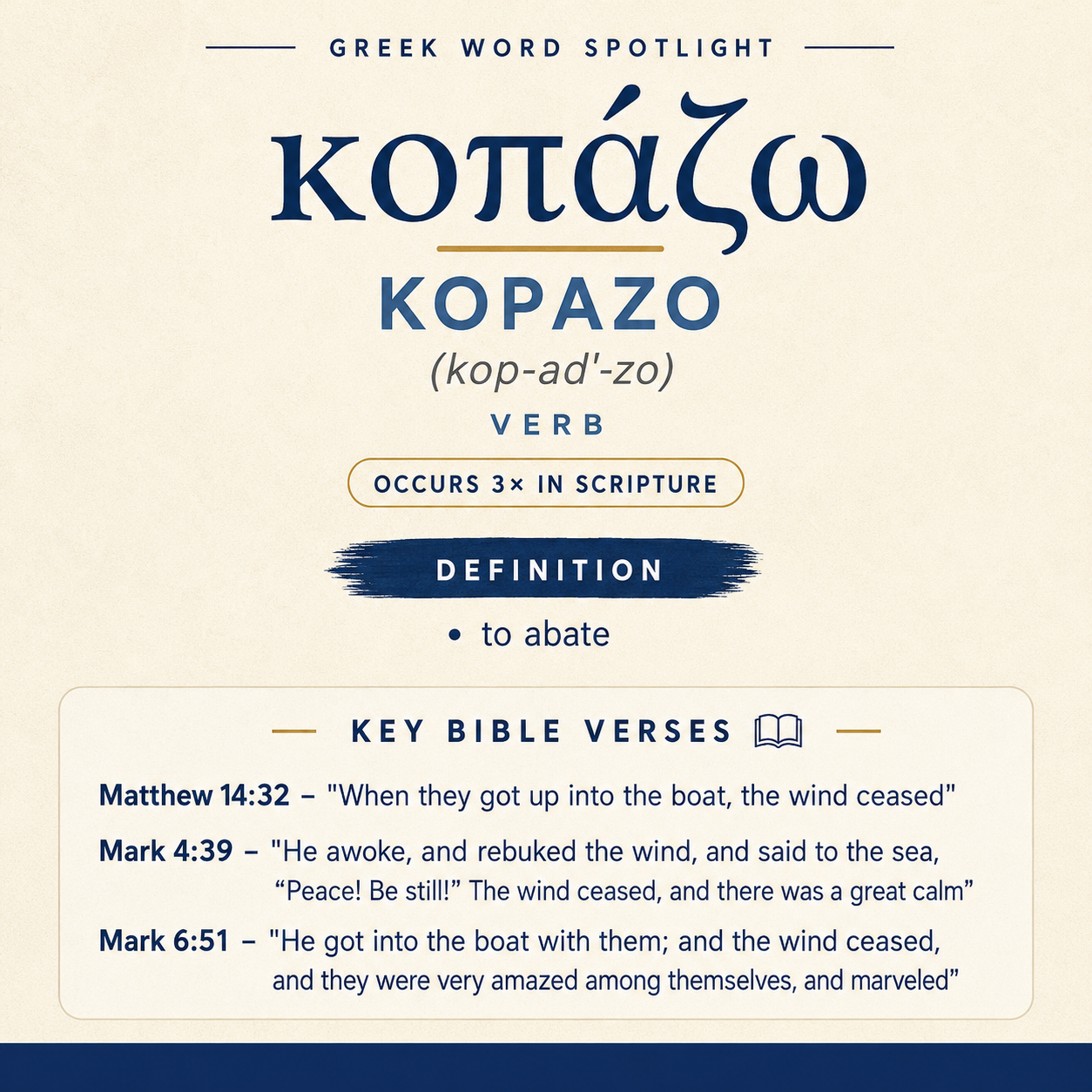
κοπάζω means “to abate” and appears in Matthew 14:32, Mark 4:39, and Mark 6:51.
Meaning
κοπάζω means “to abate.” In its Gospel contexts, it describes the wind ceasing.
Learn More →Gospel Scenes
It occurs when Jesus and the disciples are in a boat and the wind ceases. These scenes appear in Matthew 14:32, Mark 4:39, and Mark 6:51.
Learn More →Occurrences
κοπάζω occurs 3 times in Scripture. Each occurrence reports the wind ceasing.
Learn More →κοπάζω means “to abate,” and in the Gospels it appears in storm-and-boat scenes where wind gives way to stillness. In each setting, the verb marks a decisive change in conditions on the water.
Root and Related Words
κοπάζω is connected with kopos (κόπος), “labor” (Strong’s G2873).

Occurrences
Matthew 14:32 — “When they got up into the boat, the wind ceased.”
Here κοπάζω describes what happens to the wind at the moment Jesus and the others “got up into the boat.” The action is presented as immediate and complete within the short sentence: a transition from active wind to a state where it no longer exerts itself against them. The verb does not draw attention to the boat, the waves, or the crew’s actions; it concentrates the reader’s focus on the wind itself and its sudden stopping. In narrative terms, κοπάζω functions like a hinge: the scene turns from exposure to the elements to respite, and that shift is carried by the simple report that “the wind ceased.”
Mark 4:39 — “He awoke, and rebuked the wind, and said to the sea, “Peace! Be still!” The wind ceased, and there was a great calm.”
In Mark 4:39 κοπάζω stands between a command and its result. Jesus first “rebuked the wind” and addressed the sea with the imperatives, “Peace! Be still!” The verb then reports the immediate outcome: “The wind ceased.” The following clause, “and there was a great calm,” shows the wider effect that accompanies the wind’s abating; the change is not merely reduced intensity but a settled condition described as “great calm.” Within the verse, κοπάζω is the key predicate that marks the end of disturbance and the beginning of calm, linking Jesus’ spoken rebuke to a transformed environment.
Mark 6:51 — “He got into the boat with them; and the wind ceased, and they were very amazed among themselves, and marveled;”
In Mark 6:51 κοπάζω again portrays the wind’s abating, but the verse frames it as part of a chain of reactions. Jesus “got into the boat with them,” and then “the wind ceased.” The narrative continues with the disciples’ response: “they were very amazed among themselves, and marveled.” The verb therefore carries more than a meteorological report; it is the turning point that triggers astonishment. The wind’s ceasing is presented as a conspicuous event, notable enough to elicit intense amazement. By placing the verb between Jesus’ entrance into the boat and the disciples’ emotional reaction, the verse uses κοπάζω to mark the moment when the danger and strain of the situation gives way, producing immediate human wonder.
Sense and Usage
Across these three occurrences, “to abate” is applied in a focused and concrete way: it is the wind that abates. κοπάζω does not describe a gradual easing spread across time but a decisive cessation within the narrative line. Each verse presents the wind as active and then, at a specific moment, no longer active—so that the abating can be reported as a completed event (“ceased”).
Because the subject is consistently “the wind,” the verb takes on a strongly scene-shaping role. Wind in these passages is not background detail; it is the main environmental pressure that threatens progress and safety on the water. When κοπάζω is used, the reader is meant to feel that pressure release. The verb names the instant when resistance ends: the boat is no longer opposed by the same force, the situation is no longer driven by turbulence, and the scene can move from peril or struggle into safety and calm.
The verb also works as a marker of authority and response. In Mark 4:39, the wind’s abating follows a rebuke and a command, so κοπάζω functions as the narrated compliance of the wind to spoken words. In Matthew 14:32 and Mark 6:51, the abating coincides with Jesus’ coming into the boat; the verb captures the change that accompanies his presence within the boat itself. In all three, κοπάζω points to the wind as something that can be brought from activity to inactivity at a moment tied to Jesus’ action—whether speech (“Peace! Be still!”) or movement (“got up into the boat,” “got into the boat with them”).
Finally, κοπάζω’s placement tends to sharpen contrasts within each verse. Mark 4:39 makes the contrast explicit by pairing “The wind ceased” with “there was a great calm.” Mark 6:51 highlights contrast by moving from the environmental change to the disciples’ inner response: calm outside is matched by amazement inside. Matthew 14:32, in its brevity, lets the contrast stand on the single before-and-after implied by the report itself: the wind was present, and then it “ceased.” In every case, the verb “to abate” is not an abstract idea but an observable, narrative-defining reversal.
Imagery
κοπάζω carries the imagery of a force letting go. The wind is depicted as something that presses, resists, and agitates the scene—until it abates, and the water-world of the story becomes livable again. In Mark 4:39 the imagery resolves into “a great calm,” while Mark 6:51 links the same kind of resolution to stunned silence and marveling. Matthew 14:32 expresses the image most simply: the moment the boat receives its passengers, the wind’s activity ends.
Sources: Lexical data from Strong’s Exhaustive Concordance and the Translators Brief Lexicon of Extended Strongs for Greek (STEPBible, CC BY). Occurrence data from the Translators Amalgamated Greek New Testament (STEPBible, CC BY). Scripture quotations from the World English Bible (public domain).