
Exploring the Meaning of Kope in Greek
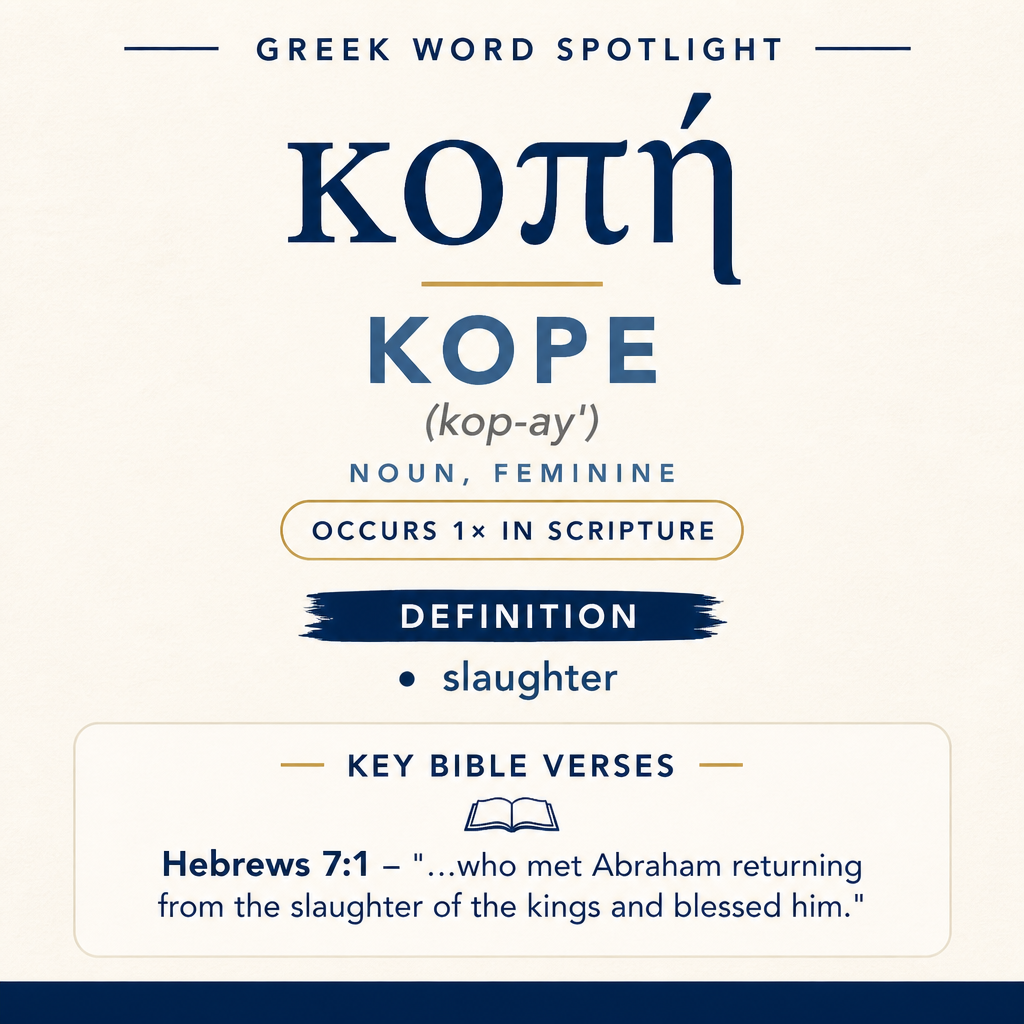
κοπή means “slaughter” and appears once in Scripture, in Hebrews 7:1.
Narrative Context
Hebrews 7:1 describes Melchizedek meeting Abraham as he returned from the slaughter of the kings.
Learn More →κοπή expresses “slaughter” and appears in the New Testament in connection with Abraham’s return after a violent conflict involving kings. In Hebrews 7:1 it functions as the event-marker that frames Melchizedek’s meeting with Abraham.
Root and Related Words
κοπή is derived from the verb kopto (κόπτω), “to cut/mourn.”

Occurrences
Hebrews 7:1: For this Melchizedek, king of Salem, priest of God Most High, who met Abraham returning from the slaughter of the kings and blessed him,
In this description of Melchizedek, κοπή names the decisive background event: Abraham is “returning from the slaughter of the kings.” The noun does not merely indicate that there was a confrontation; it identifies the outcome as an episode of lethal violence, giving the encounter with Melchizedek a setting shaped by bloodshed and victory. The verse builds a compact chain of identifiers—Melchizedek’s royal title (“king of Salem”), his priestly role (“priest of God Most High”), his action toward Abraham (“met Abraham”), and his spoken act (“blessed him”). Within that chain, κοπή anchors the narrative moment in the aftermath of combat: Abraham is on the move away from a scene defined by killing, and Melchizedek meets him at precisely that transitional point.
The phrase “slaughter of the kings” also sharpens the scope of the violence. The object is not unnamed enemies but “the kings,” presenting the conflict as one that reached the highest level of leadership. By situating Abraham’s return in relation to this slaughter, the verse portrays Abraham not as arriving from ordinary travel, but as coming back from a significant and consequential military outcome. κοπή therefore helps the line communicate why this meeting and blessing is memorable: it occurs immediately after a moment marked by death and the downfall of rulers.
Sense and Usage
As “slaughter,” κοπή conveys the stark fact of killing in a conflict, with emphasis on the deadly result rather than the strategies or movements of battle. In Hebrews 7:1 it operates as a compressed narrative summary: the reader is not invited to linger over the mechanics of warfare, but to register that a violent decisive act has taken place and that Abraham now stands on the other side of it. The noun’s placement after “returning from” makes it function like a boundary in time and experience—what comes next (the meeting and blessing) is colored by what has just occurred (slaughter).
The expression also contributes to the verse’s portrait of Abraham. The line does not speak of his emotions or intentions; it characterizes his situation by the public event attached to his return. κοπή thus gives Abraham a context of hard-won triumph and survival: he is returning from an episode that has ended in death for others, specifically for “the kings.” The blessing that follows is thereby heard against a backdrop where life and death have been at stake, making the act of blessing feel like a solemn pronouncement spoken into the aftermath of violence.
Because the verse uses κοπή to qualify “the kings,” it also shapes how the conflict is understood socially. “Kings” are figures of authority and power; their mention heightens the sense that this was not a minor skirmish. κοπή, in this collocation, expresses more than generic hostility: it marks a severe outcome that has altered the status of rulers. The noun therefore serves a rhetorical purpose within the sentence: it magnifies the significance of the moment when Melchizedek meets Abraham, since Abraham approaches not simply as a traveler but as one returning from an event that overturned powerful opponents.
The related verb kopto (κόπτω), “to cut/mourn,” stands behind the noun and adds a concrete verbal backdrop: κοπή is naturally heard as an action-result term, the “slaughter” that corresponds to cutting down in violent conflict. Even without expanding the sense beyond “slaughter,” this relationship highlights how physical and forceful the word’s imagery is: it belongs to a sphere where bodies are harmed and lives are ended. Hebrews 7:1 employs that imagery economically, using a single noun to evoke the severity of the episode without narrating it in detail.
Imagery
In Hebrews 7:1, κοπή carries the visual weight of a battlefield’s aftermath—an event of death that lies behind Abraham as he returns and encounters Melchizedek. The verse holds slaughter and blessing in close proximity: the same sentence that names “the slaughter of the kings” immediately speaks of Melchizedek who “met Abraham” and “blessed him.” κοπή thus supplies the dark, violent background against which the meeting and blessing stand out as a solemn, defining moment.
Sources: Lexical data from Strong’s Exhaustive Concordance and the Translators Brief Lexicon of Extended Strongs for Greek (STEPBible, CC BY). Occurrence data from the Translators Amalgamated Greek New Testament (STEPBible, CC BY). Scripture quotations from the World English Bible (public domain).




