
Exploring the Meaning of Energema in Greek
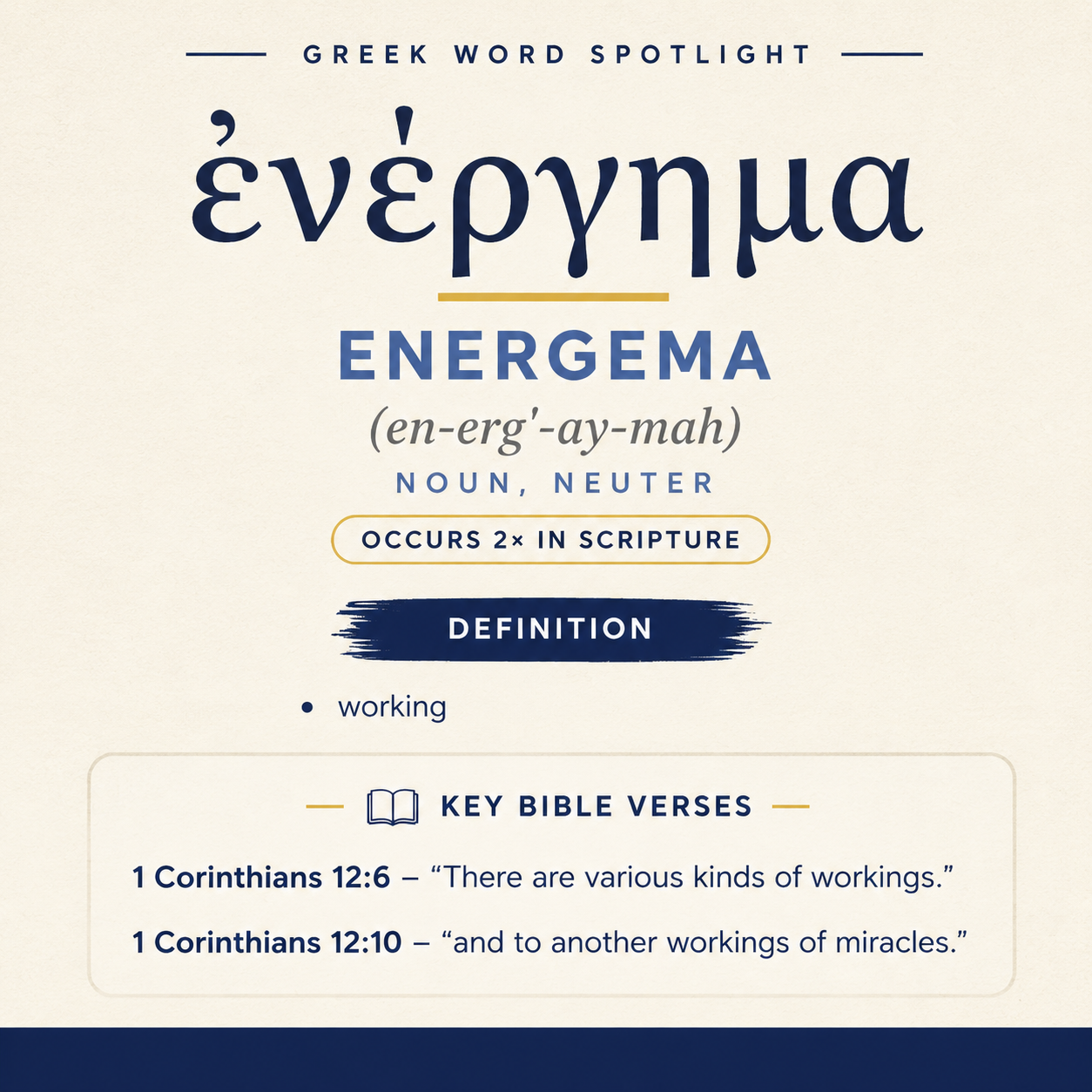
ἐνέργημα means “working” and appears twice in Scripture, both in 1 Corinthians 12:6 and 1 Corinthians 12:10.
Scripture Occurrences
It occurs 2 times in Scripture. Both occurrences are in 1 Corinthians 12.
Learn More →Context in Corinthians
In 1 Corinthians 12:6 it refers to various kinds of workings under the same God. In 1 Corinthians 12:10 it appears in “workings of miracles.”
Learn More →ἐνέργημα speaks of a “working” as something effected or brought about. In the New Testament it appears in Paul’s discussion of spiritual variety and divine activity in 1 Corinthians 12.
Root and Related Words
ἐνέργημα (Energema) derives from the verb ἐνεργέω (energeo), “be active” (Strong’s G1754). The relationship between the two highlights an action-to-result movement: the verb portrays activity, and the noun points to what that activity produces as a working.

Occurrences
“There are various kinds of workings, but the same God, who works all things in all.” (1 Corinthians 12:6)
Here ἐνέργημα names the concrete expressions of divine activity within the community: “various kinds” of such workings exist, yet they are gathered under “the same God.” The sentence holds together difference and unity by pairing diversity (“various kinds”) with a single source (“the same God”) and a comprehensive scope (“all things in all”). In this framing, the “workings” are not treated as random occurrences or isolated events; they function as instances within a larger pattern of God’s effective working. The parallel phrasing also gives the noun weight: the line does not merely acknowledge that God is active, but that His activity is recognizable in multiple distinct workings that can be spoken of, distinguished, and yet traced back to one agent.
“and to another workings of miracles; and to another prophecy; and to another discerning of spirits; to another different kinds of languages; and to another the interpretation of languages.” (1 Corinthians 12:10)
In this list, ἐνέργημα is set alongside other named manifestations in the congregation, and it is qualified: “workings of miracles.” The plural phrasing presents more than one instance or form, and the repeated “to another” distributes these workings across different individuals rather than concentrating them in a single person. Within the list, “workings of miracles” stands as a distinct category next to “prophecy,” “discerning of spirits,” “different kinds of languages,” and “the interpretation of languages.” That placement helps define how the word functions here: it points to acts that are observable as effects—something that happens as a working—rather than to an office, a title, or a general ability described abstractly. Even in a compact list, the noun supports the idea that what the church sees includes specific workings that can be recognized as belonging to the realm of “miracles,” in the same way other items can be recognized and named as prophecy, discernment, languages, or interpretation.
Sense and Usage
The two uses in 1 Corinthians 12 keep ἐνέργημα within the sphere of effected activity: a working is something done in such a way that it stands out as an event or result of action. In 12:6, the word is broad and programmatic—“various kinds of workings”—serving as a summary category that gathers many expressions under one heading and anchors them in God’s comprehensive working (“who works all things in all”). In 12:10, the word narrows to a particular kind of working, “workings of miracles,” as one item among others apportioned across the body.
Across both verses the noun helps Paul speak about diversity without losing coherence. The diversity is real: there are “various kinds,” and people receive different assignments (“to another… to another”). Yet the workings are not detached from the One who acts; the statement in 12:6 gives an interpretive frame in which God’s own working is the underlying reality that makes these different workings intelligible as belonging together. In that sense, ἐνέργημα supports a way of speaking that is both practical and theological: practical, because it lets the community refer to distinct workings that can be listed and recognized; theological, because it locates such workings within God’s active agency that is described as reaching “all things” and “all.”
The word’s placement also suggests a distinction between activity and its effect. The same verse that speaks of “workings” immediately describes God as the one “who works,” using the verbal idea alongside the noun. This pairing draws attention to the difference between the doer and the done thing: God works, and the church experiences and names the workings. When the list in 12:10 speaks of “workings of miracles,” it likewise points to identifiable outcomes of action—miracles that occur as workings—rather than merely to an inward disposition. Thus ἐνέργημα serves Paul’s aim of describing Spirit-shaped diversity in terms that remain grounded in what is actually effected among people.
Imagery
In these verses, the imagery carried by ἐνέργημα is that of active power made visible in results: workings that can be counted as “various kinds” and singled out as “workings of miracles.” The language evokes a community in which God’s activity is not only confessed but perceived through concrete workings distributed among many, while still belonging to “the same God, who works all things in all.”
Sources: Lexical data from Strong’s Exhaustive Concordance and the Translators Brief Lexicon of Extended Strongs for Greek (STEPBible, CC BY). Occurrence data from the Translators Amalgamated Greek New Testament (STEPBible, CC BY). Scripture quotations from the World English Bible (public domain).





