
Exploring the Meaning of Kataskenosis in Greek
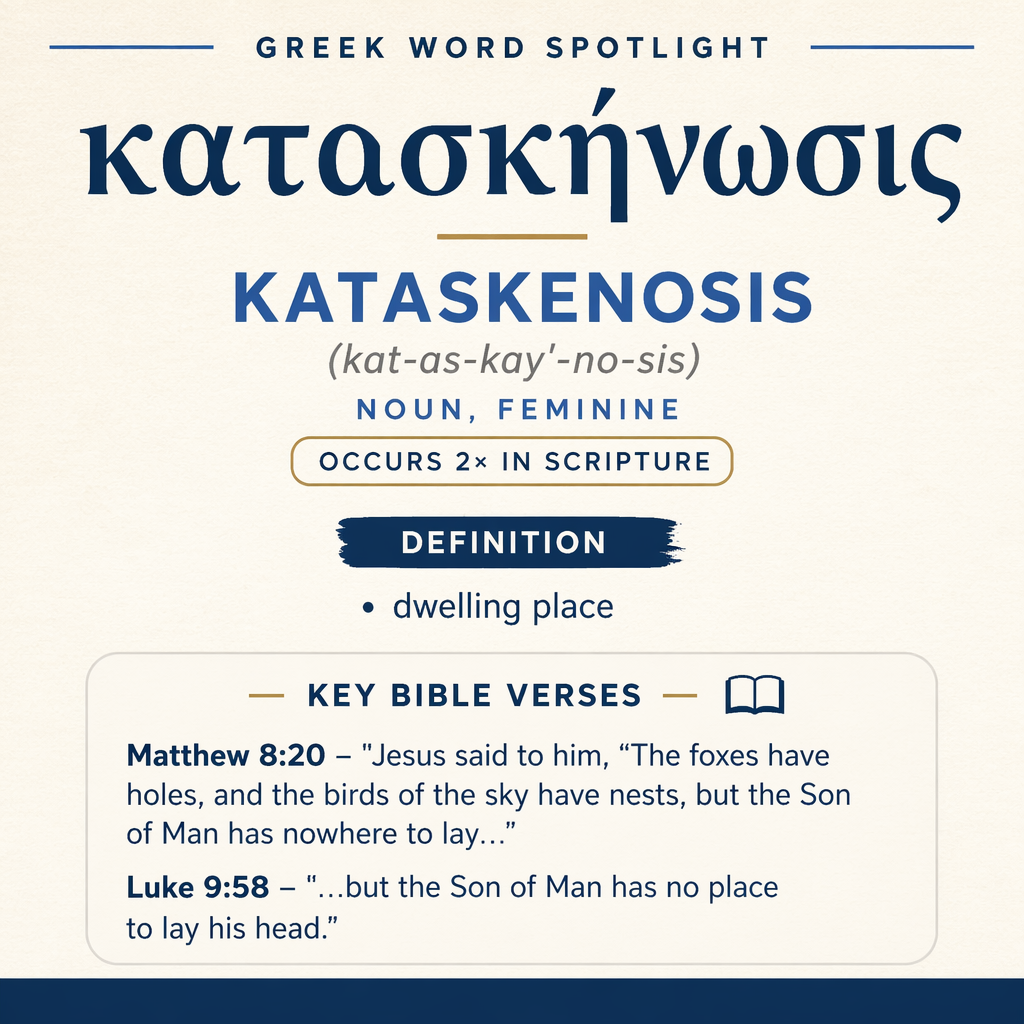
κατασκήνωσις means “dwelling place” and appears twice in Scripture: Matthew 8:20 and Luke 9:58.
Context Snapshot
In both verses, Jesus contrasts animals’ shelters with the Son of Man having no place to lay his head.
Learn More →Kataskenosis denotes a “dwelling place” and appears in two closely parallel sayings of Jesus in the Synoptic Gospels. In both, it is part of a vivid contrast between animals that have a settled place and the Son of Man who does not.
Root and Related Words
Kataskenosis derives from the verb kataskenoo (κατασκηνόω), “to dwell” (Strong’s G2681). The noun expresses the result or locus of that action: a place conceived as a site of dwelling.
Occurrences
Matthew 8:20: Jesus said to him, “The foxes have holes, and the birds of the sky have nests, but the Son of Man has nowhere to lay his head.”
Within this saying, kataskenosis is carried by the concrete image of a “nest” belonging to “the birds of the sky.” The scene sets ordinary animal security—foxes with “holes” and birds with “nests”—against the Son of Man’s lack of even the minimum rest of “nowhere to lay his head.” Here a “dwelling place” is not an abstract idea but a real, bodily location associated with shelter, rest, and belonging. The emphasis falls on the contrast: creatures can be described as having settled places, while the Son of Man is defined by the absence of such a place, even at the level of laying down one’s head. In this context, a dwelling place functions as a marker of stability; the saying draws its force from presenting that stability as something readily observable in the natural world.
Luke 9:58: Jesus said to him, “The foxes have holes, and the birds of the sky have nests, but the Son of Man has no place to lay his head.”
Luke’s version repeats the same paired images and the same contrast. The “nests” of “the birds of the sky” again represent a dwelling place as an identifiable, possessed location. The wording “has no place to lay his head” places the lack of dwelling in spatial terms: not merely an inner experience, but the absence of a “place.” The parallel structure—foxes have holes; birds have nests; but the Son of Man has no place—frames a dwelling place as something creatures normally “have,” something that can be spoken of as theirs. In Luke, as in Matthew, the word’s contribution lies in evoking a fixed resting site, so that the Son of Man’s condition is described through deprivation of what even animals routinely possess.
Sense and Usage
Across these two occurrences, kataskenosis is anchored in the everyday world of animal shelter. A “dwelling place” is pictured as the kind of location that can be found, returned to, and used for rest: “holes” for foxes, “nests” for birds. The sayings do not linger on the construction or details of these shelters; instead, they treat them as self-evident realities of creaturely life. That obviousness is the point: the audience is expected to recognize immediately what it means for an animal to have a place that counts as its own dwelling.
In both verses, the meaning of “dwelling place” is sharpened by the immediate contrast clause. The Son of Man is presented as lacking a comparable place, and the sayings intensify the idea of dwelling by reducing it to its simplest expression—having somewhere to “lay” one’s head. In this way kataskenosis helps define dwelling as basic shelter rather than luxury. A dwelling place is the minimum location where a body may rest without exposure; the force of the comparison depends on the shared human intuition that having even such a minimal place is normal.
Because kataskenosis is embedded in a triad of possessive statements (“have … have … has nowhere/no place”), the noun’s sense leans toward the notion of a place one can count on. It is not merely a site that exists somewhere in the landscape, but a place that belongs to a creature’s life-pattern—something it “has.” Thus the word’s semantic weight in these passages rests on the association between dwelling and settledness. In both settings, the sayings present dwelling as a sign of ordinary stability and then deny that stability to the Son of Man.
The repeated pairing of “holes” and “nests” also sets kataskenosis within a range of physical refuges. A hole is an earthbound shelter; a nest is elevated and crafted for habitation in the skyward sphere of birds. Together they form a small spectrum of habitats, suggesting that in the natural order there are many kinds of dwelling places fitted to different creatures. Against that varied sufficiency, the Son of Man’s lack of any corresponding “place” stands out more starkly: the issue is not that a particular kind of dwelling is unavailable, but that no dwelling place at all is assigned to him in the terms of the saying.
Finally, the word functions rhetorically by calling attention to what is usually unnoticed. Most listeners do not need to be persuaded that animals have shelters; the statement works because it appeals to a common observation. Kataskenosis therefore contributes to a saying whose persuasive power rests in concrete, almost proverbial imagery. The word brings the reader into the realm of tangible places—holes and nests—so that the concluding clause about the Son of Man lands with clarity and immediacy.
Imagery
The imagery tied to kataskenosis here is the quiet certainty of a creature returning to its shelter: a fox to its hole, a bird to its nest. Against that simple picture stands a life described without such a fixed point—“nowhere” or “no place” even for the basic act of laying down one’s head. The word’s contribution is to make “dwelling place” feel concrete and local, so that the contrast is felt not as a theory but as a stark difference in where one can rest.
Sources: Lexical data from Strong’s Exhaustive Concordance and the Translators Brief Lexicon of Extended Strongs for Greek (STEPBible, CC BY). Occurrence data from the Translators Amalgamated Greek New Testament (STEPBible, CC BY). Scripture quotations from the World English Bible (public domain).




