
Exploring the Meaning of Kataskenoo in Greek
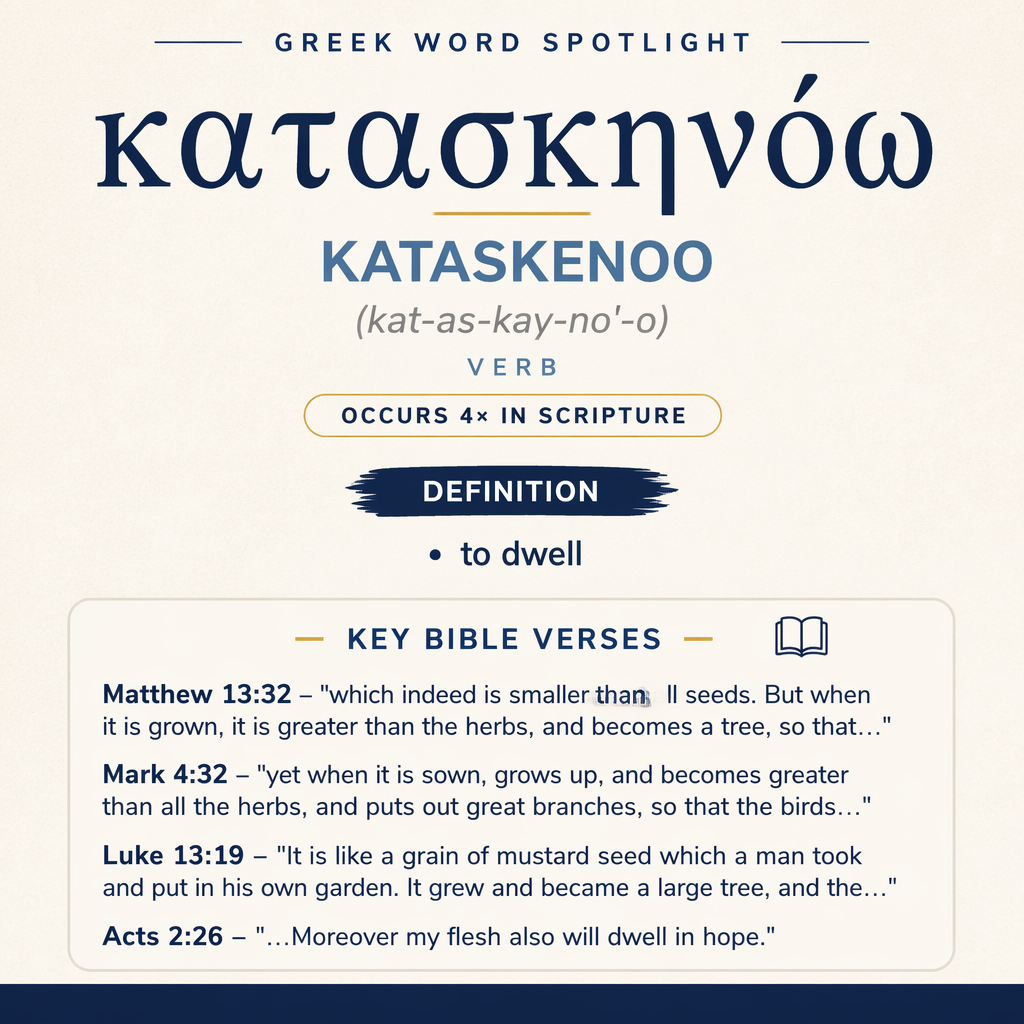
κατασκηνόω means “to dwell” and appears 4 times in Scripture: Matthew 13:32, Mark 4:32, Luke 13:19, and Acts 2:26.
Gospel Occurrences
It occurs in Matthew 13:32, Mark 4:32, and Luke 13:19 in the mustard-seed parable context.
Learn More →Acts Occurrence
It appears in Acts 2:26 in the phrase “my flesh also will dwell in hope.”
Learn More →κατασκηνόω means “to dwell,” and it appears in three Synoptic parable sayings about birds in relation to a grown plant and once in a quoted confession of hope. Across these passages, the verb frames dwelling as a settled, location-bound reality—either in the shelter of branches or in hope.
Root and Related Words
Kataskenoo (κατασκηνόω) derives from kata (κατά), “according to” (Strong’s G2596), and skenoo (σκηνόω), “to dwell” (Strong’s G4637). The compound form foregrounds dwelling as something expressed with reference to a place or setting, an action that can be pictured and located within a scene.
Occurrences
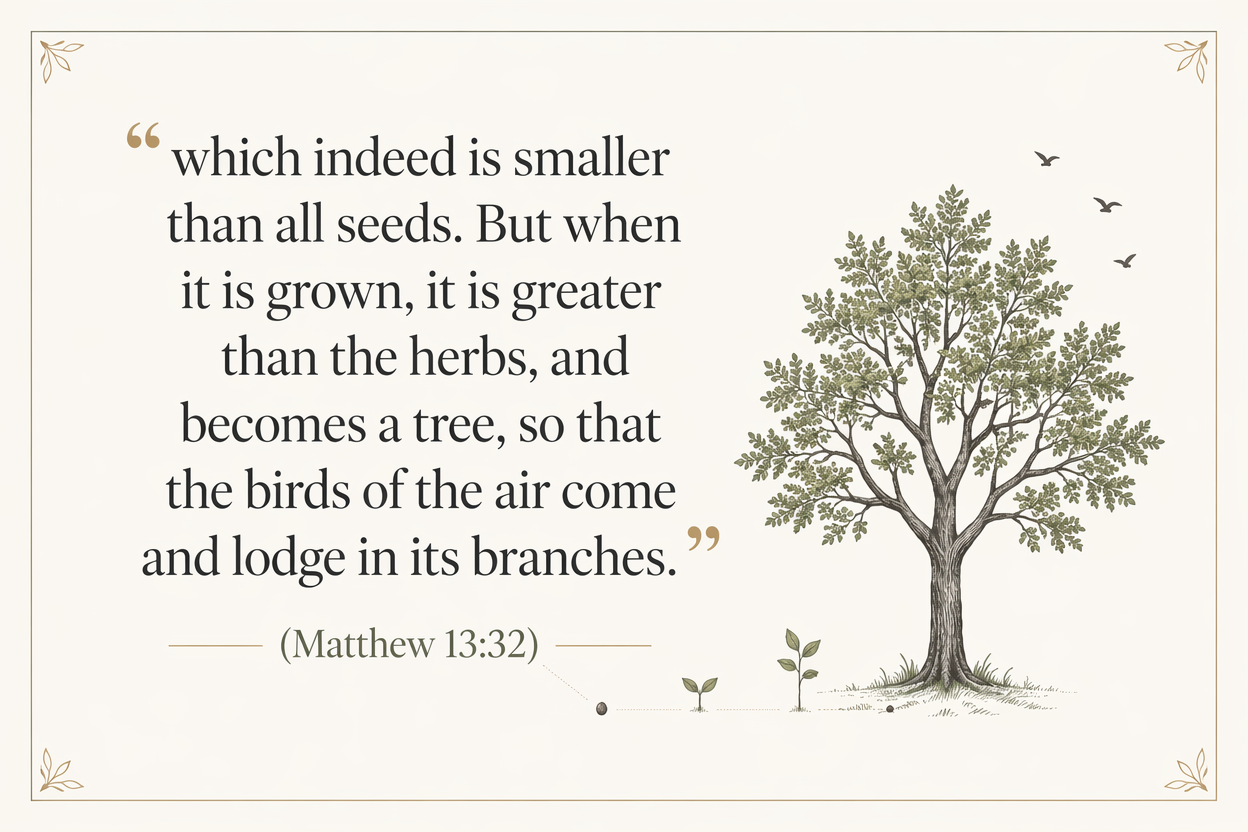
“which indeed is smaller than all seeds. But when it is grown, it is greater than the herbs, and becomes a tree, so that the birds of the air come and lodge in its branches.” (Matthew 13:32)
Here the dwelling action is presented as the outcome of growth: a small seed becomes “a tree,” and that change creates a place where “the birds of the air come and lodge.” The verb attaches to a concrete location—“in its branches”—so the picture is not merely of birds alighting briefly but of birds finding a place within the tree’s structure. In the logic of the sentence, the tree’s greatness is expressed not only in size (“greater than the herbs”) but also in its capacity to host dwelling.
“yet when it is sown, grows up, and becomes greater than all the herbs, and puts out great branches, so that the birds of the sky can lodge under its shadow.” (Mark 4:32)
In Mark the setting is shaped more by shelter than by perching: the plant “puts out great branches,” and the birds “can lodge under its shadow.” The dwelling is still tied to a specific place, but the phrase “under its shadow” stresses the protective space cast by the branches rather than the branches as physical perches. The modal phrasing (“can lodge”) links the verb to capability: the plant’s growth produces conditions that make dwelling possible. The action of dwelling therefore functions as an index of the plant’s developed, branch-spreading form.
“It is like a grain of mustard seed which a man took and put in his own garden. It grew and became a large tree, and the birds of the sky live in its branches.” (Luke 13:19)
Luke sets the scene in a cultivated space: the seed is placed “in his own garden,” and from that domestic act comes a “large tree.” The birds “live in its branches,” again locating dwelling within the tree itself. Compared to the previous sayings, the wording “live” casts dwelling as continuing habitation, not simply a moment of lodging. The verb contributes the idea that the tree’s branches become a stable habitat, the kind of place where life can be carried on, not merely where rest can be taken.
“Therefore my heart was glad, and my tongue rejoiced. Moreover my flesh also will dwell in hope;” (Acts 2:26)
In Acts the subject of dwelling shifts from birds to “my flesh,” and the location shifts from branches and shadow to “hope.” The verb depicts the body itself as residing within a condition described as hopeful. The surrounding parallel lines (“my heart was glad,” “my tongue rejoiced”) are immediate expressions, but “my flesh also will dwell in hope” presents dwelling as an ongoing posture: the speaker’s embodied life is portrayed as situated within hope rather than displaced by fear or uncertainty. In this sentence, dwelling gives hope a kind of experienced space—something one can inhabit.
Sense and Usage
Across these four passages, “to dwell” consistently implies more than contact; it implies settlement in a place that can be named. In the Synoptic sayings, that place is spatial and visible: “in its branches” (Matthew; Luke) and “under its shadow” (Mark). The verb works with growth language (“when it is grown,” “grows up,” “grew and became a large tree”) to show how dwelling depends on developed capacity: a plant that becomes “greater” and spreads “great branches” becomes a fitting site for habitation. Dwelling is thus presented as an effect that reveals the plant’s matured state—its branches and shadow are not incidental details but the very features that support occupancy.
The three parable settings also show that dwelling can be framed in slightly different spatial terms without changing the central idea. Matthew and Luke locate the dwelling “in” the branches, picturing inhabitation within the tree’s structure; Mark locates it “under” the shadow, picturing habitation within the sheltered space created by the tree. In each case the verb draws attention to a stable relationship between inhabitant and place: birds are not merely passing by; they are pictured as taking up residence within the conditions provided.
Acts 2:26 extends the same sense into a non-botanical setting: dwelling still means residing, but the “place” is expressed as “hope.” The verb thereby functions to portray hope as something that can hold a person—specifically, “my flesh,” the embodied self. The shift shows that dwelling can describe a settled condition as well as a settled location. Yet the grammar of the clause preserves the verb’s core force: “will dwell” presents a continuing state, and the prepositional phrase “in hope” supplies the sphere in which that state is experienced.
Imagery
These passages attach dwelling to sheltering spaces. The repeated tree-and-birds scene pictures dwelling as finding a home amid branches or within shade, while Acts’ line, “my flesh also will dwell in hope” (Acts 2:26), transfers that spatial imagery to the inner life by speaking of hope as a sphere that can be inhabited. In both kinds of scenes, dwelling is depicted as being held and situated, whether by a tree’s growth or by hope’s steadiness.
Sources: Lexical data from Strong’s Exhaustive Concordance and the Translators Brief Lexicon of Extended Strongs for Greek (STEPBible, CC BY). Occurrence data from the Translators Amalgamated Greek New Testament (STEPBible, CC BY). Scripture quotations from the World English Bible (public domain).




