Exploring the Meaning of Huperakmos in Greek
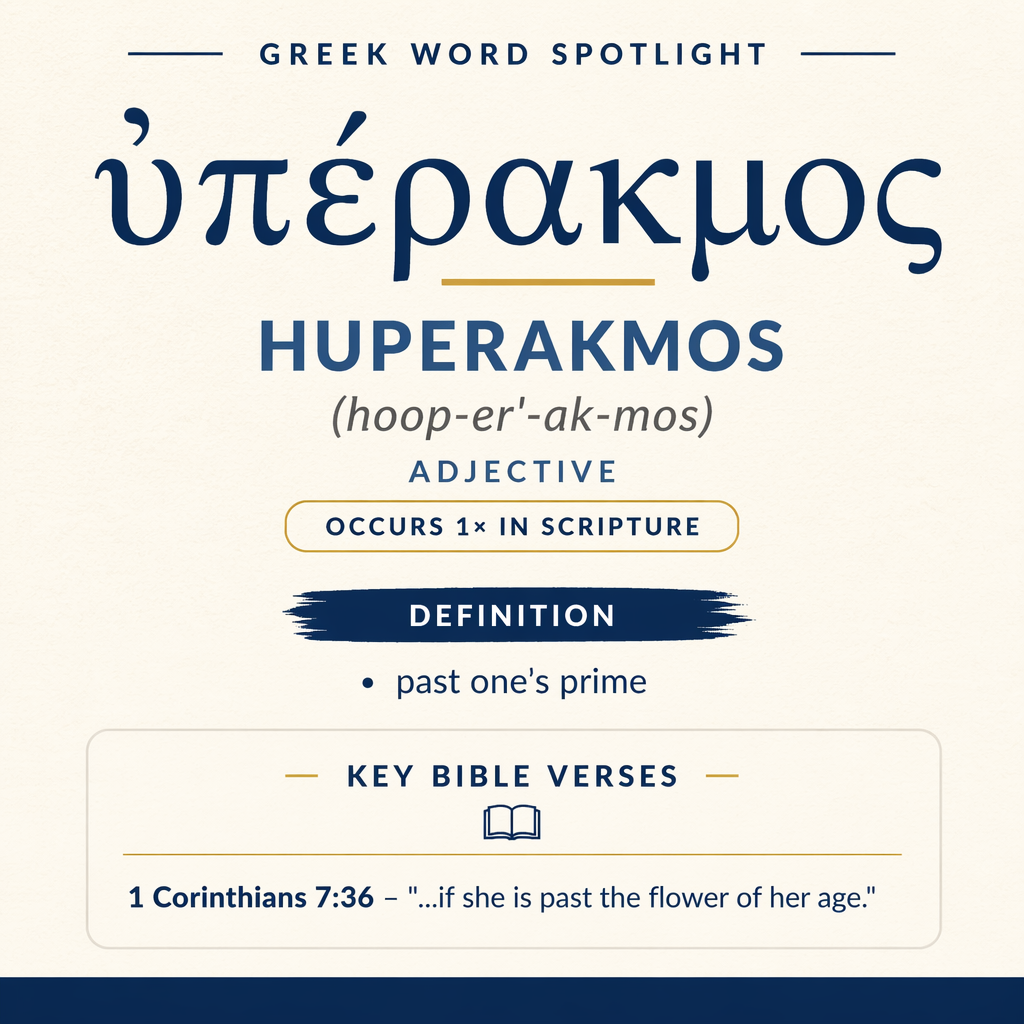
ὑπέρακμος means “past one’s prime” and appears once in Scripture, in 1 Corinthians 7:36.
Scripture Occurrence
ὑπέρακμος occurs 1 time in Scripture. Its single occurrence is in 1 Corinthians 7:36.
Learn More →Verse Context
In 1 Corinthians 7:36, it is used of a virgin described as “past the flower of her age.”
Learn More →ὑπέρακμος means “past one’s prime” and appears in Paul’s counsel on marriage and propriety in 1 Corinthians 7:36. In that setting it marks a perceived change of season—an awareness that time has moved forward in a way that bears on the decision to marry.
Root and Related Words
ὑπέρακμος is built from hyper (ὑπέρ), “above/for” (Strong’s G5228), and akmen (ἀκμήν), “still” (Strong’s G188). The combined form provides the word’s shape as a descriptor used in relation to a person’s stage of life.

Occurrences
“But if any man thinks that he is behaving inappropriately toward his virgin, if she is past the flower of her age, and if need so requires, let him do what he desires. He doesn’t sin. Let them marry.” (1 Corinthians 7:36)
Here ὑπέρακμος functions inside a conditional sentence (“if … if … and if …”), naming one factor that may press the matter toward marriage. The situation Paul sketches includes (1) a man’s concern that his conduct toward “his virgin” may be “inappropriately” handled, (2) the assessment that she is “past the flower of her age,” and (3) a sense that “need so requires.” The adjective gives language to the second element: it frames the woman’s age as having passed a certain peak, and that perception becomes part of the moral and practical reasoning that follows.
The word’s contribution is not merely descriptive but deliberative. The man “thinks” (an inward judgment) that his behavior may be improper; in that same line of thought he evaluates her as “past the flower of her age.” The adjective thus belongs to the realm of conscientious decision-making in a relationship, not to a detached medical or demographic statement. Paul then answers the concern directly: in the circumstance described, marriage is permitted—“He doesn’t sin. Let them marry.” In other words, the age-related consideration expressed by ὑπέρακμος is treated as a legitimate part of discerning what is fitting, without turning the resulting decision into wrongdoing.

Placed where it is, the adjective also strengthens the force of “if need so requires.” The verse does not treat “need” as abstract; it is the kind of pressure that may arise when time has advanced and the couple’s situation calls for clarity and propriety. By pairing the assessment about age with the concern for appropriate conduct, the word helps depict a case where delay may feel increasingly difficult or unwise, so that proceeding to marriage becomes the straightforward, non-sinful course.
Sense and Usage
“Past one’s prime” is a time-and-season descriptor. In 1 Corinthians 7:36 it is anchored to a relational setting: a man is weighing whether his behavior is “inappropriately” directed toward “his virgin,” and the adjective provides one concrete reason the question feels urgent. The focus is not on defining a precise age or creating a universal timetable, but on the recognition that a season regarded as most fitting for unmarried youth has moved on. The phrase “past the flower of her age” conveys that sense of a life-stage crossing, and ὑπέρακμος is the pivot that makes the crossing explicit.
Because it is used within an “if” clause, the word operates as a situational marker rather than a command. Paul does not present it as an absolute threshold that forces a single outcome; rather, it is one element in a cluster of considerations: propriety (“behaving inappropriately”), perceived necessity (“need so requires”), and personal intention (“let him do what he desires”). Within that cluster, ὑπέρακμος gives a way to speak about time’s progression as a morally relevant factor—something that can legitimately inform whether remaining as they are continues to be appropriate.
The immediate result of acknowledging this condition is pastoral and practical: permission to marry without guilt. The adjective therefore does not function as a tool of shame in the verse; it functions as part of a realistic scenario in which marriage can be the fitting resolution. The logic in the text moves from concern (“thinks that he is behaving inappropriately”) through circumstances (including that she is “past the flower of her age”) to an uncomplicated conclusion (“He doesn’t sin. Let them marry.”). In that movement, ὑπέρακμος serves as a term that places the situation within a later stage of eligibility or opportunity as perceived by those involved.
Imagery
The wording “past the flower of her age” presents age as a season of bloom that can be recognized as having passed. Within Paul’s counsel, this seasonal imagery is not used for poetry’s sake; it supplies a plain way to speak about time’s effect on human choices, especially choices shaped by propriety, desire, and what “need” demands in a given relationship.
Sources: Lexical data from Strong’s Exhaustive Concordance and the Translators Brief Lexicon of Extended Strongs for Greek (STEPBible, CC BY). Occurrence data from the Translators Amalgamated Greek New Testament (STEPBible, CC BY). Scripture quotations from the World English Bible (public domain).