Exploring the Meaning of Huperairomai in Greek
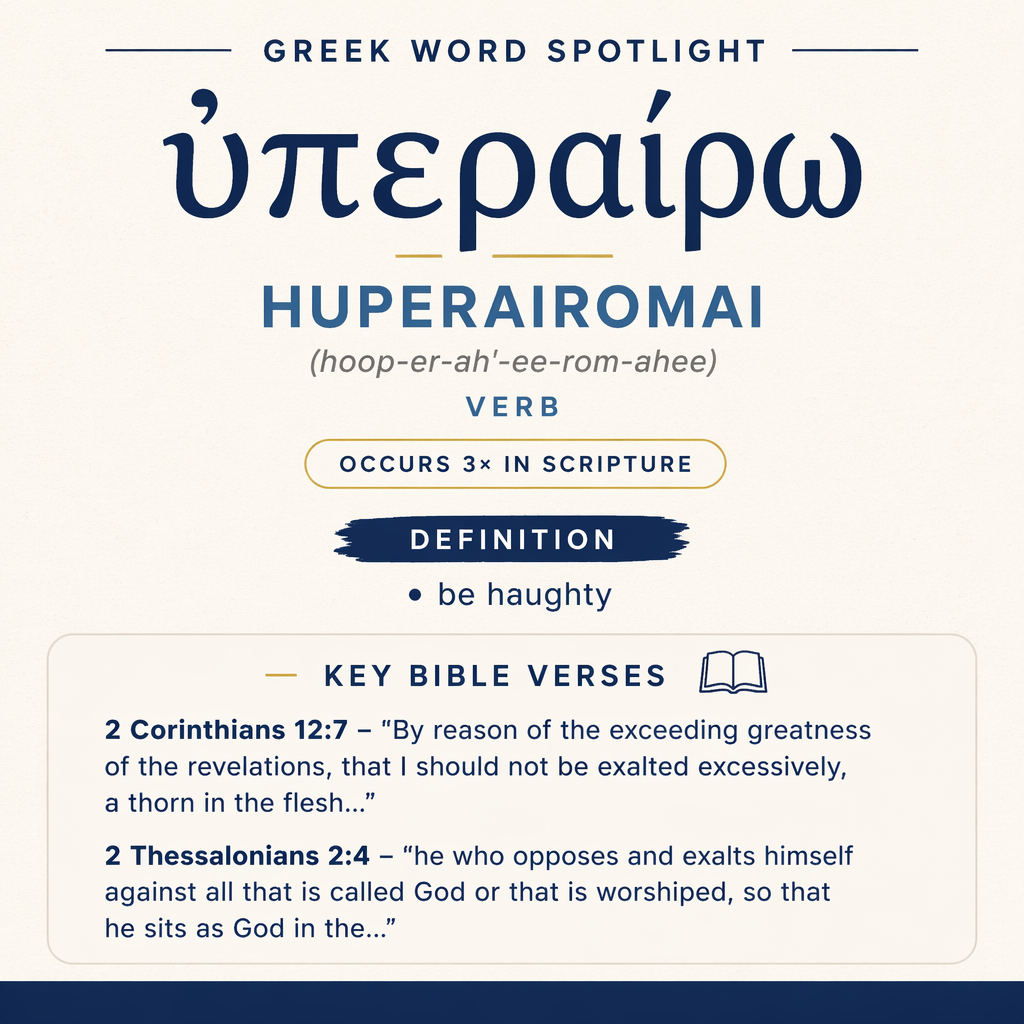
ὑπεραίρω means “be haughty” and occurs three times in Scripture, including 2 Corinthians 12:7 and 2 Thessalonians 2:4.
Scripture Occurrences
This verb occurs three times in Scripture. It appears in 2 Corinthians 12:7 and 2 Thessalonians 2:4.
Learn More →Verse Contexts
In 2 Corinthians 12:7 it is connected with not being “exalted excessively.” In 2 Thessalonians 2:4 it describes one who “exalts himself” against God.
Learn More →ὑπεραίρω means “be haughty,” and it appears in Paul’s discussion of overwhelming revelations and suffering, and in a description of a figure who sets himself against God. In both settings it marks an inner posture that pushes beyond proper limits and takes an inflated stance.
Root and Related Words
ὑπεραίρω (Huperairomai) is connected with αἴρω (airo), “to take up” (Strong’s G142), and with ὑπέρ (hyper), “above/for” (Strong’s G5228). Joined together, these elements supply the shape of the verb’s imagery: a movement “up” or “above,” expressed through the action of “taking up,” which suits a verb used for haughty self-elevation.

Occurrences
“By reason of the exceeding greatness of the revelations, that I should not be exalted excessively, a thorn in the flesh was given to me: a messenger of Satan to torment me, that I should not be exalted excessively.” (2 Corinthians 12:7)
Here the word sits inside a carefully balanced explanation: extraordinary spiritual privilege (“the exceeding greatness of the revelations”) is paired with a counterweight (“a thorn in the flesh”). The repeated clause “that I should not be exalted excessively” shows the haughty impulse as a real hazard connected to remarkable experiences. The verb’s force is not merely social pride; it is a self-inflation that could arise from legitimate gifts and experiences, as though revelations could become an occasion for a lifted self-regard. In the flow of the sentence, the “thorn” and the “messenger of Satan” function as restraints against that haughtiness: torment is framed not as meaningless pain but as something that checks an over-exaltation. The repetition of the purpose clause underscores the threat and the intended prevention: the haughty lift is something to be resisted, not indulged.
“he who opposes and exalts himself against all that is called God or that is worshiped, so that he sits as God in the temple of God, setting himself up as God.” (2 Thessalonians 2:4)
In this scene, the verb is overtly confrontational and public. The subject “opposes and exalts himself against all that is called God or that is worshiped,” and the rest of the verse spells out what such haughtiness looks like when it is acted out: “he sits as God in the temple of God, setting himself up as God.” The haughty posture is directed “against” every object of true reverence, and it moves beyond internal attitude into a claim of place and status. The clauses depict escalation: opposition, then self-exaltation, then enthronement “as God,” then the deliberate act of “setting himself up as God.” In this context, ὑπεραίρω marks not a passing arrogance but a driving self-assertion that tries to occupy the space reserved for God, making haughtiness an assault on worship itself.
Sense and Usage
Across these passages, “be haughty” is shown as an elevating of the self that seeks a higher stance than is fitting. In 2 Corinthians 12:7 the danger is inward and preventative: extraordinary revelations could become the soil in which a person’s self-estimation rises too high, so a painful restraint is described as given “that I should not be exalted excessively.” The verb therefore names a temptation that can accompany real spiritual privilege, and it frames humility not as a vague virtue but as a necessary guardrail when one’s experiences might invite self-inflation.
In 2 Thessalonians 2:4, by contrast, haughtiness becomes programmatic and antagonistic. The self-exalting is aimed “against all that is called God or that is worshiped,” and it culminates in seating oneself “as God” and “setting himself up as God.” The verb thus fits a portrait where the inner posture of haughtiness expresses itself in outward claims, location, and display—haughtiness that does not merely compare itself with others but challenges God’s place. Taken together, these uses show haughtiness as a rising self-stance: it can be a subtle inner lift nourished by privilege, or an aggressive public self-enthronement that contests worship.
Imagery
The word carries a consistent spatial feel in these verses: a self being “lifted” into an elevated position. In 2 Corinthians 12:7 that lift is checked by a “thorn in the flesh,” a bodily image that pulls a person back down into weakness and dependence. In 2 Thessalonians 2:4 the lift reaches its most vivid expression in the act of sitting “as God in the temple of God,” where the posture of elevation becomes a seat of usurped honor. In both, the imagery presses the same point: haughtiness is not only a thought, but a self-raising that seeks a higher place.
Sources: Lexical data from Strong’s Exhaustive Concordance and the Translators Brief Lexicon of Extended Strongs for Greek (STEPBible, CC BY). Occurrence data from the Translators Amalgamated Greek New Testament (STEPBible, CC BY). Scripture quotations from the World English Bible (public domain).