
Understanding the Meaning of Akmen in Greek
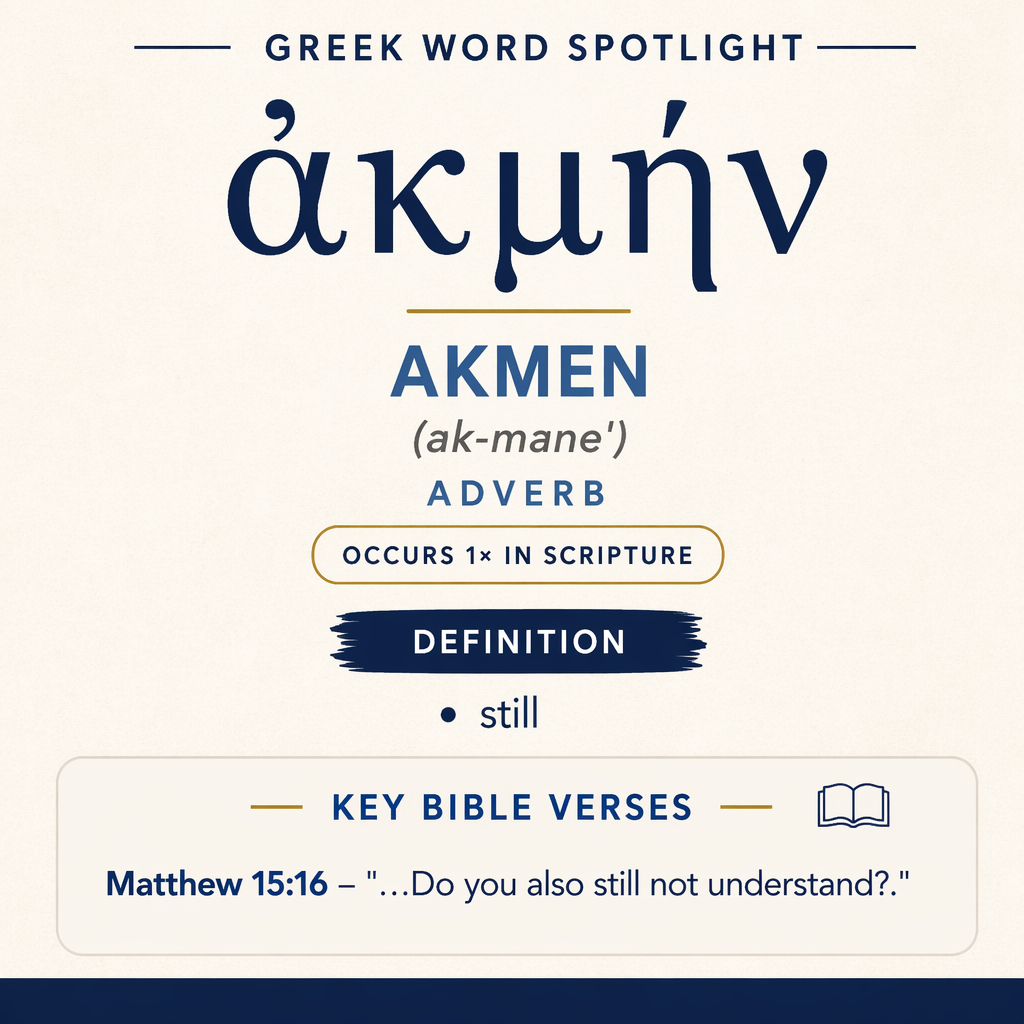
ἀκμήν means “still” and appears once in Scripture in Matthew 15:16.
ἀκμήν means “still” and appears in Jesus’ pointed question to His disciples in Matthew 15:16. In that single setting, it marks an ongoing condition that Jesus expects to have changed by now.
Occurrences
“So Jesus said, “Do you also still not understand?”” (Matthew 15:16)
In this exchange Jesus addresses His disciples directly: “Do you also still not understand?” The force of ἀκμήν lies in the temporal persistence it highlights. The disciples’ “not understand[ing]” is presented as continuing, not merely as a momentary lapse. By inserting “still,” the question becomes more than a check of comprehension; it becomes a rebuke framed around duration. The misunderstanding has endured across enough instruction and enough opportunity that Jesus can speak of it as an ongoing state.
The sentence also contains “also,” which places the disciples’ lack of understanding alongside someone else’s lack of understanding within the same moment of teaching. The “still” works with that comparison: it implies that the disciples, who have special proximity to Jesus’ teaching, ought not to remain in the same condition. The word therefore intensifies the contrast between what might be expected of them and what is actually true at the time Jesus speaks.
Because the verse is cast as a question, ἀκμήν does not merely label a static fact (“you do not understand”); it presses on the incongruity of that fact continuing. The tone is sharpened by the placement of “still” immediately before the negative clause “not understand,” so that persistence is foregrounded as the key issue. The disciples’ incomprehension is not treated as innocent ignorance but as a stubbornly lingering gap between teaching and grasping it.

Sense and Usage
As “still,” ἀκμήν functions here as a marker of continuity: something previously true remains true at the present moment of speech. In Matthew 15:16, it modifies a cognitive state (“not understand”) and frames that state as continuing when it ought to have been resolved. The word therefore carries a mild but real evaluative edge. It does not introduce a new problem; it points to an unresolved one.
The immediate effect is to locate the disciples’ misunderstanding on a timeline. Jesus’ words assume earlier instruction or experience sufficient to create the expectation of understanding by now. “Still” does not specify how long the condition has lasted, but it draws attention to the gap between expectation and reality. The disciples’ position is not described as “not yet” in the sense of a future hope; rather, “still” confronts the present persistence of what should have passed.
In discourse, “still” often serves to heighten accountability without changing the basic proposition. The proposition remains “you do not understand”; ἀκμήν adds the implication that this lack of understanding has been exposed before and is now being revisited. That revisiting is what gives the question its sting. Jesus is not merely informing the disciples of their condition but challenging them to reckon with the fact that it persists.
Within the verse, ἀκμήν also interacts with the interpersonal setting. Jesus is the speaker; the disciples are the addressees; the matter is comprehension of His teaching. By using “still,” Jesus treats understanding as a reasonable expectation for discipleship in that moment. The word underscores that being a disciple entails more than hearing: it entails arriving at understanding, and the continued absence of understanding becomes notable enough to be questioned.
Because the word’s contribution is temporal and aspectual rather than descriptive, it works economically: one short term reshapes the entire clause. It makes the question about persistence (“still not understand”) rather than mere absence (“not understand”). It also implies that the misunderstanding is not isolated, which makes the question carry implicit history. The verse itself supplies that history only in the form of Jesus’ assumption and the pointedness of His question, but that is enough for “still” to do its work.
The semantic weight of ἀκμήν in this occurrence is therefore tied to the tension between present reality and implied prior opportunity. It signals that the present moment is not the first moment in which understanding was needed; it is a moment in which a prior need remains unmet. In a single line, “still” turns misunderstanding into a persistent problem and makes the disciples’ failure to grasp the point an issue that has lasted long enough to be confronted directly.
Implied Picture
Matthew 15:16 presents “still” as a word of stalled progress. The implied picture is not of a new lesson meeting fresh confusion, but of instruction that has been given and yet has not produced the expected understanding. In Jesus’ question, ἀκμήν puts the disciples’ minds in a kind of arrested motion: they remain where they should no longer be.
Sources: Lexical data from Strong’s Exhaustive Concordance and the Translators Brief Lexicon of Extended Strongs for Greek (STEPBible, CC BY). Occurrence data from the Translators Amalgamated Greek New Testament (STEPBible, CC BY). Scripture quotations from the World English Bible (public domain).




