Exploring the Meaning of Hopou in Greek
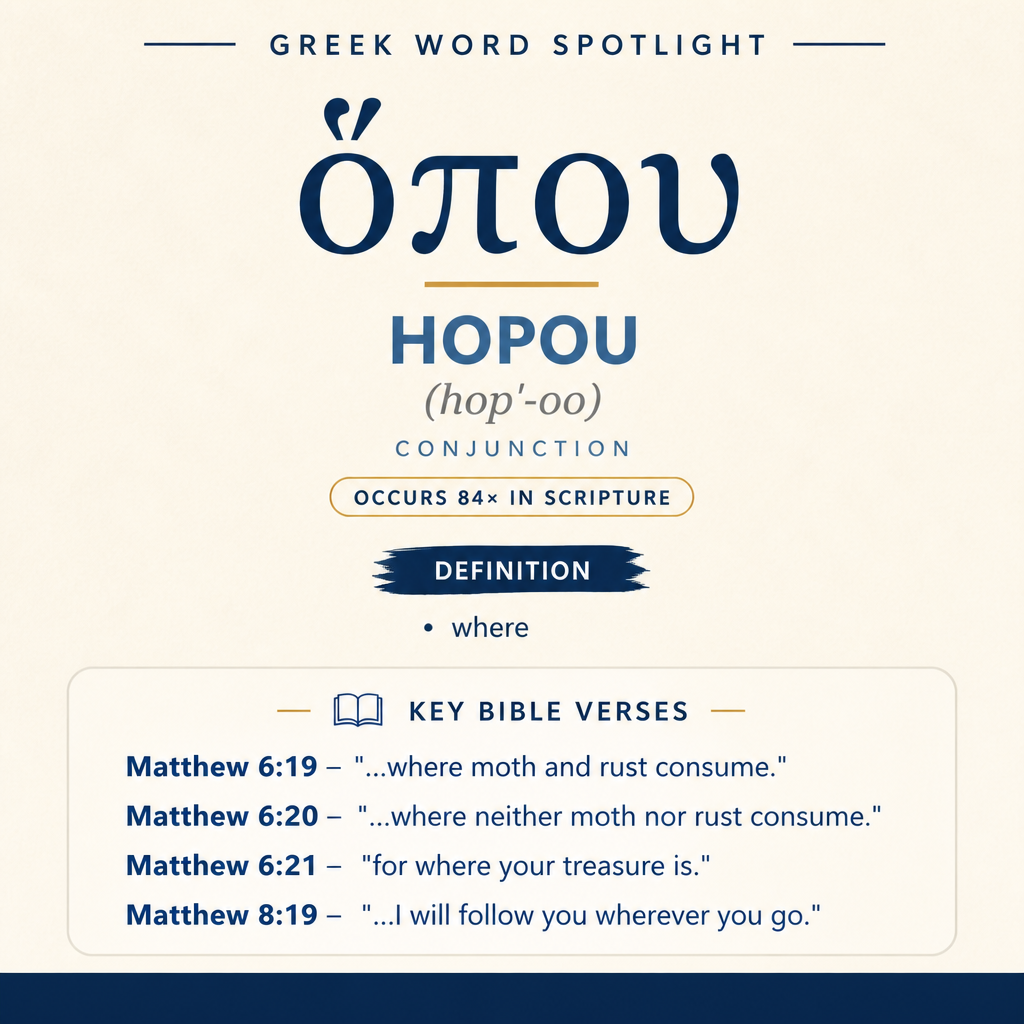
ὅπου means “where” and occurs 84 times in Scripture, including Matthew 6:19–21 and 8:19.
Core Meaning
ὅπου is defined as “where.” It marks location in statements such as “where your treasure is.”
Learn More →Matthew Examples
In Matthew 6:19–20 it appears in repeated clauses describing where moth and rust consume and where thieves break through. In Matthew 24:28 it marks the place where vultures gather.
Learn More →Usage Range
Matthew uses ὅπου in varied settings, including discipleship (“wherever you go,” Matthew 8:19) and parables (“reaping where you didn’t sow,” Matthew 25:24–26).
Learn More →ὅπου locates something by place, marking where an action happens or where a person or thing is found. In the passages below it connects teaching, parables, and narrative scenes by pointing the reader to the decisive “where” of each statement.
Occurrences
“Don’t lay up treasures for yourselves on the earth, where moth and rust consume, and where thieves break through and steal;” (Matthew 6:19)
Here ὅπου anchors the warning in a specific sphere: “on the earth” is defined as the place where damage and loss occur. The word links the location (“on the earth”) to its characteristic outcomes—consumption by “moth and rust” and vulnerability to “thieves”—so that the place itself is portrayed as insecure.
“but lay up for yourselves treasures in heaven, where neither moth nor rust consume, and where thieves don’t break through and steal;” (Matthew 6:20)
Again ὅπου marks location, but now the “where” is the contrastive setting “in heaven.” The clauses introduced by ὅπου describe what is true in that place: the usual agents of decay and theft do not operate there. The force is not merely to name a destination but to define it by its conditions.
“for where your treasure is, there your heart will be also.” (Matthew 6:21)
ὅπου ties an inner reality (“your heart”) to the place of a valued object (“your treasure”). The sentence uses location language to express alignment: the “where” of treasure becomes the “there” of the heart, making place a measure of attachment and direction.
A scribe came, and said to him, “Teacher, I will follow you wherever you go.” (Matthew 8:19)
In this pledge, ὅπου expands into an unrestricted commitment: “wherever you go.” The word conveys openness of destination; the scribe offers to let Jesus’ movements determine the places he himself will enter.
“Others fell on rocky ground, where they didn’t have much soil, and immediately they sprang up, because they had no depth of earth.” (Matthew 13:5)
ὅπου pinpoints the specific part of the field that explains the seed’s behavior. The growth is “immediate” precisely in the place characterized by thin soil; the “where” supplies the environmental reason for what follows.
“For wherever the carcass is, that is where the vultures gather together.” (Matthew 24:28)
Here ὅπου marks the location determined by a presence (“the carcass”). The proverb-like statement makes gathering predictable: the birds’ meeting point is defined by where the carcass lies, so “where” becomes a rule of association between object and response.
“He also who had received the one talent came and said, ‘Lord, I knew you that you are a hard man, reaping where you didn’t sow, and gathering where you didn’t scatter.” (Matthew 25:24)
ὅπου appears twice to specify the alleged spheres of the master’s profit: places “where you didn’t sow” and “where you didn’t scatter.” The servant’s accusation is framed in spatial terms—benefit taken from locations not prepared by the master’s own planting or dispersal.
“But his lord answered him, ‘You wicked and slothful servant. You knew that I reap where I didn’t sow, and gather where I didn’t scatter.” (Matthew 25:26)
The reply repeats the same two “where” clauses, keeping the focus on those locations as the servant has defined them. ὅπου maintains the spatial framing of the servant’s stated knowledge, turning it into the basis for the master’s rebuttal.
“Most certainly I tell you, wherever this Good News is preached in the whole world, what this woman has done will also be spoken of as a memorial of her.” (Matthew 26:13)
ὅπου here links proclamation to remembrance by means of place: “wherever this Good News is preached.” The “where” is worldwide in scope, and the word sets the condition for what will be said—where the message goes, the account of the woman’s deed accompanies it.
Those who had taken Jesus led him away to Caiaphas the high priest, where the scribes and the elders were gathered together. (Matthew 26:57)
ὅπου identifies the destination not only as a person (“Caiaphas the high priest”) but as a meeting site. The clause introduced by ὅπου supplies the situational detail: it is the place “where the scribes and the elders were gathered together,” showing that the transfer leads into an assembled council-like setting.
He is not here, for he has risen, just like he said. Come, see the place where the Lord was lying. (Matthew 28:6)
ὅπου points to a specific spot that can be examined: “the place where the Lord was lying.” The word connects the claim “He is not here” to concrete evidence, directing attention to an identifiable location whose emptiness confirms movement from that place.
When they could not come near to him for the crowd, they removed the roof where he was. When they had broken it up, they let down the mat that the paralytic was lying on. (Mark 2:4)
In this narrative, ὅπου identifies Jesus’ position inside the house: they open “the roof where he was.” The word guides the action with precision; the roof is not removed indiscriminately but at the point corresponding to Jesus’ location, so the later lowering of the mat can reach him.

Sense and Usage
Across these passages ὅπου consistently marks place, but it does more than answer a bare “where?” question. In the teaching about treasures (Matthew 6:19–21), the word helps define two contrasting realms by the conditions found in each: one “where” decay and theft operate, another “where” they do not. The result is a moral contrast expressed through spatial description, with location carrying the weight of security or vulnerability.
In commitments and general statements, ὅπου broadens into an open-ended range (“wherever you go,” Matthew 8:19; “wherever this Good News is preached,” Matthew 26:13). In such lines, the word establishes a scope without naming specific destinations; it signals that the statement holds for any place that fits the condition named in the clause (going with Jesus; preaching the Good News). This gives the sentence a kind of portability: it travels with the action, applying wherever the action occurs.
In parabolic and proverbial material (Matthew 13:5; 24:28; 25:24–26), ὅπου links outcomes to the locations that explain them. Rocky ground is the place that accounts for quick sprouting without depth. The carcass is the place that accounts for vultures gathering. In the talent exchange, the contested description of the master’s activity is framed as taking place in locations characterized by absence of prior sowing or scattering. In each case, ὅπου introduces a place-clause that functions like a premise: if the action is situated there, then the described effect or evaluation follows.
In narrative settings (Matthew 26:57; 28:6; Mark 2:4), ὅπου supplies concrete orientation. It identifies a destination as a gathering point, a spot as the former location of a body, and a point in a roof as corresponding to a person’s position below. These uses show ὅπου working almost like a narrative camera cue, fixing attention on the relevant place so the reader can track movement, assembly, and access.
Imagery and Texture
The repeated “where” language creates a map-like texture across these scenes: earth and heaven are contrasted as places of loss or safety; a field contains patches distinguished by soil depth; a carcass fixes a predictable gathering point; a household roof becomes an access point directly above Jesus; and an empty resting place becomes a visual marker of absence. In each case, ὅπου makes location meaningful—not as background, but as the setting that shapes what happens and how it is understood.
Sources: Lexical data from Strong’s Exhaustive Concordance and the Translators Brief Lexicon of Extended Strongs for Greek (STEPBible, CC BY). Occurrence data from the Translators Amalgamated Greek New Testament (STEPBible, CC BY). Scripture quotations from the World English Bible (public domain).