Exploring the Meaning of Pote in Greek
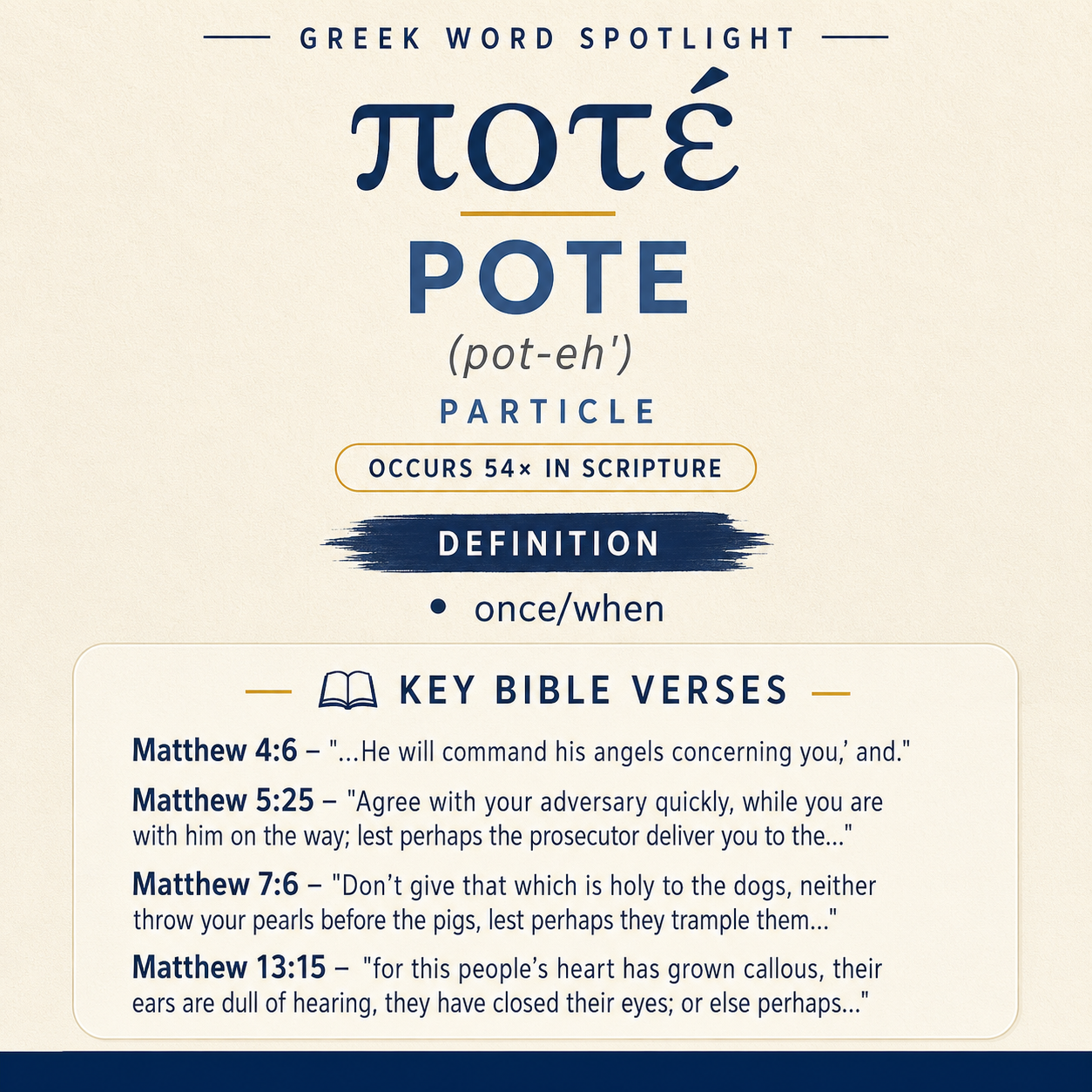
ποτέ means “once/when” and occurs 54 times in Scripture, including Matthew 4:6; 5:25; 7:6; 13:15; 13:29; 15:32; 25:9; 27:64.
Matthew Examples
Examples include Matthew 4:6; 5:25; 7:6; 13:15; 13:29; 15:32; 25:9; and 27:64.
Learn More →ποτέ expresses time with the sense “once/when,” and it regularly appears in warnings, quotations, and questions that turn on what could happen at a given moment. In the passages below, it helps speakers frame actions and consequences with an eye to timing and possibility.
Root and Related Words
ποτέ is related to pou (πού), “somewhere” (Strong’s G4225), and to te (τε), “and/both” (Strong’s G5037).

Occurrences
Matthew 4:6 — and said to him, “If you are the Son of God, throw yourself down, for it is written, ‘He will command his angels concerning you,’ and, ‘On their hands they will bear you up, so that you don’t dash your foot against a stone.’ ”
In this temptation scene, ποτέ belongs to the quoted assurance about protection at the critical moment of a fall: the concern is what happens “when” one’s foot might strike a stone. The particle situates the promise in a concrete, time-bound contingency rather than as a vague generality.
Matthew 5:25 — Agree with your adversary quickly, while you are with him on the way; lest perhaps the prosecutor deliver you to the judge, and the judge deliver you to the officer, and you be cast into prison.
Here ποτέ supports a practical warning tied to timing: reconciliation is urged “while you are with him on the way,” because a particular sequence may occur at the wrong time—handoff from prosecutor to judge to officer—ending in imprisonment. The particle presses the urgency by pointing to what could happen “when” events move forward.
Matthew 7:6 — “Don’t give that which is holy to the dogs, neither throw your pearls before the pigs, lest perhaps they trample them under their feet, and turn and tear you to pieces.
ποτέ frames a caution about the moment of reversal: giving what is holy or casting pearls could lead to a sudden change “when” the recipients trample and then attack. The instruction depends on anticipating a time when the action produces the opposite of what was intended.
Matthew 13:15 — for this people’s heart has grown callous, their ears are dull of hearing, they have closed their eyes; or else perhaps they might perceive with their eyes, hear with their ears, understand with their heart, and would turn again; and I would heal them.’
Within the quotation, ποτέ marks the turning point that would follow true perception: “when” they perceive, hear, and understand, they would turn and be healed. The particle presents that response as a potential outcome tied to a decisive moment of understanding.
Matthew 13:29 — “But he said, ‘No, lest perhaps while you gather up the darnel weeds, you root up the wheat with them.
In the parable’s agricultural setting, ποτέ attaches to the risk that accompanies premature action: “when” gathering weeds, one may uproot wheat at the same time. The particle highlights the danger that arises in the very act of sorting before the proper time.
Matthew 15:32 — Jesus summoned his disciples and said, “I have compassion on the multitude, because they continue with me now three days and have nothing to eat. I don’t want to send them away fasting, or they might faint on the way.”
ποτέ here underscores a pastoral concern about what could occur during the journey: sending the crowd away fasting could lead to fainting “when” they are on the way. The time element is integral—risk is located not merely in hunger, but in the moment of travel after dismissal.
Matthew 25:9 — But the wise answered, saying, ‘What if there isn’t enough for us and you? You go rather to those who sell, and, buy for yourselves.’
In the dialogue between wise and foolish, ποτέ introduces a practical scenario: “when” supply is limited, sharing may leave all unprepared. The particle gives shape to the imagined moment of shortage that governs the decision to send others to buy.
Matthew 27:64 — Command therefore that the tomb be made secure until the third day, lest perhaps his disciples come at night and steal him away, and tell the people, ‘He is risen from the dead;’ and the last deception will be worse than the first.”
ποτέ is tied to a feared window of time—“until the third day”—and to the possibility of an intrusion “when” night provides cover. The request is built on preventing a specific moment in which disciples could act and a public claim could follow, producing a compounded deception.
Mark 4:12 — that ‘seeing they may see, and not perceive; and hearing they may hear, and not understand; lest perhaps they should turn again, and their sins should be forgiven them.’ ”
In this quotation, ποτέ points to the moment that would change the hearers’ condition: “when” they turn again, forgiveness would follow. The particle is placed at the hinge between incomprehension and the transformative act of turning.
Mark 14:2 — For they said, “Not during the feast, because there might be a riot among the people.”
ποτέ here helps specify timing as the controlling issue: action is avoided “during the feast” because unrest could arise “when” the people are gathered. The particle supports the calculation that certain times are volatile, making consequences more likely.
Luke 3:15 — As the people were in expectation, and all men reasoned in their hearts concerning John, whether perhaps he was the Christ,
In this atmosphere of expectation, ποτέ introduces a reflective question about identity that forms “when” hearts are actively reasoning. The particle lends the inquiry an open-ended, time-sensitive character: speculation is occurring in the present moment of heightened anticipation.
Luke 4:11 — and, ‘On their hands they will bear you up, lest perhaps you dash your foot against a stone.’ ”
As in the earlier temptation quotation, ποτέ situates the protection in the critical instant of danger: the concern is the moment “when” the foot might strike a stone. The particle again connects the promise to a concrete point in time where harm could occur.
Sense and Usage
Across these scenes, ποτέ consistently organizes speech around time as a decisive factor: what happens at a particular moment, or what might occur when a situation reaches a certain point. In several passages it appears in cautions introduced by “lest perhaps,” where the speaker is not merely listing remote possibilities but directing attention to the moment consequences can unfold—handoff to authorities (Matthew 5:25), animals turning violent (Matthew 7:6), uprooting wheat while gathering weeds (Matthew 13:29), fainting on the way (Matthew 15:32), theft “at night” after a burial (Matthew 27:64), or unrest “during the feast” (Mark 14:2). In each, the particle keeps the warning tethered to timing: the wrong action taken at the wrong time brings an identifiable outcome.
The word also serves in quotations that hinge on a change of state occurring at a key time. In Matthew 13:15 and Mark 4:12, the quoted lines imagine a moment of perceiving and turning again, after which healing or forgiveness would follow. ποτέ thus stands near the pivot between present condition (calloused hearts; hearing without understanding) and the potential future turn. In the temptation quotations (Matthew 4:6; Luke 4:11), it likewise attaches to the critical instant of danger—dashing a foot against a stone—so that the promised bearing-up is framed as protection in the very moment harm would otherwise occur.
Finally, ποτέ can introduce a deliberative “what if” moment in practical decision-making. In Matthew 25:9 the wise envision the time of shortage and let that imagined moment govern their response. In Luke 3:15 it introduces the internal question prompted by public expectation, capturing speculation that arises when people are actively reasoning about John’s role.
Imagery
The passages attach ποτέ to vivid, time-bound scenes: a foot near a stone (Matthew 4:6; Luke 4:11), a pathway where legal transfer can occur (Matthew 5:25), pearls and animals that may suddenly turn (Matthew 7:6), a field where uprooting can happen in the act of gathering (Matthew 13:29), hunger turning to collapse on the road (Matthew 15:32), a guarded tomb threatened by night intrusion (Matthew 27:64), and festival crowds whose mood can shift (Mark 14:2). In each, the particle sharpens attention to the “when” that makes the difference between safety and harm, restraint and disaster, blindness and turning.
Sources: Lexical data from Strong’s Exhaustive Concordance and the Translators Brief Lexicon of Extended Strongs for Greek (STEPBible, CC BY). Occurrence data from the Translators Amalgamated Greek New Testament (STEPBible, CC BY). Scripture quotations from the World English Bible (public domain).